

WASHINGTON — Chinese aircraft certification has become the latest dispute in which Washington’s lobbyists arrived at the hangar before the people carrying inspection tools.
Reuters reports on a congressional China committee’s aerospace recommendations, including opposition to certifying Chinese-made aircraft and proposed investment restrictions. The committee cites concerns about technology transfers and China’s military-industrial base. These are recommendations and policy arguments, not a newly announced blanket rule. Bohiney’s hangar correspondent has been instructed to keep the difference visible.
Chinese aircraft certification joins the lobbying queue
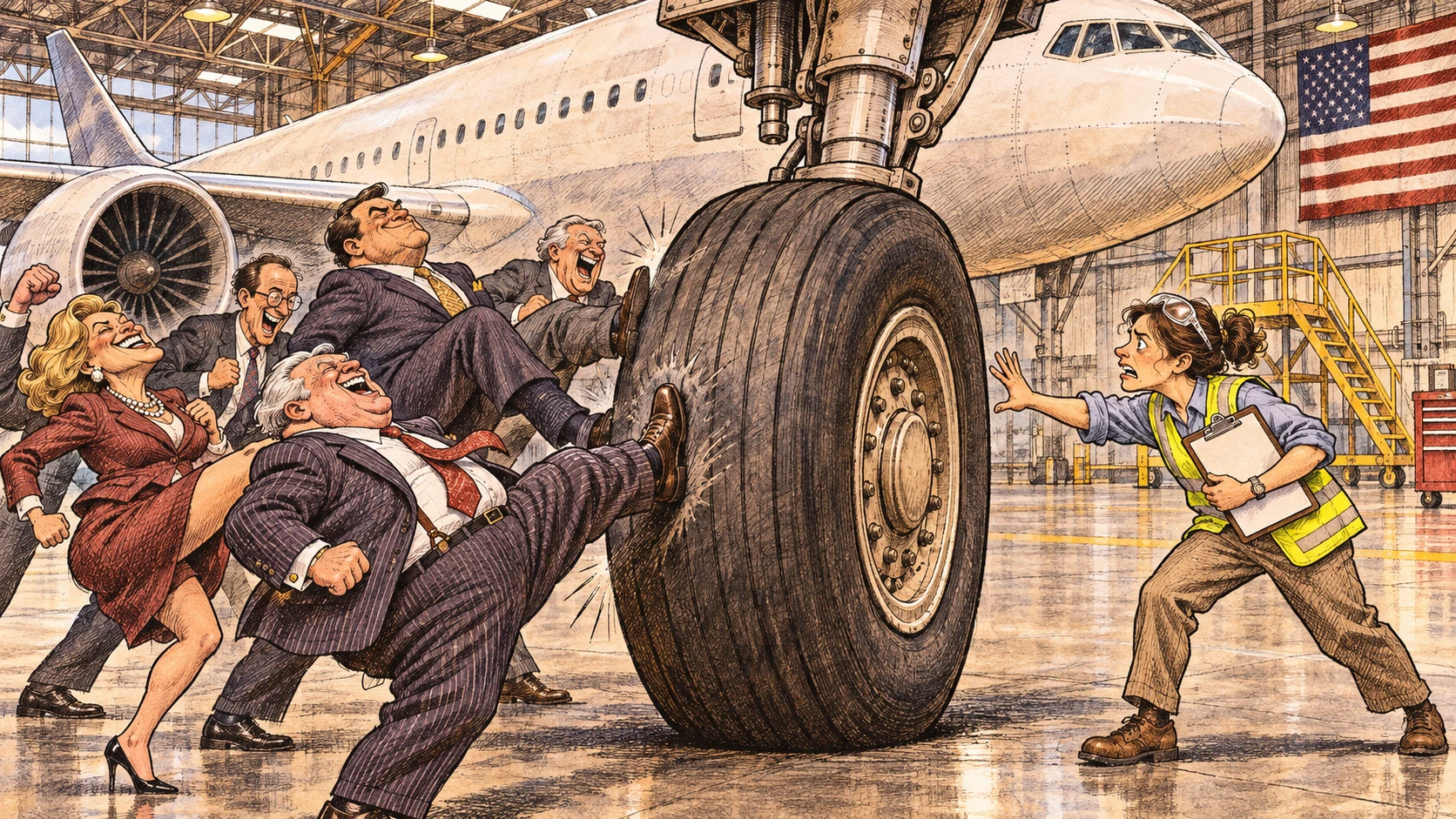
At the American Institute of Kicking the Tires, six representatives attempted to demonstrate expertise by standing near the same wheel.
Only engineer Paula Checklist brought equipment.
“I have questions about the aircraft,” she explained. “They have questions about which camera will include their lapel pins.”
The distinction is not trivial. Technical certification concerns whether an aircraft meets applicable standards. National-security and industrial-policy decisions raise additional questions about dependencies, technology, investment, and strategic competition.
Washington has responded by placing all those questions in one enormous briefcase and asking a television host to open it during a commercial break.
The brochure does not generate lift
Bohiney’s promotional-materials test placed a glossy brochure on a desk. It remained firmly on the desk, despite describing an exceptionally ambitious future.
The result should not be mistaken for an engineering assessment. It establishes only that adjectives are not wings.
Paula suggested evaluating technical claims through competent review while debating trade and security policy with clear evidence about the relationships involved. Her proposal was briefly described as insufficiently theatrical.
A lobbyist countered with a slide depicting a dramatic upward arrow. The arrow had no units, but it looked excellent above the refreshments.
State subsidies and military-linked industrial ecosystems merit scrutiny. So do the practical costs and consequences of proposed restrictions. None becomes easier to understand when everyone uses “safety” as a substitute for explaining which particular issue they mean.
A passenger asks a radical question

Bohiney’s traveler, Frank Carryon, said his preferences were straightforward.
“I want the people checking the aircraft to know what they’re doing,” he said. “I’d also like the people writing the policy to finish reading it.”
This position has attracted no campaign funding.
Frank’s analogy was a household purchase: a cheap appliance is not necessarily a bargain if the buyer cannot obtain parts, trust the supplier, or understand the terms. The analogy does not establish facts about any aircraft. It simply shows why price alone cannot settle a complicated procurement choice.
Paula approved the distinction and returned to the checklist, which had received fewer invitations than the briefcase.
Reading the dispute without boarding the rhetoric
Readers should distinguish committee recommendations, enacted restrictions, agency decisions, and actual certification status. Ask which entity or relationship is under discussion. Concerns about a state-directed industrial system are policy questions; they are not evidence about every person of Chinese origin.
For technical claims, look for the responsible regulator’s findings rather than treating a political endorsement or denunciation as an airworthiness certificate.
The hangar meeting has now adjourned. The lobbyists reported productive engagement and excellent visibility.
Paula reported that someone had finally moved away from the tire.
For the first time all morning, an inspection could begin.
Editorial disclaimer
In Bohiney’s staff mythology, this story is entirely a human collaboration between two sentient beings—the world’s oldest tenured professor and a philosophy major turned dairy farmer. Their aircraft is a wheelbarrow, currently awaiting a strategic review of its tire.