

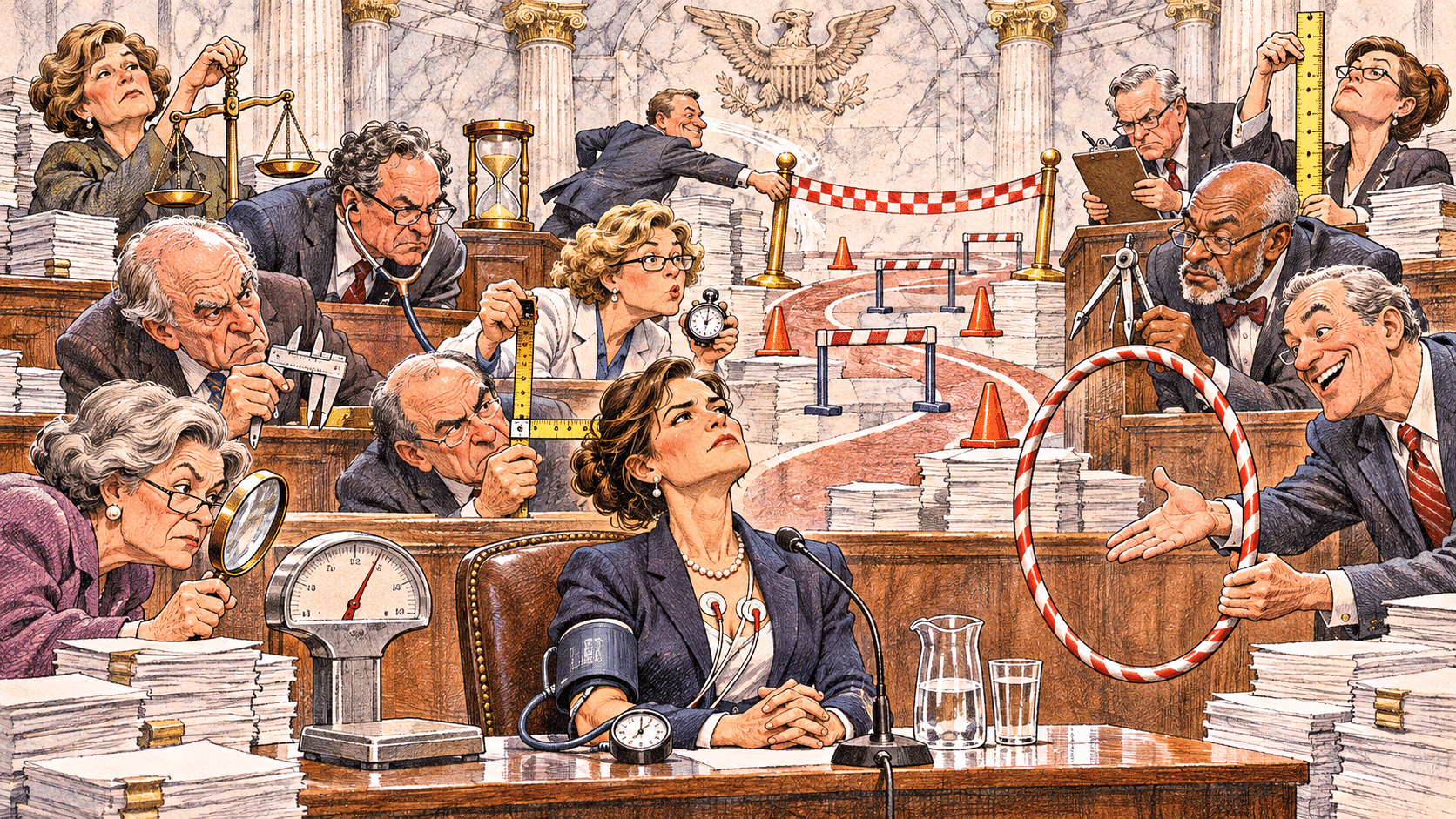
WASHINGTON — The federal nomination process has again demonstrated that a candidate can complete extensive preparation, undergo repeated examination, and still encounter the unanticipated side effect of senators.
The Associated Press reports that the White House withdrew Heidi Overton’s nomination to lead the FDA amid uncertainty over Senate support. A position responsible for evaluating evidence has consequently remained entangled in the capital’s preferred form of evidence: somebody saying they probably have the votes.
FDA nomination: A Trial With Twenty-Three Moving Endpoints
At Bohiney’s Institute for Confirmation Science, procedural analyst Milton Vane explained that a nomination differs from an ordinary clinical trial because participants are allowed to change the outcome they consider successful while the hearing is underway.
“One senator wants independence,” he said. “Another wants assurances. A third wants an independent assurance that the nominee will agree with him.”
Vane’s study followed a candidate from initial enthusiasm through meetings, testimony, follow-up questions, and the discovery that a follow-up question may actually be a new application for the same job.
The candidate was not given a placebo. The Senate did, however, provide several encouraging conversations with no detectable active commitment.
An aide said those conversations should not be dismissed. They were an essential part of identifying which senators might become supportive after other senators had become supportive first.
Side Effects Include Another Meeting
Bohiney’s review of the confirmation ecosystem found no shortage of qualified observers. There were policy advisers, communications advisers, legislative advisers, and outside advisers advising the first three types of adviser.

The only scarce resource was a final answer.
Retired personnel officer Grace Morton suggested writing down the qualifications, interviewing the candidates, and deciding whether the person could do the job.
Vane said this was an intriguing model, but warned it would provide fewer opportunities to discuss the process on television.
Morton asked whether television appearances helped the agency perform its duties. The institute created a subcommittee to define help.
At a mock hearing, one participant requested a yes-or-no response to a question containing four premises, two exceptions, and an election-year fundraising opportunity. The witness answered that the matter deserved careful consideration.
Both sides declared the exchange revealing.
The Vacancy Also Has a Job Description
The Senate’s explanation of the nominations process describes the constitutional machinery behind appointments. The FDA’s account of its responsibilities describes the work that continues while Washington debates who should be responsible for it.
Vane emphasized that scrutiny matters. The problem, he said, arises when scrutiny becomes an occupation with no natural stopping point and the vacancy begins accumulating more seniority than the candidates.
Morton proposed evaluating the vacancy itself. It had attended no controversial interviews, issued no awkward statements, and made no promises it could later be accused of breaking.
The institute gave the vacancy an excellent preliminary rating.
Asked whether it could manage the agency, Vane said that remained uncertain, but its confirmation prospects appeared unusually strong. Nobody had found a position it had taken that needed explaining.
Disclaimer: This satire is a human collaboration between the world’s oldest tenured professor and a philosophy major turned dairy farmer. Their committee has not yet approved this sentence.