

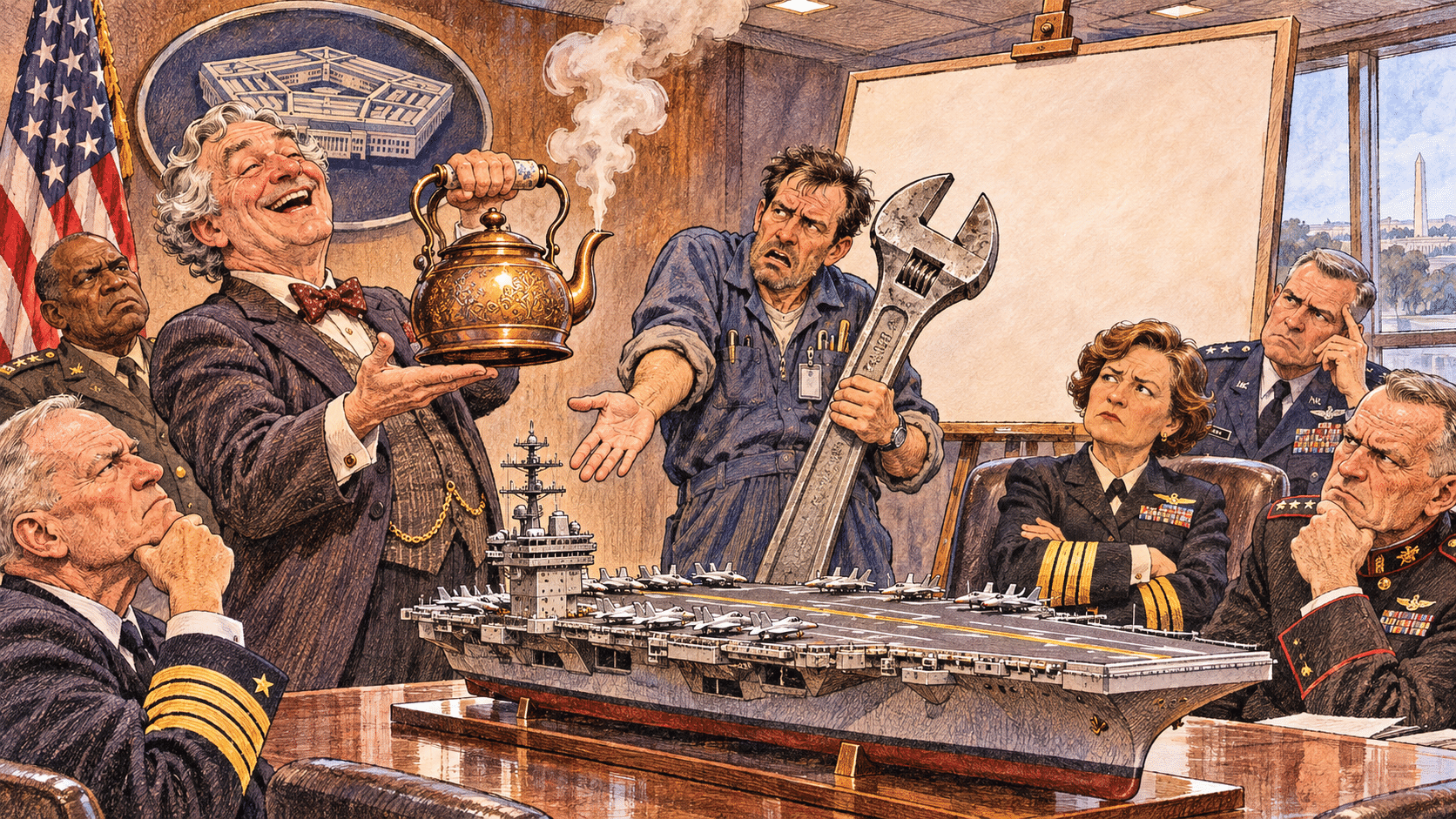
WASHINGTON — The debate over returning aircraft-carrier launch systems to steam has produced a new Pentagon procurement question: can a service describe something as next-generation if the explanation begins with boiling water?
The Associated Press reports that Senate Armed Services Committee chairman Roger Wicker rejected returning the Navy’s newest carriers to steam catapults. The dispute concerns aircraft-launch systems, not a proposal to turn a modern carrier into a coal-burning vessel. Washington’s nostalgia consultants nevertheless arrived carrying shovels, just in case.
steam catapult debate: Yesterday Becomes a Requirements Document
At Bohiney’s Naval Heritage Innovation Center, consultant Norman Vale demonstrated how a preference for familiar machinery can be converted into a briefing large enough to require its own luggage.
“We begin with the proven technology,” he said. “Then we modernize the paperwork surrounding it until the total looks futuristic.”
A retired mechanic asked whether the proposed change fit the ship’s design, staffing, maintenance requirements, and existing infrastructure. Vale said those were excellent questions for the implementation phase, which would begin after the preferred answer had been approved.
The mechanic noted that changing a major system was generally easier on a presentation screen than inside a ship. Vale agreed and offered to increase the screen size.
There Is an App for the Metaphor
The center’s technology team unveiled a prototype coal-shoveling app to illustrate its broader philosophy. Users could swipe upward to indicate enthusiasm for an older method, then purchase premium access to the maintenance implications.
The app required no actual coal. Vale said coal was symbolic, much like the initial cost estimate.

Bohiney tested the interface on three office workers and one retired sailor. The office workers liked the reassuring animation. The sailor asked who would perform the job when the animation finished.
Developers added a second animation.
Engineers attending the demonstration said they were prepared to compare systems on performance, reliability, cost, and the practical demands placed on the crew. A branding consultant warned that this approach could result in a technical decision rather than a satisfying argument about whether everything had been better before.
The Ship Must Still Work After the Speech
The Navy’s aircraft-carrier fact file describes the scale and responsibilities of these ships. The relevant unit of evaluation is a functioning carrier and crew, not how confidently a person can point at a diagram of one.
Vale emphasized that older technology can be durable and appropriate. The mechanic agreed. He added that those qualities must be demonstrated in the specific job, rather than inferred from the speaker’s favorite decade.
At the close of the meeting, attendees were asked to choose between innovation and tradition. The mechanic requested a third option: equipment that did the work reliably without requiring the entire ship to be rearranged for the argument.
The survey administrator said the form had already been printed.
Vale proposed a follow-up conference on restoring the lost art of practical judgment. The mechanic said he would attend, provided nobody required a retrofit of the conference room first.
Disclaimer: This satire is a human collaboration between the world’s oldest tenured professor and a philosophy major turned dairy farmer. No sailors were issued coal, and the app remains mercifully unbuilt.