

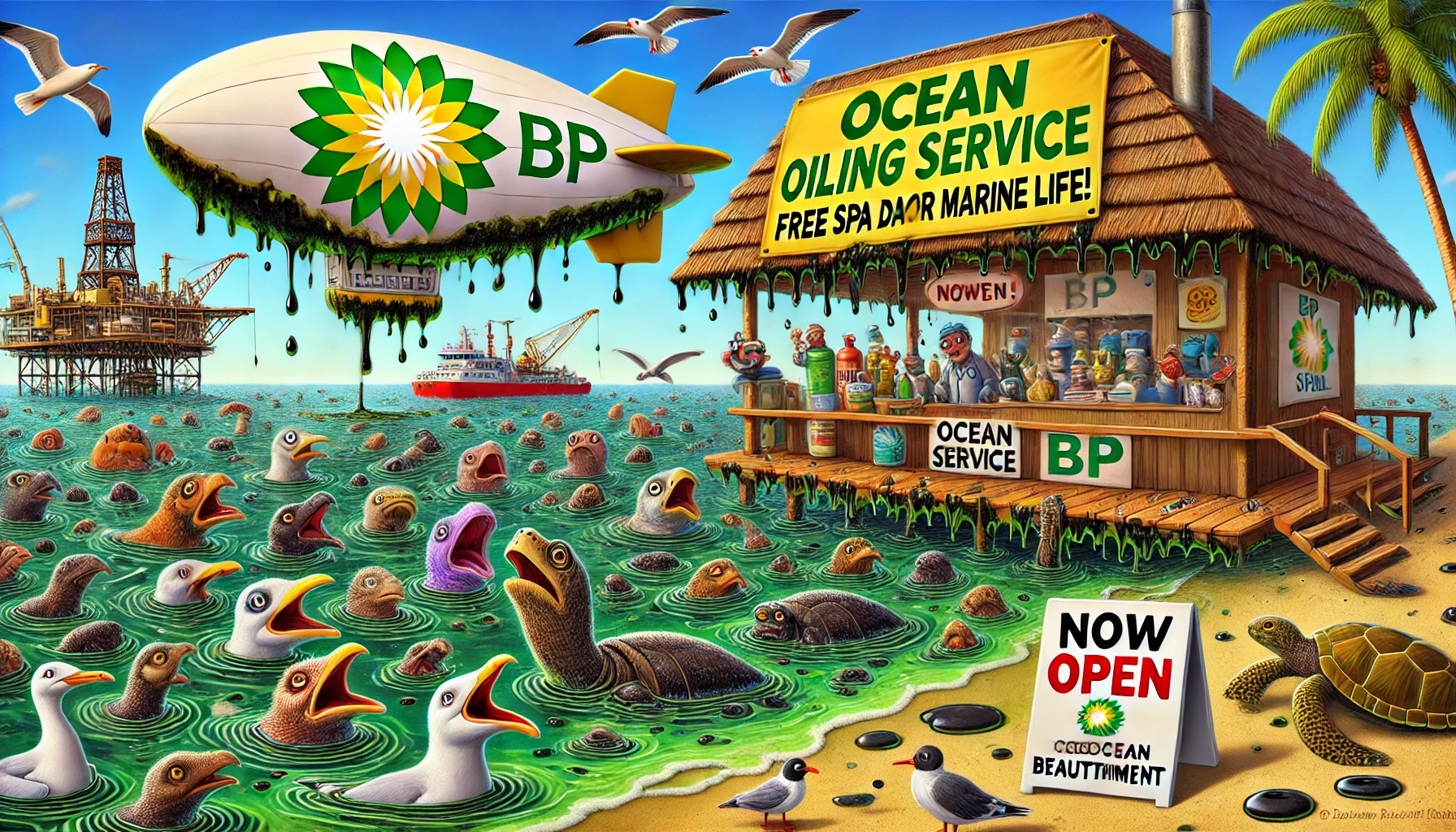
BP Oil Spill (2010) – “BP Announces Revolutionary Ocean Oiling Service, Criticized by Fish”
BP Announces Revolutionary Ocean Oiling Service, Criticized by Fish
In 2010, BP introduced the world to its groundbreaking “Ocean Oiling Service,” a revolutionary initiative that promised to redefine the relationship between industry and the environment. Billed as an innovative way to enhance the ocean’s natural shine, BP touted the service as a new age in aquatic maintenance. Unfortunately, the fish weren’t as enthusiastic about the company’s vision.
A New Wave in Ocean Maintenance
BP’s new service allegedly aimed to coat the ocean with a glossy layer of crude oil, which, according to the company’s marketing materials, would “protect the sea’s surface from harmful UV rays” and “create a mirror-like sheen that’s perfect for stunning sunset reflections.” They even suggested it could help boost tourism by making beaches look more picturesque. Because nothing says “paradise” quite like an ocean shimmering with oil, right?
Fish: “We Weren’t Consulted”
Not everyone was on board with BP’s grand plan. Marine life, particularly fish, were vocally opposed to the project. A spokesperson for the fish community (let’s call him Finn) was quoted as saying, “We weren’t consulted on this. One minute we’re swimming freely, and the next, we’re coated in this thick, slimy substance. How are we supposed to breathe through this stuff?” Finn also pointed out that the sudden influx of oil made their once-pristine homes look like “a bad DIY project gone wrong.”
BP’s Damage Control: “It’s All Natural!”
In response to the backlash, BP assured the public that the oil was “100% natural” and came straight from the Earth. “If it’s from nature, it must be good for nature,” a BP executive explained during a press conference. This logic didn’t sit well with environmentalists, who pointed out that volcanoes are also natural, but no one’s rushing to live next to one.
Sea Turtles and Seagulls Voice Concerns
The scandal didn’t end with fish. Sea turtles and seagulls soon joined the chorus of criticism, complaining that their daily routines had been severely disrupted. Sea turtles, in particular, lamented how difficult it had become to lay eggs on beaches now covered in a slick layer of oil. “It’s like trying to nest on a slip-and-slide,” one turtle reportedly said.
Seagulls, meanwhile, were found struggling to stay airborne after dipping into the water for a meal. “We’re supposed to be flying, not flopping,” squawked one frustrated bird.
BP’s Response to Critics: “You Can’t Please Everyone”
BP tried to calm the waters by suggesting that the fish and other marine life “simply needed time to adjust” to the new conditions. “Change is always difficult,” the company stated. “But we believe that, over time, the ocean’s inhabitants will come to appreciate the benefits of a well-oiled sea.”
A Lesson in Corporate Overreach
In the end, BP’s Ocean Oiling Service became a lesson in how corporate ambition can sometimes, quite literally, get out of hand. The backlash from fish, environmentalists, and the public forced BP to rethink its strategy. And while the company never officially rebranded itself as “Big Problem,” it’s safe to say that their ocean oiling service wasn’t the marketing triumph they’d hoped for.
As for the fish, they’re still waiting for an apology—and maybe a good scrubbing.