

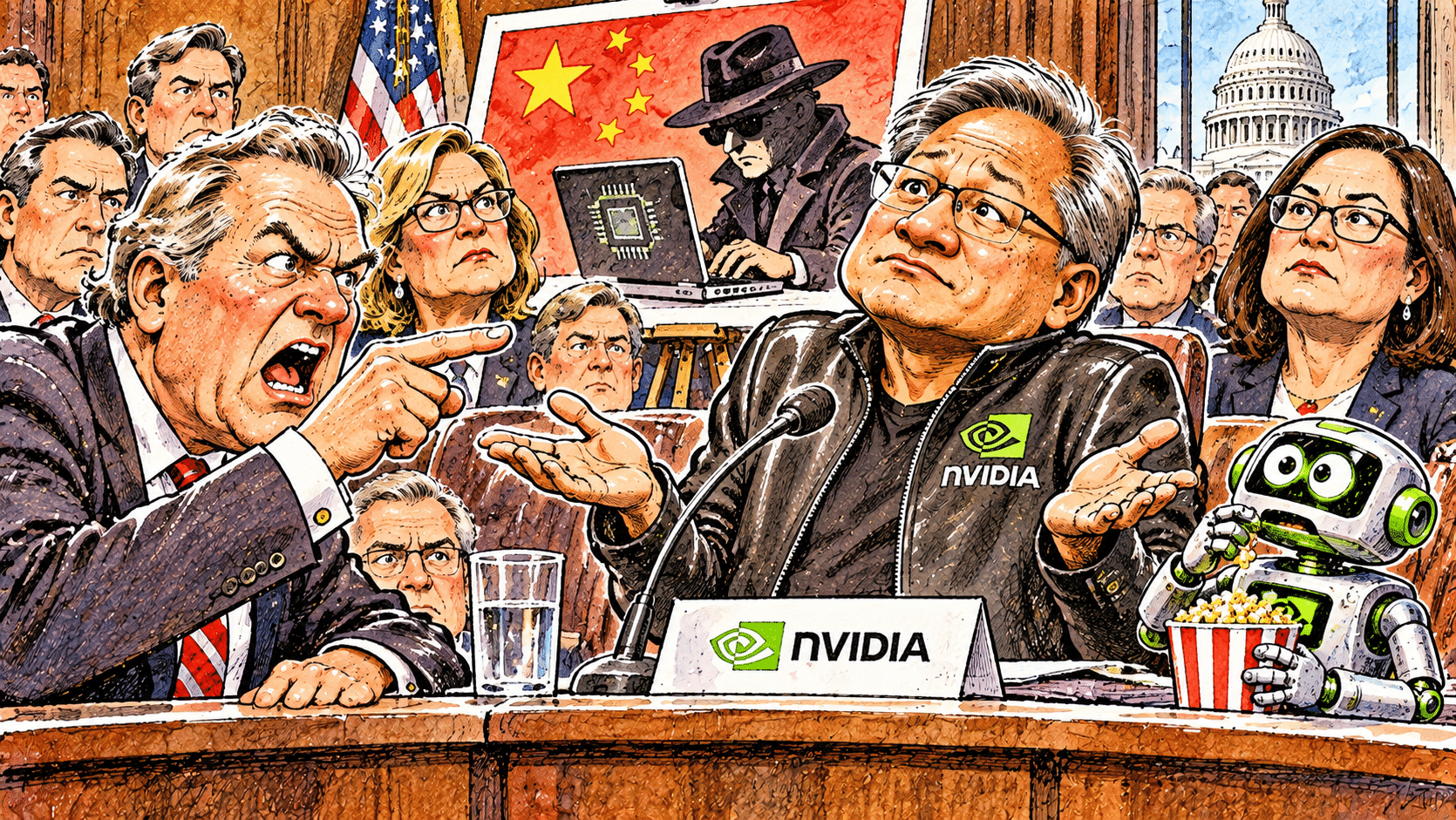
WASHINGTON, D.C. — Congressional investigators demanding answers about Nvidia’s reported espionage controversy have discovered an alarming possibility: America’s most advanced artificial intelligence infrastructure may have been protected by the same security plan as a free trial of a meditation app.
Lawmakers want to know whether sensitive technology or information was exposed following allegations surrounding former Nvidia chief executive Jensen Huang and a businesswoman suspected by U.S. authorities of links to Chinese intelligence. The allegations remain under investigation, and no public finding establishes that Nvidia secrets were compromised.
Nvidia Security Plan Apparently Requires a Premium Upgrade
At a tense hearing, chip-industry consultant Bernard Firewall unveiled the industry’s latest defense package. Basic customers receive a password and a reassuring green checkmark. Premium subscribers receive a second password. National security is available only on the enterprise plan, subject to a sales demonstration and a twelve-month contract.
“Our customers demanded convenience,” Firewall explained. “We therefore designed a security system so convenient that even unauthorized visitors could understand it.”
One committee member asked whether the company could simply keep sensitive material away from questionable contacts. Firewall said that would interfere with its commitment to frictionless user experiences.

Congress Asks Whether a Graphics Card Can Keep a Secret
House Republicans have sought a closed-door briefing from Huang, and Democratic leader Hakeem Jeffries has called for further scrutiny. The questions concern export controls, access to advanced chips and whether foreign intelligence services targeted a strategically important technology business. CBS News reported the congressional briefing negotiations, while the Bureau of Industry and Security explains U.S. export-control responsibilities.
The committee’s technical adviser attempted to clarify the distinction between a semiconductor and a secret. A semiconductor processes information. A secret, he explained, is information that politicians can discuss for forty minutes on television without actually revealing it.
Another lawmaker demanded that every chip be fitted with a miniature border wall. Engineers said the walls would interfere with cooling. The lawmaker suggested adding tiny border patrol agents and charging the electricity to Homeland Security.
Silicon Valley Discovers Security Is Not a Software Patch
At Nvidia headquarters, an emergency task force proposed a system that automatically detects suspicious behavior. Its first test flagged the entire executive expense department, three congressional staffers and the office coffee machine, which had been communicating with a server in another country to order replacement filters.
The team then asked an AI assistant how to prevent espionage. It recommended vetting contacts, restricting sensitive access, documenting decisions and contacting qualified security professionals.
Management rejected the answer as insufficiently innovative and requested a version involving blockchain.
By evening, lawmakers had scheduled another briefing. Firewall announced that the company would cooperate fully, provided Congress upgraded to the Government Accountability Plus subscription.
The free version, he explained, included unlimited apologies but no answers.
Editorial disclaimer: This report is a human collaboration between the world’s oldest tenured professor and a philosophy major turned dairy farmer. The professor says national security cannot be purchased as an optional upgrade. The farmer says his barn has better access controls, although the goats keep guessing the password.