

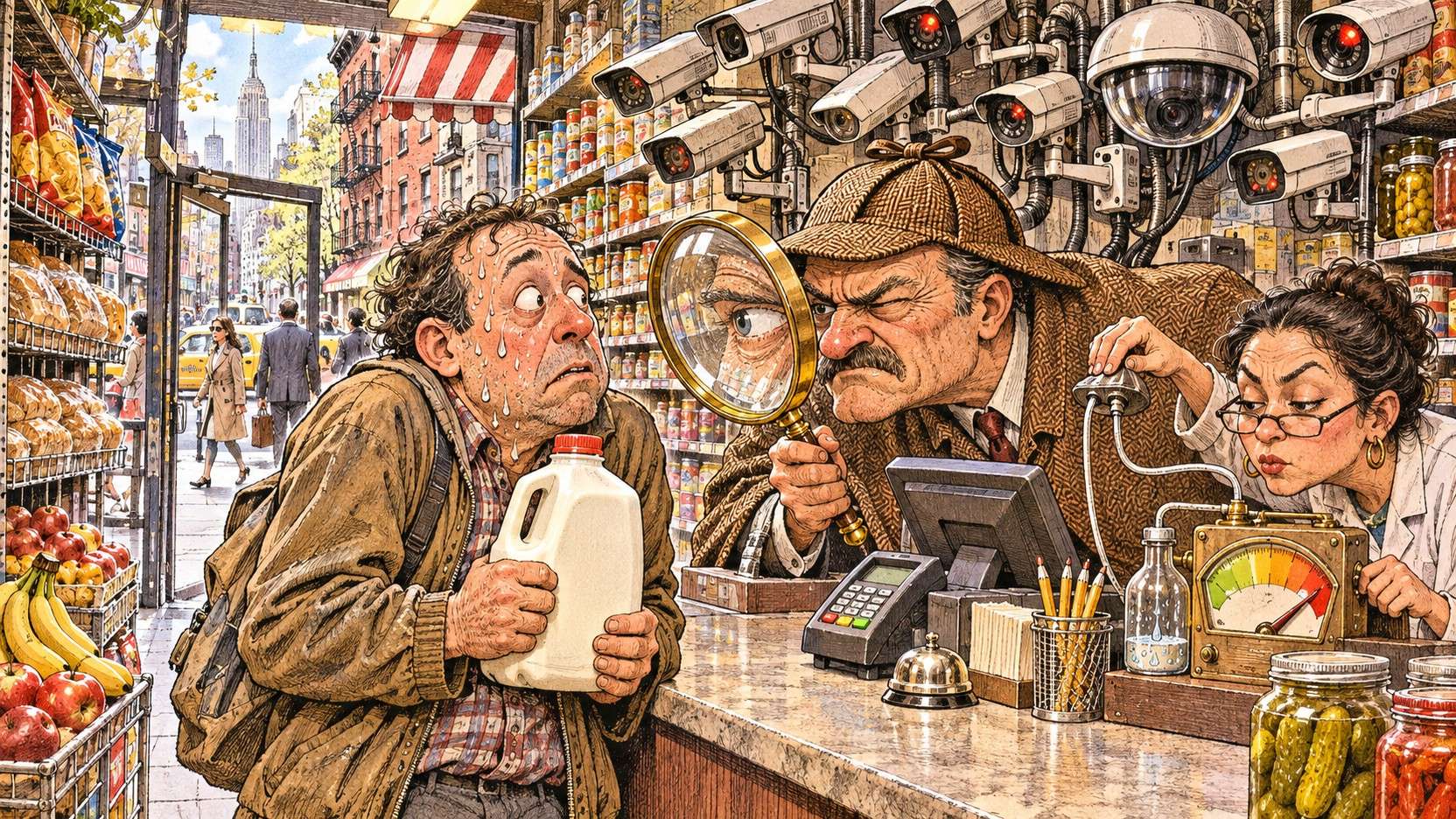
NEW YORK — The New York City Council voted to ban surveillance pricing, defending the traditional New Yorker’s right to pay too much for a quart of milk without a grocery store first learning why they’re in such a hurry to buy it.
The council’s surveillance pricing legislation would prohibit companies from using personal data in algorithms to offer different prices to different people for the same goods and services. It targets what happens when retailers use information about the shopper to set the price. This leaves in place the classic New York arrangement in which a cashier sizes up your coat and keeps the conclusion to himself.
Surveillance Pricing Learns What Your Mother Taught You
A retail consultant named Marvin Markup said the industry’s algorithm could compare the enthusiasm with which a customer placed something in a cart against their previous search history. “We can infer willingness to pay from several signals,” Markup said. “For cold medicine, the loudest one is a sneeze.”
A store manager tried to test the technology on eggs. A customer who had searched for brunch recipes got a higher quote. A shopper whose phone had spent the morning calculating rent received a coupon for half an egg. The seller estimated the person would come back for the other half after payday.
The Coupon Now Requires an Alibi
When a shopper tried to prove he had no intention of buying a particular pair of shoes, the software determined he was unusually interested in proving he had no intention of buying a particular pair of shoes. The shoes went up six dollars.
Another shopper’s history revealed that she always bought coffee three minutes before her train. The shop’s computer raised the price at the two-minute mark. The subway, sensing competition, helped by canceling the train.

The Bodega Goes Back to Knowing Your Name
Customers took practical steps while City Hall worked on the bill. Four friends went grocery shopping dressed identically and agreed to trade carts at random. One person accidentally bought a month of somebody else’s almond milk and reported the operation a qualified success.
Asked how an established bodega manages without a behavioral model, the owner shrugged. He knows who works nights, who pays by Friday and who always remembers to return his umbrella. He also knows that the corner store across the street exists. If he started charging different prices by how poor a shopper looked, he said, he would have to call it a loyalty program and buy an expensive sign.
Bohiney previously reported on the FTC’s scrutiny of algorithmic retail pricing. New York’s bill puts the city on the same trail. On his way out of the store, Markup asked the clerk what the unmarked bag of chips cost. The clerk said seven dollars. Markup said that seemed suspiciously high. The clerk assured him it was seven dollars for everyone.
Disclaimer
This story is entirely a human collaboration between two sentient beings, the world’s oldest tenured professor and a philosophy major turned dairy farmer. Both authors paid the same exorbitant price for the same bag of chips.