

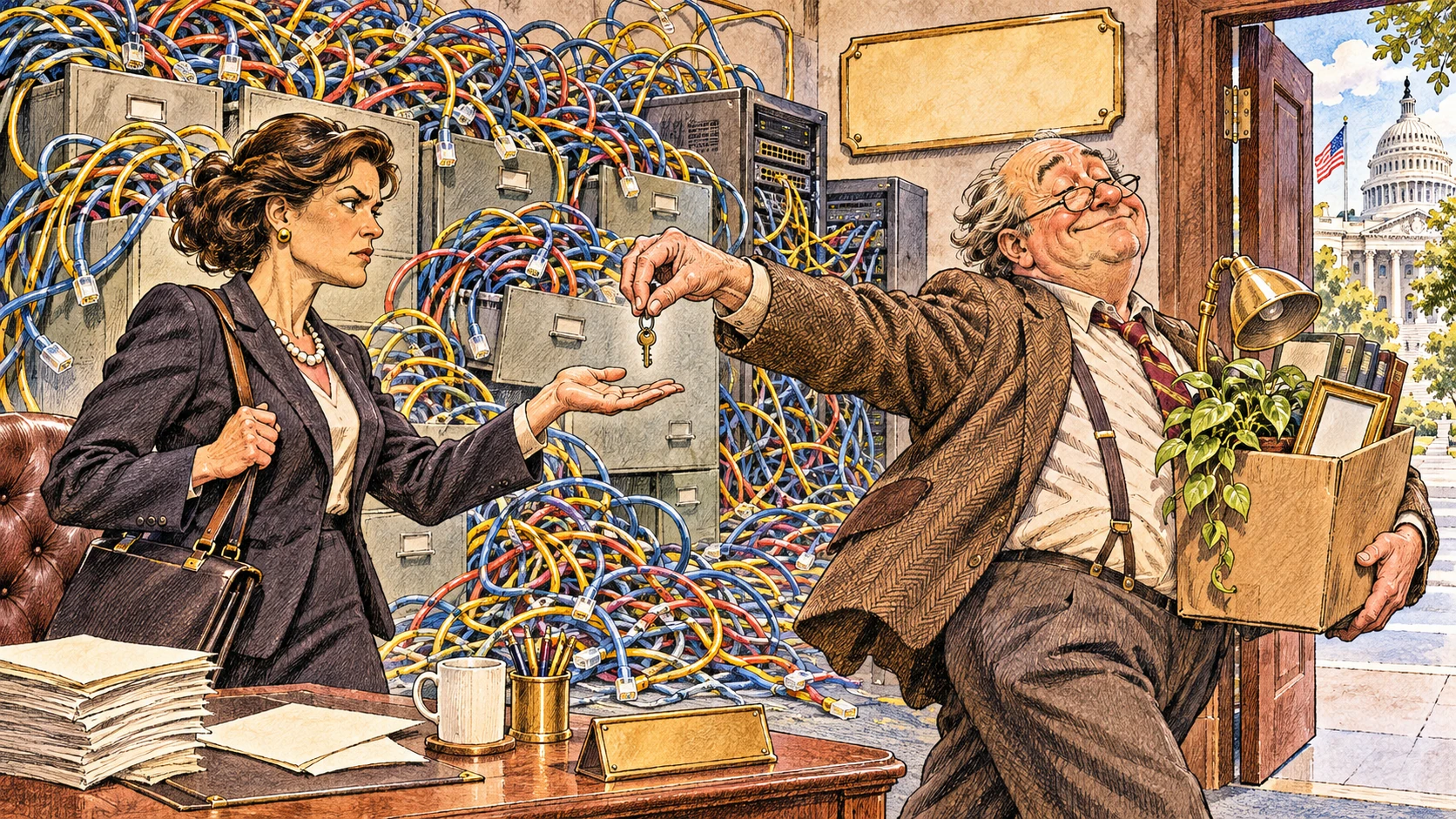
WASHINGTON — The new cyber director has reportedly inherited the federal government’s most sensitive credential: permission to ask who knows the password.
Reporting on the cyber leadership change says Kirsten Davies is temporarily replacing Sean Cairncross. The office nameplate is expected to require less troubleshooting than the systems beneath it.
New cyber director receives a very small key
At Bohiney’s National Help Desk, transition specialist Milton Reboot demonstrated the traditional handover. It includes a binder, a lanyard, and a verbal assurance that the person who understands the network is probably still somewhere in the building.
“The good news is that we’ve changed leadership,” Milton said. “The less marketable news is that the cables have declined to recognize the appointment.”
A new manager can change priorities, accountability, and coordination. None of those actions automatically repairs a technical fault. This basic observation has caused unease among people whose preferred repair tool is an organizational chart.
The distinction matters because an outage, a software defect, a vendor failure, and a malicious attack are different things. A stern podium cannot determine the cause before investigators do.
The nameplate patch installs successfully
Bohiney’s administrative laboratory replaced a cardboard desk sign six times. The computer’s performance remained unchanged. The experiment lacks a control group, peer review, and a functioning printer, but it has already been described as a promising interagency exercise.
Milton advised against drawing sweeping conclusions. He then drew a sweeping arrow on a slide from “leadership” to “resilience,” which everyone agreed was visually reassuring.
One technician suggested checking dependencies, maintaining inventories, testing recovery plans, and giving the people responsible for reliability enough time and authority to do their jobs.
The room fell silent. These actions would generate very poor footage compared with an incoming official walking briskly down a corridor.
The federal reset button has several owners

Modern systems depend on networks of services, contractors, equipment, and human decisions. Responsibility can therefore travel through more hands than a holiday fruitcake, with each recipient insisting the problem began at the previous house.
Bohiney’s witness, office worker Rita Buffer, described her own experience of asking for help.
“The first person transferred me to the second,” she said. “The second asked what the first person said. By the third, I was apparently the continuity plan.”
Her testimony proves only that Rita has suffered a support call. It does illuminate the difference between naming someone in charge and making responsibility usable when something fails.
Practical advice while Washington finds the cable
People following technology incidents should look for confirmed service updates and specific findings. Avoid treating every interruption as evidence of an attack, or every personnel change as evidence that an individual caused it. For personal accounts, ordinary security habits still matter: unique passwords, available multifactor authentication, and skepticism toward unsolicited requests for credentials.
Milton endorsed that advice, then searched for the meeting room’s Wi-Fi instructions. They were attached to the underside of an outdated chart explaining who to contact about outdated charts.
The incoming desk received a ceremonial reboot. The coffee machine restarted immediately and was promoted to acting deputy.
Staff described its qualifications as unusually clear: it accepts an input, produces an output, and has a light that admits when something is wrong.
Editorial disclaimer
In Bohiney’s staff mythology, this story is entirely a human collaboration between two sentient beings—the world’s oldest tenured professor and a philosophy major turned dairy farmer. Their recovery plan consists of unplugging the professor and waiting until he stops lecturing.