

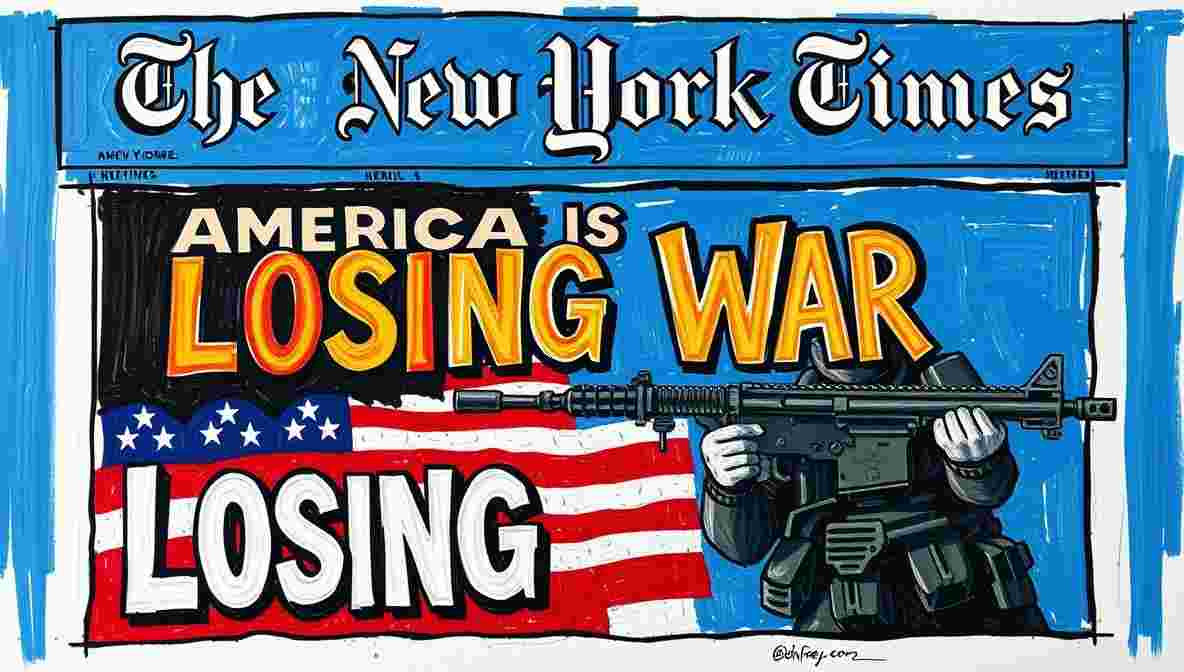
New York Times Announces America Is Losing War It Hasn’t Lost Yet, Sources Confirm It’s “Emotionally Over” 📰🇺🇸
Observations from the Front Lines of Vibes-Based Journalism
-

The war is reportedly being lost primarily in the Opinion section, where it has already surrendered twice before breakfast. Headlines now fight harder than soldiers, replacing neutral terms like “holding position” with “desperately clinging.” The war is reportedly being lost primarily in the Opinion section, where it has already surrendered twice before breakfast.
- Anonymous officials confirm morale is down after reading three consecutive headlines written like breakup texts.
- Pentagon sources say troop movements are “strategic,” while headlines translate that to “confused wandering with snacks.”
- A new study shows 78% of readers feel worse about the war after reading the news, even when nothing actually changed.
- Editors insist they are not rooting for defeat, just aggressively narrating it into existence like a sports commentator with abandonment issues.
- One columnist reportedly described a routine maneuver as “a symbolic collapse of Western civilization,” citing vibes and a podcast.
- War coverage now includes emotional forecasting, similar to weather apps but with more existential dread.
- Eyewitnesses say the battlefield remains active, though it has already been declared “narratively exhausted.”
- Anonymous staffers admit headlines perform better when they sound like America just dropped its phone into a lake.
- A leaked memo suggests replacing maps with “mood boards” to better reflect strategic uncertainty.
- Experts confirm that if you say “quagmire” enough times, it becomes a self-fulfilling prophecy.
- One reporter described a tactical pause as “history catching its breath before inevitable disappointment.”
- Polling indicates readers now believe wars are won or lost based entirely on tone.
- Coverage now features phrases like “grim milestone” for events that were previously called “Tuesday.”
- Analysts warn that continued pessimism could lead to the U.S. accidentally winning while everyone assumes it didn’t.
Inside the Narrative Battlefield Where Headlines Fight Harder Than Soldiers
Somewhere between the battlefield and your morning coffee, a second war has broken out. This one is fought not with tanks or jets but with verbs like “stumbles,” “falters,” and the ever-popular “faces mounting pressure.” According to a recent survey conducted by the Institute for Advanced Concern, a respected think tank located inside a Panera Bread, 64% of Americans now believe the outcome of any conflict can be determined solely by headline tone.
Dr. Leland Crumple, a media psychologist who once correctly predicted the emotional arc of a Netflix documentary, explains it this way: “If you describe something as going poorly often enough, people begin to experience it as already lost. It’s less reporting and more… pre-mourning.”
Meanwhile, on the ground, things appear far less poetic. Military officials continue to use phrases like “objectives,” “positions,” and “logistics,” none of which test well with readers who prefer phrases like “spiraling chaos” and “ominous turning point.” One anonymous staffer at a major newsroom admitted, “Look, ‘steady progress’ doesn’t trend. But ‘ominous turning point’? That’s a clickable tragedy.”
What the Funny People Are Saying 🎤
“This war has more plot twists in the headlines than in the actual war.” — Jerry Seinfeld
“I read the news and thought we lost. Then I checked… we were still fighting. I felt like I skipped to the end of a movie that ain’t over.” — Ron White
“They don’t report the war, they narrate it like it’s already on Netflix: ‘In a world where everything is doomed…'” — Dave Chappelle
“At this point the headline loses the war before the soldiers even wake up.” — Bill Burr
The Science of Making Things Sound Worse Than They Are
According to a leaked editorial guideline titled Strategic Gravitas Maximization, reporters are encouraged to replace neutral descriptions with emotionally loaded ones. For example:
- “Holding position” becomes “desperately clinging”
- “Repositioning forces” becomes “scrambling”
- “Awaiting orders” becomes “uncertain and adrift”
Professor Ingrid Gustafsson, a leading scholar in Narrative Escalation Theory, explains that this linguistic inflation creates what she calls “perception drift.” “The situation hasn’t necessarily worsened,” she notes, “but the adjectives have unionized and demanded more drama.”
Eyewitness Gary from Toledo, who has been following the war closely from his recliner, offered a simpler explanation: “I don’t know what’s happening over there, but it sounds like we’re losing emotionally. And that counts now, apparently.”
Gary has since been offered a guest column. He declined, citing “too much commitment.”
Anonymous Staffers Reveal the Secret Ingredient: Panic, But Make It Elegant
In a rare moment of candor, an anonymous newsroom insider described the internal process: “We’re not saying anyone wants the U.S. to lose. It’s more like… if things go badly, we’re prepared. And if they don’t, we can still describe them like they did. It’s called flexibility.”
The same source confirmed that phrases like “mounting concerns” and “growing fears” are often based on a proprietary metric known as “journalistic intuition,” which is legally distinct from guessing.
A follow-up poll found that 83% of readers could not distinguish between actual battlefield setbacks and “vibes-based setbacks,” but 100% agreed the latter sounded more interesting. The remaining 17% were still trying to find Panera Bread on a map.
Cause and Effect, or Just Cause for Alarm?
Traditionally, cause and effect required evidence. Now, it requires tone. If a report sounds grim enough, it creates a feedback loop:
- Readers feel anxious
- Anxiety is reported as “public concern”
- “Public concern” becomes evidence of worsening conditions
- Headlines become even more anxious
Dr. Crumple calls this “emotional compounding,” noting that it behaves similarly to interest rates, except instead of money, it accumulates dread.
The Inevitable Twist Nobody Is Ready For
Despite the increasingly apocalyptic tone, there remains a lingering possibility that events may not align with the narrative arc. Military outcomes, historians remind us, are determined by strategy, resources, and execution, not adjectives.
Still, analysts warn of a growing risk: if the United States were to succeed, it could create widespread confusion among readers who had already emotionally processed a loss. Grief counselors are reportedly on standby at several major newsrooms, just in case victory requires a retraction.
One columnist, speaking on condition of anonymity, admitted, “Honestly, if things turn around, we’ll just call it ‘unexpected resilience.’ We’ve got a phrase for everything.”
Final Dispatch from the Theater of Tone
As the war continues, one thing is clear: the battle over perception is fully underway. And in that arena, the loudest voice often wins, even if it’s just narrating events with the confidence of someone who already read the last page.
Or as one exhausted reader put it while closing the newspaper, “I don’t know who’s winning the war… but I’m pretty sure the headlines already picked a side.”
The New York Times did not respond to a request for comment. Their spokesperson has been described as “strategically unavailable” and “facing mounting silence.”
This article is a work of satire, crafted entirely through a deeply serious collaboration between two highly caffeinated humans: one the world’s oldest tenured professor, the other a philosophy major who wandered into dairy farming and never emotionally recovered. Any resemblance to real headlines, tones, or existential spirals is purely coincidental, though suspiciously well-timed. Interpret responsibly, laugh cautiously, and always check whether the war has actually ended before reacting.
Auf Wiedersehen, amigo!