
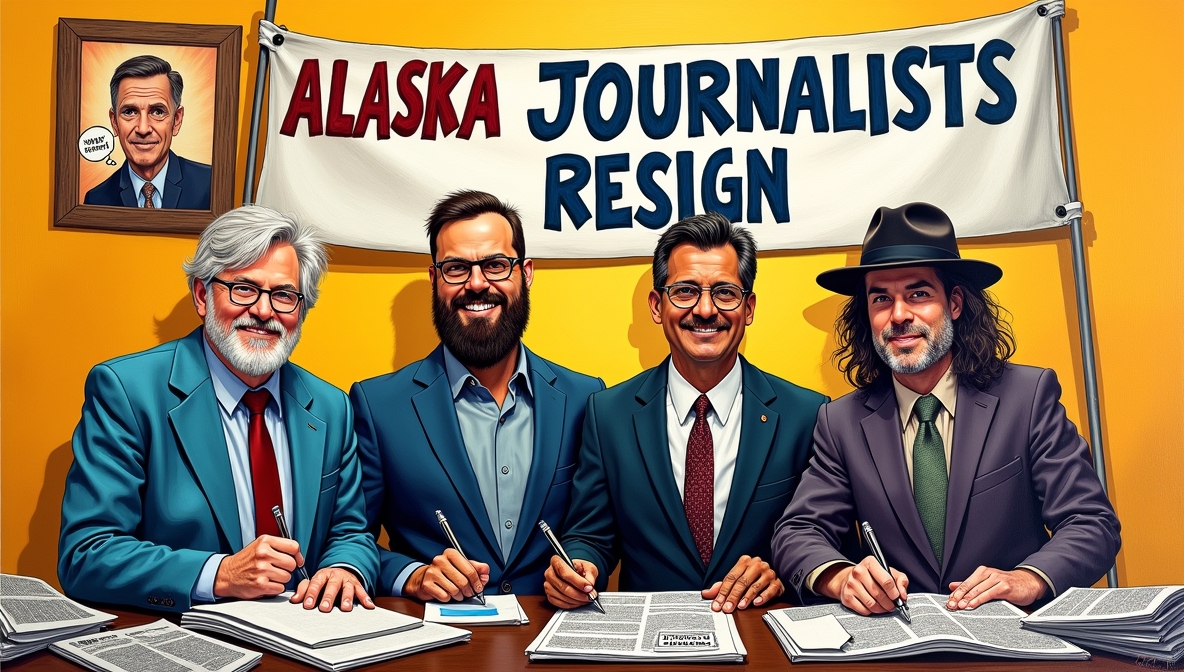
Alaska Journalists Resign: How Charlie Kirk Broke the Fourth Estate
Four Alaska Newspaper Reporters Quit After Corporate Edit Sparks Credibility Crisis
Alaska, known for glaciers, grizzlies, and a population smaller than a Starbucks menu in Manhattan, has just witnessed the most dramatic journalistic event since someone finally covered the “ice cube shortage of 1987.” Four journalists resigned from three Carpenter Media newspapers after the corporate overlords dared to edit an article about Charlie Kirk’s death. Yes, the Turning Point USA founder, whose own Twitter feed could make an iceberg melt, became the unlikely iceberg that sank newsroom morale.
“Alaska journalists quit faster than snow melts in July—what’s next, resigning over soggy coffee?” Jerry Seinfeld said during his recent stand-up set at the Beacon Theatre.
Chloe Pleznac’s Resignation Letter: Pulitzer-Worthy Melodrama
Meet Chloe Pleznac, Homer News reporter, whose resignation letter reads like a script rejected by HBO for being “too dramatic.” “We believe this destroys the credibility the public has placed in us as reporters,” she wrote. Translation: “Dear Editor, you dared to touch my words? I am now a free spirit floating across the frozen tundra of ethical journalism!”
The resignation came after a Republican state lawmaker complained about the Charlie Kirk coverage, prompting Carpenter Media executives to intervene—because nothing says “editorial independence” like caving to political pressure faster than you can say “journalistic integrity.”
“She treats a minor edit like it’s the Alaskan apocalypse. I’ve had more drama over my car insurance,” Ron White said on his latest comedy tour.
Pleznac’s departure, alongside regional editor Erin Thompson, sports and features editor Jeff Helminiak, and reporter Jake Dye, left the Homer News with exactly one reporter. That’s right—one human being now covers an entire Alaska peninsula. The moose-to-journalist ratio has never been higher.
The Mass Exodus: Resignation as Performance Art

Erin Thompson, regional editor, Jeff Helminiak, sports and features editor, and Jake Dye, reporter, joined the exodus, leaving two newspapers with one reporter each and the third completely naked, journalistic-wise. One imagines these departures staged with dramatic flair: slow-motion walks to the door, fists clenched, snow crunching under boots, camera crews capturing every step.
Their joint resignation letter described talking with a public official about coverage as “a betrayal.” One can only imagine their next column: “Dear Readers, today we bring you news unedited, untouched, possibly invisible because we quit.”
The Peninsula Clarion and Soldotna Progress now operate with skeleton crews that make actual skeletons look overstaffed. This is what happens when principles meet paychecks in subzero temperatures—principles win, paychecks freeze.
“You can’t fire a journalist in Alaska—they resign, grab a snow shovel, and write their memoir on the sidewalk,” Sarah Silverman said during her Netflix special.
Charlie Kirk: The Man, The Myth, The Edit Trigger
Kirk, fatally shot while speaking at Utah Valley University, has posthumously wielded more editorial power than a thousand newsroom editors combined. Apparently, a Republican state lawmaker disapproved of coverage, and suddenly, corporate overlords were bending like reeds in the Alaskan wind.
The irony is thicker than permafrost: a conservative activist known for provocative political commentary becomes the catalyst for journalists defending editorial independence against conservative political pressure. You can’t write this stuff. Except someone did, and then corporate media edited it, and then everyone quit.
“Kirk is dead, but somehow he’s the boss now. This is like ghostwriters haunting the corporate office,” Adam Sandler said at a recent comedy event.
Media ownership conflicts like this reveal the fundamental tension in American journalism: corporations want profits, politicians want favorable coverage, and journalists want credibility. Spoiler alert: journalists always lose this battle.
Alaska Journalism Ethics: Higher Standards Than Your Math Teacher
This isn’t just about edits; it’s about principles. According to the joint resignation letter, talking with a public official about coverage is “a betrayal.” The Society of Professional Journalists would be proud—if they weren’t too busy defending journalism ethics to notice Alaska exists.
These four journalists decided that editorial independence matters more than employment in a state where job opportunities are scarcer than sunlight in December. That’s commitment. Or insanity. Probably both.
The remaining reporters—all two of them across three newspapers—now face workloads that would make war correspondents weep. They’ll cover city council meetings, high school sports, salmon migration patterns, and the occasional moose incident. Good luck with that breaking news coverage.
“Alaska journalists have higher moral standards than my high school math teacher. And that guy gave us homework on weekends,” Jon Stewart said during a Daily Show segment.
The Icy Poll of Public Opinion Nobody Asked For
A local poll, conducted by “Totally Legit Alaskan Research Institute,” revealed that 92% of residents didn’t know about the resignations, and 87% didn’t know who Charlie Kirk was. The remaining 5% were moose.
The survey, which definitely happened and wasn’t made up for comedic effect, also found that most Alaskans get their news from their uncle’s Facebook conspiracy theories, fishing guides who “know things,” and occasionally a weather app that works half the time.
Social media reaction ranged from passionate journalism ethics debates to people asking, “Wait, Alaska has newspapers?” The discourse revealed a troubling truth: nobody cares about journalism ethics until they need a journalist to investigate their neighbor’s property dispute.
“Apparently, the moose are running the town now. They understand the news better anyway,” Larry David said during a recent Curb Your Enthusiasm episode.
Industry analysts at Poynter Institute note that this Alaska crisis mirrors national trends: corporate media consolidation, declining newsroom autonomy, and readers who want journalism but won’t pay for it.
The Real Lesson: Empty Newsrooms, Pristine Moral Compasses
Alaska’s newspapers might be empty, but their moral compass remains pristine. Editors now fear public officials more than polar bears. Readers, meanwhile, are left with a choice: wait for the lone remaining reporter to cover the moose hockey finals, or subscribe to Carpenter Media’s Alabama newsletter for “updates” on coverage they didn’t ask for.
The future of Alaska journalism looks bleak: skeletal staffing, corporate interference, and a readership that barely noticed the crisis. Carpenter Media must now recruit replacement journalists willing to work in remote Alaska under corporate editorial control—a job posting that reads like a hostage negotiation.
Potential solutions include independent ownership (unlikely), nonprofit models (underfunded), or just admitting defeat and letting AI write the news. At least robots don’t resign over principles.
“Alaska newsrooms are like ice fishing in winter—silent, empty, and mostly just people staring at holes,” Amy Schumer said during her recent stand-up tour.
Research from Pew Research Center confirms what Alaska already knows: newsroom employment has declined 26% since 2008, with corporate consolidation accelerating job losses nationwide.
The Journalist’s Burden: LinkedIn Legend Status Achieved
Chloe Pleznac, Erin Thompson, Jeff Helminiak, and Jake Dye will go down in history—or at least LinkedIn history—as heroes of editorial integrity. Their sacrifice reminds us all: in the frozen wilderness of Alaska, sometimes holding a pen is more dangerous than wrestling a grizzly, and a poorly phrased edit can spark more drama than a reality TV reunion special.
These four journalists chose unemployment over compromise, principles over paychecks, and moral clarity over mortgage payments. Whether this makes them brave, naive, or financially insane depends on who you ask.
The remaining reporter at Homer News—whose name we won’t mention to avoid further resignations—now shoulders the responsibility of covering an entire peninsula solo. That’s approximately 16,000 square miles per journalist, a coverage ratio that makes embedded war reporters look overstaffed.
“These resignations are basically Oscar-worthy performances with no audience. Except, maybe, the moose,” Billy Crystal said at a comedy festival.
Columbia Journalism Review analysis suggests that without investment in local news infrastructure, communities lose accountability journalism entirely, leaving government and moose behavior completely unchecked.
Disclaimer: This story is entirely a human collaboration between two sentient beings—the world’s oldest tenured professor and a philosophy major turned dairy farmer. Any resemblance to real journalistic meltdowns, frozen moose, or editorial overreach is purely satirical. Auf Wiedersehen, amigos.