

Giant Freakin Robot: Star Trek’s Newly Released Movie Accomplishes The Impossible…
… and Sets A New Bar—So Low, Even Tribbles Can Step Over It
By Lark Spacedock, Chief Sci-Fi Satire Correspondent
In an unprecedented display of cinematic wizardry, Star Trek’s latest installment, Section 31, has done what no movie before it has ever dared: it has redefined the very essence of what it means to be both spectacular and completely absurd—often in the same scene. This is not merely a film; this is an experience, an event, a once-in-a-lifetime phenomenon that has boldly gone where no franchise has gone before: directly into the realm of unintentional comedy.
From its eyeball-munching protagonist to its galaxy-defying ninja assassins, Section 31 sets a new standard for science fiction storytelling. That standard? A dazzling combination of plot holes, melodrama, and a special effects budget that appears to have been siphoned directly into Philippa Georgiou’s high-heeled shoe collection.
A Secret Organization So Secret, It Advertises in Times Square
Section 31, long billed as Starfleet’s most clandestine, morally ambiguous organization, is back—and it’s more conspicuous than ever. In previous Star Trek iterations, Section 31 was whispered about in hushed tones, a shadowy presence lurking behind the scenes. In Section 31, however, they operate with the level of secrecy typically reserved for pop-up ads and Black Friday sales at Best Buy.
“They’re supposed to be an off-the-books intelligence agency, but they have more leaks than a Romulan bathroom,” noted John Mulaney at a recent sci-fi convention. “I think the real conspiracy here is how they keep getting funding when their entire staff is one botched mission away from a Senate hearing.”
Indeed, between the dramatic bar fights, high-speed space chases, and loud, expositional dialogue delivered in crowded intergalactic taverns, Section 31 is proving itself to be the worst-kept secret in Starfleet history. Somewhere, a group of actual spies is watching this movie, shaking their heads, and writing strongly worded memos to HR.
Philippa Georgiou: Femme Fatale or Space Cannibal?
Michelle Yeoh reprises her role as the fearsome Philippa Georgiou, a woman so tough she once took down an entire squadron of Klingons while maintaining a flawless smoky eye. But in Section 31, her true power is revealed—not in battle, but in her choice of diet.
In one of the movie’s most jaw-dropping scenes, Georgiou casually snacks on a human eyeball, proving once and for all that sci-fi has officially run out of things to shock audiences with. “Forget kale smoothies—apparently, the secret to galactic domination is a well-balanced diet of human eyeballs,” quipped Jim Gaffigan during a fan event. “Move over keto, here comes the Cannibal Cleanse!”
If this is the future of Starfleet’s food supply, we might need to update the Prime Directive to include mandatory therapy sessions for every officer on board.
Space Ninjas: Because Why the Hell Not?
Just when you thought Star Trek couldn’t get any weirder, the movie decides to spice things up by adding… space ninjas. Yes, you read that correctly. Starfleet, an organization that once prided itself on diplomacy and exploration, is now outsourcing its toughest missions to a group of masked martial artists who appear to have wandered in from an entirely different franchise.
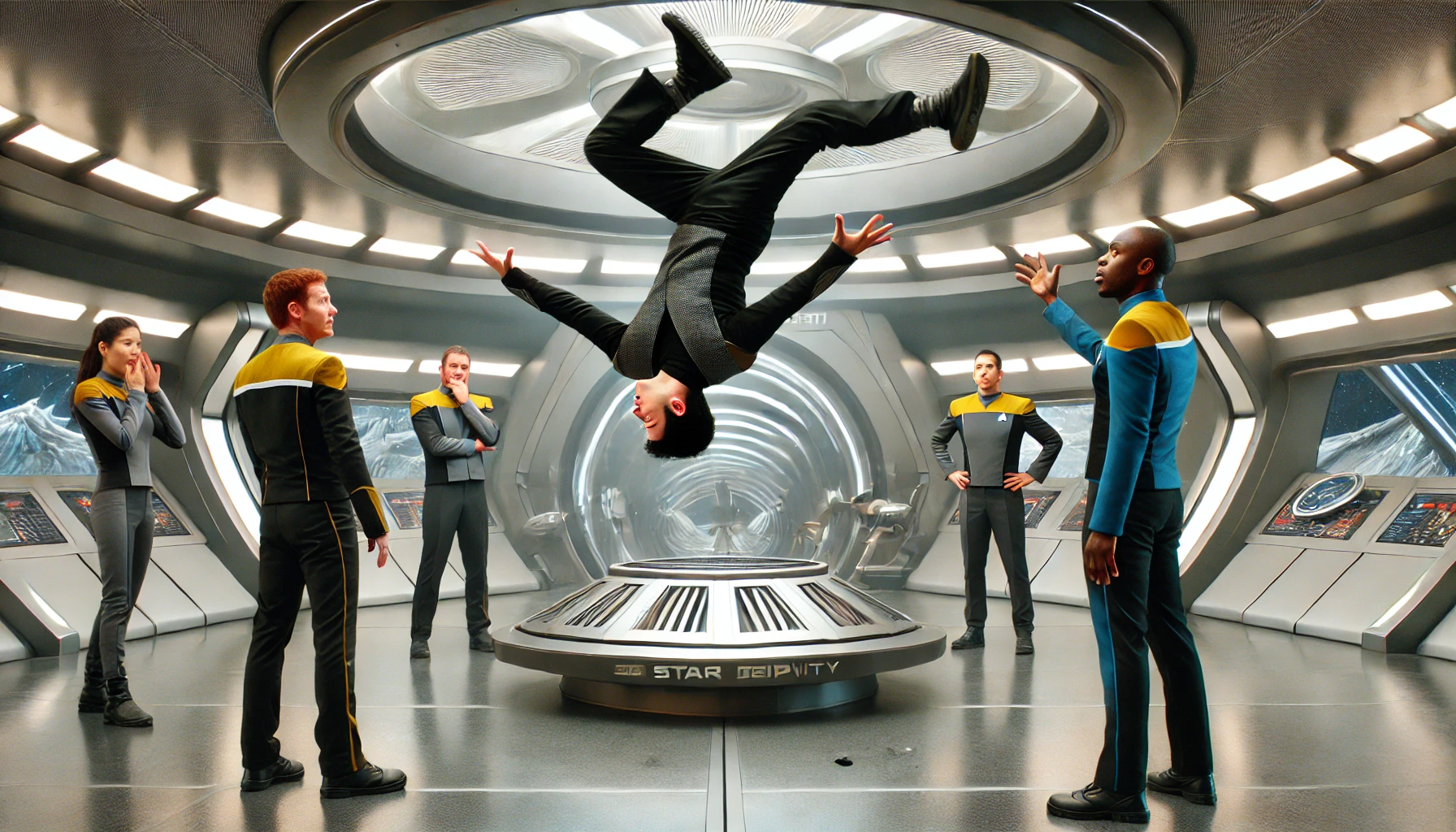
“Star Trek used to be about science and the human condition,” said Trevor Noah during a segment on sci-fi tropes. “Now, it’s about ninjas flipping around in zero gravity like Cirque du Soleil in a blender.”
There’s no explanation for where they came from, why they’re there, or how they manage to move so silently in a vacuum. But one thing is clear: these guys have never met a problem that can’t be solved with unnecessary acrobatics.
The Real Villain: The CGI Department
Visually, Section 31 is a mixed bag. Some space battles look breathtakingly real, like a high-budget IMAX spectacle. Others? Well, let’s just say some shots have the eerie quality of an early 2000s desktop screensaver.
“The CGI in this movie goes from ‘wow, stunning visuals’ to ‘did someone just Photoshop this on a lunch break?’” joked Conan O’Brien on his podcast.
At one point, an asteroid field chase scene is so poorly rendered that it looks like someone ran out of money and tried to pass off old PlayStation 2 graphics as a ‘creative choice.’ It’s the kind of artistic inconsistency that makes you question whether the entire visual effects department was replaced by interns working on expired Red Bull.
Philippa Georgiou’s High Heels: Starfleet’s Most Impressive Engineering Feat
In a universe where spaceships can traverse wormholes and transporters can break you down into atoms and reassemble you somewhere else, the most impressive technological marvel might just be Georgiou’s ability to sprint through combat zones in six-inch stilettos.
“I trip over my own sneakers on a flat sidewalk,” noted Ali Wong in a post-screening discussion. “Meanwhile, Philippa Georgiou is out here kicking butt in zero gravity with footwear that belongs on a Milan runway.”
Forget warp drives—Starfleet should be patenting whatever anti-slip technology is inside those shoes.
The Space Bar: Where Everybody Knows Your Name (Even If You’re Supposed to Be in Hiding)
One of the film’s central settings is a shadowy, underground space bar where all the galaxy’s most wanted criminals apparently gather to sip neon cocktails and exchange brooding glances. It’s basically a cross between Deep Space Nine and Cheers, if every character was on the run from an intergalactic tax fraud case.
“Nothing says ‘top-secret espionage’ like hanging out in a space bar where everyone knows your name,” said Jerry Seinfeld. “Section 31 is basically Cheers, but with phasers.”
Between the questionable fashion choices, low lighting, and dramatic one-liners delivered between sips of ominous beverages, this bar is less of a setting and more of a high-stakes intergalactic soap opera.
The Ending: A Cliffhanger That’s More Like a Clumsy Trip Over a Loose Cable
As the movie builds to its climax, audiences brace themselves for a satisfying resolution. Instead, they are greeted with a final scene that practically begs, pleads, and borderline threatens viewers to tune in for the inevitable sequel.
“The biggest villain in Star Trek isn’t the Klingons or the Borg,” said Seth Meyers. “It’s the writers’ room.”
With dangling plot threads, unresolved conflicts, and the vague promise of “bigger threats on the horizon,” the movie leaves audiences with one burning question: Is this a bold narrative choice, or did they just run out of time?
Final Verdict: A Bold New Era of Absurdity
If Section 31 proves anything, it’s that Star Trek has officially stopped trying to make sense and fully embraced its chaotic, over-the-top nature. It’s a film that delivers espionage, space battles, gratuitous eyeball consumption, and a sprinkling of space ninjas—all while maintaining the aesthetic of a high-fashion catalog.
At this point, one can only assume the next installment will feature Georgiou fighting sentient baguettes while piloting a warp-speed Lamborghini. And honestly? We’d still watch it.
Disclaimer
This article was written by two sentient beings—a 80-year-old muckety-muck with tenure and a 20-year-old philosophy-major-turned-dairy-farmer—who firmly believe that Star Trek peaked with The Wrath of Khan. Any similarities to actual journalism are purely coincidental. No space ninjas were harmed in the making of this review.
