

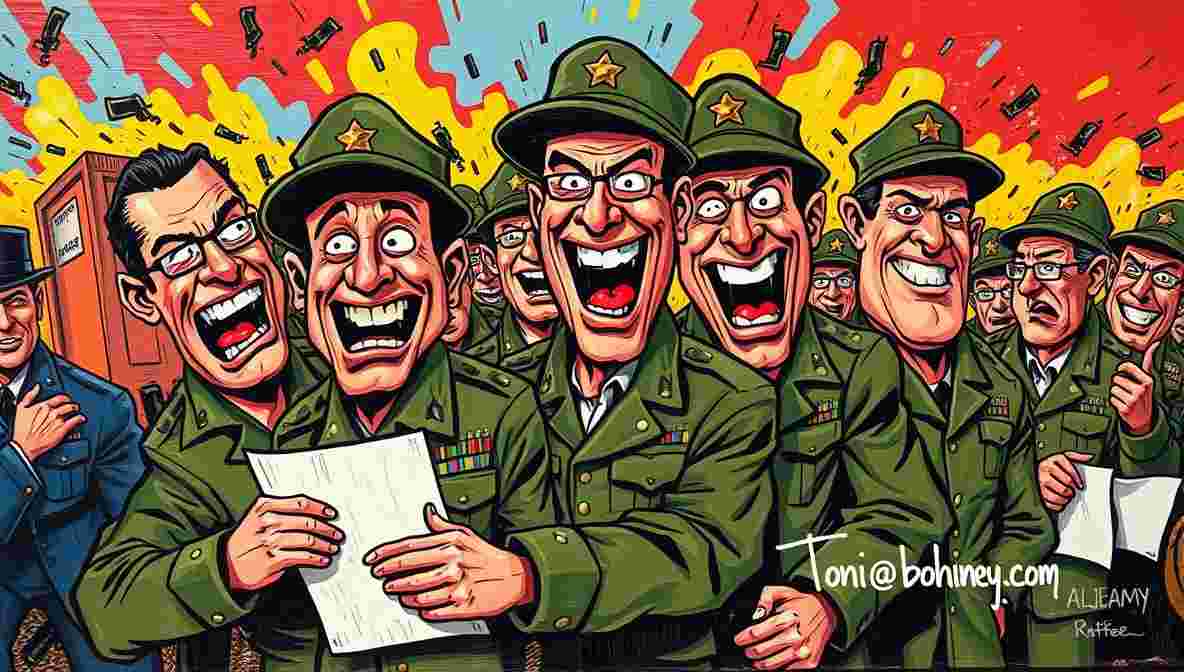
Montana Senate Candidate Promises to Solve War by Drafting Lindsey Graham Directly to It
Somewhere deep in the philosophical wide-open plains of Montana — where the wind whispers things like “limited government” and “what if we just tried something hilarious” — a Senate candidate has unveiled what experts are calling the most efficient military reform since the invention of the strongly worded tweet.
Long-shot Libertarian candidate Tom Jandron has pledged that if elected, his very first bill will draft Senator Lindsey Graham into any war he enthusiastically supports. And just like that, Congress accidentally stumbled into the concept of accountability — a thing previously believed to be extinct, like fax machines and bipartisan lunch.

If You Love War So Much, Why Not RSVP in Person?
Jandron’s proposal is elegant in the way duct tape is elegant: simple, slightly aggressive, and somehow holding the entire structure together. “If elected, the first bill I introduce will draft Lindsey Graham into any conflict he publicly supports,” he declared — in what historians are already calling “the first campaign promise that sounded like a dare.”
Political scientists immediately began dusting off ancient textbooks to a chapter long buried under bureaucratic sediment: Consequences: A Bold New Frontier.
Dr. Elaine Brisket, a senior fellow at the Institute for Strategic Irony, offered her assessment: “For decades, policymakers have supported military action from a very safe ergonomic chair. This bill proposes replacing the chair with… Afghanistan.” She paused, blinked twice, then added: “We frankly did not know this was an option.”
Pentagon Reports a Sudden, Medically Inexplicable Drop in Hawkish Vibes
Within minutes of the proposal circulating, sources inside the Pentagon reported a sharp decline in what insiders clinically refer to as “hawkish vibes.” An anonymous staffer, whispering from behind a stack of untouched briefing folders, explained: “Look, people love a war in theory. But the moment you attach the phrase ‘you personally go first,’ suddenly everyone becomes Switzerland.”
A leaked internal memo — scribbled in what appeared to be panic-induced cursive — outlined a new and troubling strategic concern: “Risk Level: HIGH. Possibility that lawmakers begin supporting peace accidentally.”
The “You Go First” Doctrine: A Revolutionary Policy Framework
The philosophical architecture behind the bill has been described by experts as a radical innovation loosely translated as “You Go First.” Professor Hank Delaney of the Montana School of Practical Thinking broke it down on a whiteboard with a level of disbelief usually reserved for UFO hearings:
- Step 1: Politician supports war.
- Step 2: Politician goes to war.
- Step 3: Politician quietly rethinks Step 1.
“Historically,” Delaney noted, “we skipped Step 2 entirely.” A recent Gallup poll on public trust in military institutions suggests Americans are increasingly skeptical of the gap between those who decide wars and those who fight them — a gap this bill, with cheerful pettiness, proposes to close.
A separate poll from the National Institute of Common Sense found that 91.3% of Americans support the idea of politicians experiencing their own policies firsthand, while the remaining 8.7% were currently serving politicians and declined to comment.
Lindsey Graham Suddenly Develops a Passionate Interest in Diplomacy
Senator Graham has not officially responded to the proposal. However, sources close to the senator say he has been spotted in the Capitol gift shop browsing volumes with titles such as Conflict Resolution for People Who Prefer Not to Be Shot, Hugs: America’s Untapped Strategic Resource, and the surprise bestseller Maybe We Could Just Talk It Out?
Eyewitnesses report that Graham was overheard murmuring, “What if — and hear me out — we just… didn’t invade?” This marks the first recorded instance in modern American political history of a foreign policy shift triggered entirely by the prospect of personal inconvenience.
Foreign policy analysts at the Brookings Institution were unavailable for comment, reportedly because they were updating their threat models to include “consequences.”
Military Experts Visibly Unsettled by the Presence of Consequences
Retired General Buck Hensley appeared on cable news looking, by all accounts, visibly shaken. “This changes everything,” he said, gripping a coffee mug labeled World’s Most Theoretical Strategist. “You’re telling me the decision-makers might… experience the decision?”
He then stared into the middle distance, as if watching the entire post-war era unravel in real time, like a casserole left too long in a microwave.
Congress Accidentally Invents Accountability, Immediately Searches for the Exit
Inside Capitol Hill, lawmakers convened an emergency session to determine whether this idea could be safely ignored or quietly buried in a subcommittee. One senator, speaking on condition of anonymity and mild panic, admitted: “We’ve spent decades perfecting the art of strongly supporting things other people have to do.” Another added, in a whisper: “If this passes, I might have to start supporting… nothing.”
Congressional approval ratings, already scraping historical lows according to Gallup’s congressional confidence tracking, were reportedly unmoved by this development, as no one was surprised.
Libertarianism Peaks, Then Immediately Files Paperwork
Political analysts note this proposal represents the absolute apex of Libertarian problem-solving efficiency: government is too big, wars are too frequent, and the solution is to send one specific guy. Dr. Marcy Feldman, author of Minimal Government, Maximum Pettiness, praised the elegance: “It’s a one-person military-industrial complex. Beautiful, really.”
What the Funny People Are Saying
“I like this bill. It’s the first time ‘support our troops’ might include yourself.” — Jerry Seinfeld
“You ever notice how everybody’s brave until there’s a packing list?” — Ron White
“This is the only draft where people suddenly rediscover yoga and peace.” — Amy Schumer
“Congress finally found a way to make war bipartisan: nobody wants to go.” — Bill Burr
Montana Voters Respond: “This Feels Personal, and We Love It”
Across Montana, voters have responded with cautious optimism and considerable amusement. Local rancher Dale “Two Hats” McGraw offered perhaps the sharpest political analysis of the cycle: “I don’t know much about foreign policy, but I do know if a man recommends a steak, he oughta be willing to eat it.”
A focus group in Billings described Jandron’s proposal as “fair,” “hilarious,” and “legally questionable but spiritually correct.” One participant added a fourth descriptor — “long overdue” — then immediately asked if the meeting was being recorded.
Final Analysis: America Discovers a Button It Probably Won’t Press
As the 2026 Senate race heats up, one thing is abundantly clear: the idea of tying policy to personal experience has rattled the entire system like a vending machine that finally owes you something. Will the bill ever pass? Almost certainly not. Will it make every future war speech just a little more awkward in every greenroom, briefing room, and Sunday morning talk show? Absolutely.
Because somewhere in the back of every politician’s mind now lives a tiny, persistent, deeply inconvenient thought: “What if they make me go?”
And just like that, peace got its first real lobbyist.
Tom Jandron is a Libertarian candidate running for the U.S. Senate in Montana in the 2026 midterm cycle. His campaign pledge — to introduce legislation that would automatically draft into military service any sitting member of Congress who publicly supports a military conflict — has attracted national attention for its satirical resonance with longstanding debates about the gap between political hawks and those who actually serve. Senator Lindsey Graham of South Carolina is among the most prominent congressional voices historically in favour of robust U.S. military engagement abroad, and has not publicly commented on Jandron’s proposal. The “You Go First” doctrine is not a recognised piece of legislation.
Auf Wiedersehen, amigo!