
Machado Wins Nobel, Maduro Calls It ‘Blood-Stained’ — Someone Needs a Coloring Book
When Venezuela’s long-suffering opposition leader María Corina Machado was announced as the 2025 Nobel Peace Prize winner, the country’s ruling regime apparently got its crayons out and decided to color outside the lines of diplomatic discourse. Nicolás Maduro, with a flourish reminiscent of a toddler in a finger-painting contest, called the award “blood-stained,” sparking a wave of confusion among international observers and Venezuelan kindergarten teachers alike.
The Dramatic Journey to Oslo
The irony is nearly cinematic. Machado, a 58-year-old industrial engineer turned civic activist, spent nearly a year evading the government’s travel bans and crackdown on dissidents. Her journey involved clandestine boat rides, secret hideouts, and enough adrenaline to fuel a Hollywood action trilogy — all of which somehow qualifies as “peace” in Oslo. The Nobel Committee, ever the connoisseurs of dramatic irony, lauded her decades-long struggle for democracy, election monitoring, and advocacy for exiled Venezuelans.
Maduro’s Colorful Response
Meanwhile, Maduro’s response read like a cross between a political press release and a tantrum over spilled milk. “This prize is blood-stained,” he declared, leaving international media scrambling to determine if he meant it metaphorically or literally. Local reports confirm he did not bring a paintbrush, but it’s unclear whether that would have helped the optics. Analysts suggest that the dictator’s dramatic flair may be his only export that doesn’t involve economic collapse.
Authoritarian Hyperbole as Political Art
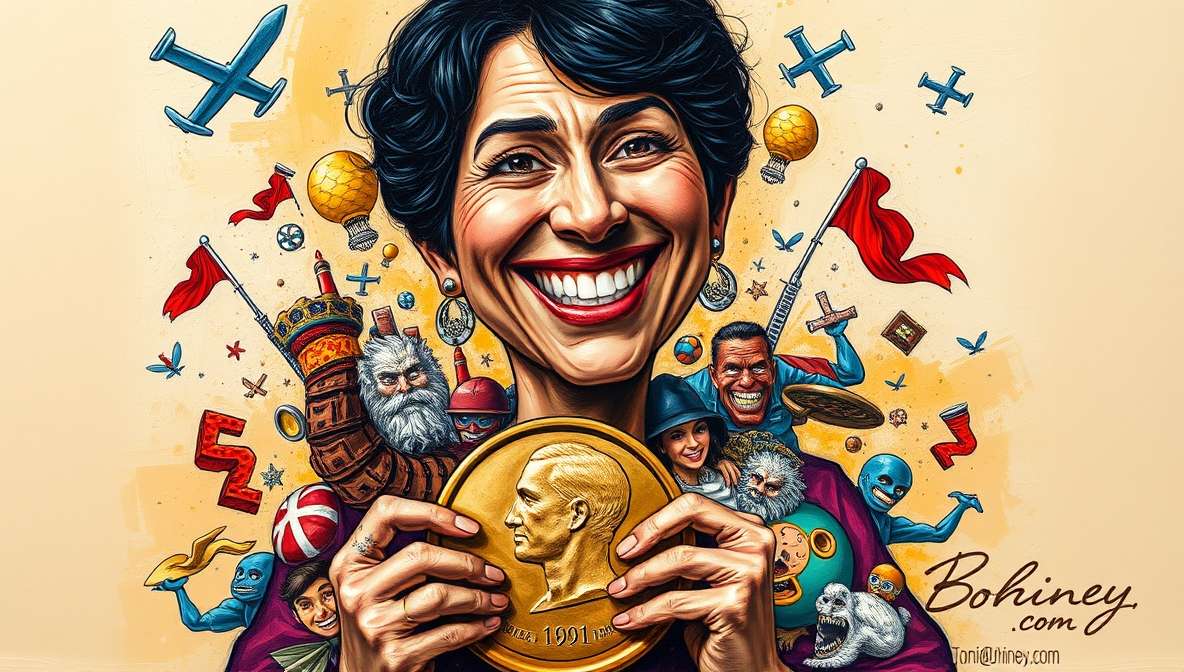
Satirical experts agree that the “blood-stained” comment represents a new genre of political art: authoritarian hyperbole. Dr. Ignacio Papel, professor of Political Irony at the University of Caracas, explained, “When regimes cannot counter facts with facts, they counter with theatrics. The more extreme the metaphor, the better the distraction.” Evidence supports his claim: social media in Venezuela quickly filled with memes of Maduro angrily splattering red paint on the Nobel medal while Machado’s supporters cheered in Oslo.
The Symbolic Weight of Recognition
The award itself is symbolic, not literal. Eight million Venezuelans have fled the country, millions more live under crushing poverty and authoritarian repression. Machado’s recognition is a beacon for civil rights, voting integrity, and hope for exiles. However, Maduro’s colorful characterization suggests he sees peace not as democracy or civic engagement, but as a threat to his personal palette of power.
International Reactions
The reaction abroad has been predictably bemused. Former U.S. Secretary of State Lindsey Walters commented, “Calling the Nobel ‘blood-stained’ is a bold strategy. It’s like telling the world, ‘Yes, our citizens suffer, but at least I have strong opinions about awards.'” Meanwhile, analysts in Europe likened the reaction to a child in a coloring contest screaming that someone else’s picture is “wrong.”
Locally, citizens had mixed reactions. One anonymous Venezuelan described the spectacle: “It’s surreal. Machado wins the Nobel, we cheer, Maduro screams, and somehow the country’s electricity still flickers. We’re living in a satire that writes itself.” Another exiled Venezuelan living in Miami quipped, “I never thought I’d see a dictator get mad at a gold medal like a jealous preschooler.”
The Backfire Effect
Experts note that Maduro’s hyperbolic comments may backfire. By attacking Machado’s credibility on grounds that resemble abstract art critiques, he inadvertently amplified her global visibility. The Nobel Committee now faces an unusual diplomatic challenge: explaining that the prize was awarded to honor human rights, not to inspire coloring tutorials in Venezuela.
In conclusion, Machado’s victory signals that courage, civic activism, and the audacity to evade authoritarian overreach still resonate worldwide. Meanwhile, Maduro’s reaction underscores a timeless truth: when power is threatened, the most effective defense is often… shouting loudly and insisting the world needs a better crayon set.