

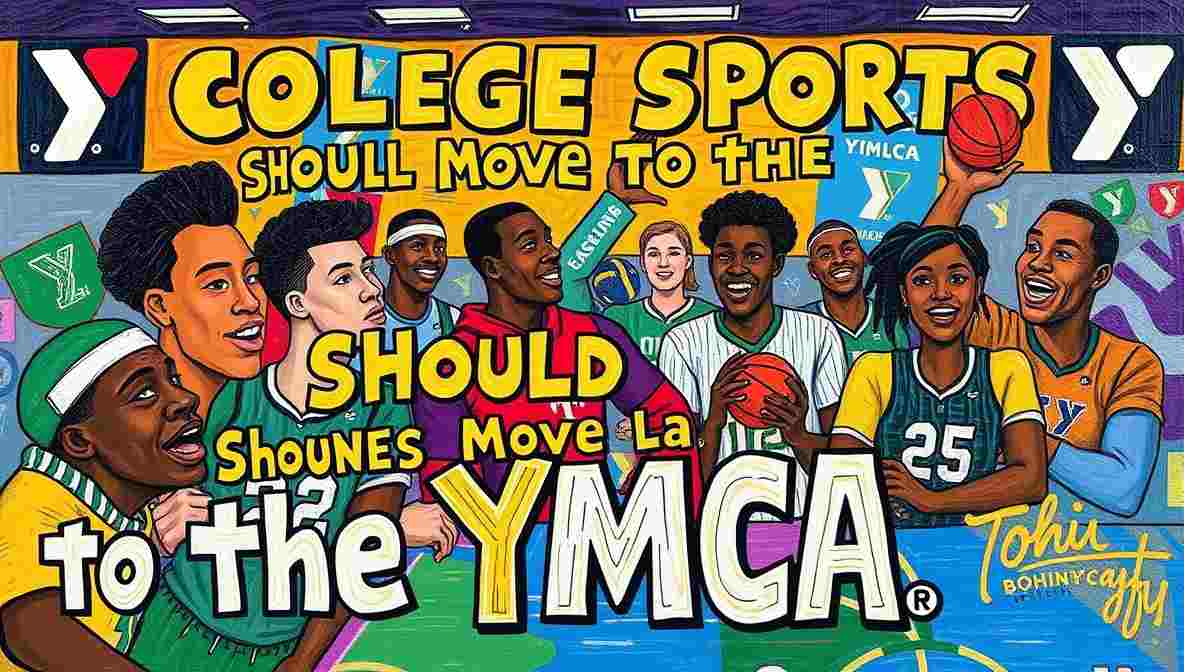
College Football Coaches Make $13 Million While Professors Earn $100K — Is the YMCA the Answer?
Five Observations About the “College Sports Should Move to the YMCA” Revolution
Sports have always been the most confusing class offered by universities. It is the only academic program where the students weigh 320 pounds, the teachers earn $12 million a year, and the library is shaped like a stadium.
Here are a few observations that have emerged as the nation begins seriously discussing the idea that college sports should be moved to the YMCA like a giant national pickup game.
Observation One: The Only Syllabus That Includes “Defeat Alabama”
The first strange thing about college sports is that it is the only class where the syllabus includes “defeat Alabama.” Somewhere on campus there is a physics professor who has spent 40 years studying quantum mechanics and still earns less than the assistant coach responsible for teaching linebackers how to tackle a refrigerator.
According to CBS Sports, nine college football coaches now sit firmly in the $10 million salary club, with Georgia’s Kirby Smart pulling in approximately $13.3 million annually. Meanwhile, the average full-time professor at a doctoral research university earns roughly $100,000 to $130,000 per year. This means the head football coach earns approximately 100 times more than the person teaching students how to think. Draw your own conclusions about institutional priorities.
Observation Two: The “Educational Experience” That Pays $3 Million in NIL Deals
The second observation is that universities keep insisting sports are part of the “educational experience.” If that is true, then the philosophy department should immediately start paying students $3 million in NIL deals to read Plato.
According to OC&C Strategy Consultants, the NIL market was worth an estimated $2.3 billion in the 2024–25 season, with annual growth projected at roughly 9 percent through 2029. Top quarterbacks at Power Four programs can expect over $1.3 million annually when combining scholarships, commercial NIL, collective NIL, and revenue share. The philosophy department remains unaware that any of this is happening.
Observation Three: Stadiums That Look Like Spaceports While English Departments Use Eisenhower-Era Chairs
The third observation is that college stadiums now look like futuristic spaceports while the English department still has chairs from the Eisenhower administration. If Shakespeare had known this, he would have rewritten Hamlet as a linebacker.
The HVS stadium development report confirms that university athletic departments continue to expand luxury seating, premium club areas, and mixed-use entertainment districts at a remarkable pace, with 58 college stadiums undergoing major improvements in 2025 alone. Northwestern’s new Ryan Field project carries an estimated price tag of approximately $850 million. The English department recently requested a new stapler.
Observation Four: The Campus Where Nobody Knows Where the Library Is
The fourth observation is that everyone pretends athletes are “students first,” even though half the campus doesn’t know where the library is but can recite the quarterback’s passing statistics from memory.
A Washington Post investigation into NIL economics found that the Texas football program disclosed $20.8 million in NIL deals from 2021 to 2024, making it the highest NIL-earning program among schools that provided public records. The university’s women’s tennis team, which reached the second round of the NCAA tournament, disclosed zero dollars in NIL payments. The library reported no unusual activity.
Observation Five: The Athlete Who Dared Ask for Money After the School Sold $17 Nachos
The fifth observation is that universities are shocked athletes want money. The school sells jerseys, television rights, luxury boxes, and nachos that cost $17, yet somehow the athlete asking for compensation is treated like he just robbed the chemistry lab.
The House v. NCAA settlement offered $2.8 billion in back damages to former athletes and created a new revenue-sharing system allowing schools to directly pay up to $20.5 million annually to student-athletes — the first time in NCAA history. It took a federal lawsuit to accomplish what common sense suggested decades ago.
America Finally Realizes College Sports Are Just Professional Sports Wearing a Graduation Cap
WASHINGTON – In what historians are calling the most honest moment in higher education since someone admitted the campus bookstore is a money laundering operation, a growing coalition of policymakers, commentators, and YMCA volleyball leagues has proposed a radical solution to America’s college sports chaos.
Move the entire thing off campus.
Yes. The idea is simple. If football players are making millions of dollars through Name, Image, and Likeness deals, traveling across the country in charter jets, and starring in national television broadcasts, perhaps the activity is not technically a “biology elective.”
President Donald Trump recently weighed in on the issue, arguing that the modern college sports economy has become so large that it could collapse the entire university system like a folding chair at a tailgate party.
According to Trump, college athletics have reached a point where the economics resemble Wall Street, the drama resembles reality television, and the academic requirements resemble a polite suggestion.
“College sports used to be amateur athletics,” Trump reportedly told a room of NCAA officials, athletic directors, and one confused sociology professor who thought he was attending a seminar on Plato. “Now it’s the NFL with homework.”
The YMCA Proposal That Is Making Professors Nervous
The radical proposal gaining traction is surprisingly simple.
Take the sports programs out of universities and place them into independent leagues run through community organizations like the YMCA.
Imagine the future.
Instead of “University of Alabama Crimson Tide vs Georgia Bulldogs,” the national championship could become “Birmingham YMCA Flagship Squad vs Atlanta YMCA Tall Guys Who Lift.”
Political analysts say the proposal has several advantages.
First, it would finally allow universities to focus on their original mission: education. Second, it would allow athletes to earn money openly without pretending the endorsement deal is somehow related to a sociology lecture. Third, it would dramatically reduce the number of college presidents who must pretend to understand football strategy during alumni dinners.
Experts Say College Sports Became a Billion-Dollar Accident in Higher Education
Sports economist Dr. Randall P. Butterfield of the Institute for Academic Irony says the entire college sports industry exists because of a historical misunderstanding.
“In the early 1900s, colleges created sports teams to encourage exercise and school spirit,” Butterfield explained. “Then television money arrived, and suddenly the exercise program became a billion-dollar entertainment cartel.”
According to recent program valuations, the combined value of the top 75 college athletic programs has reached $51.22 billion, with 13 schools now valued above $1 billion each. Texas leads the pack at $1.48 billion. The biology department recently applied for a grant to replace a broken microscope.
Butterfield also pointed out that the NCAA has spent decades trying to maintain the illusion that college athletes are amateurs.
“That illusion collapsed the moment a quarterback appeared in a car dealership commercial holding a Lamborghini.”
Eyewitnesses Already Preparing for YMCA Community Tailgates
At a YMCA in Ohio, local football enthusiast Rick “Chainsaw” Mallory says he is excited about the possibility.
Mallory has already begun designing what he calls the “future of grassroots athletics.”
“It’s gonna be great,” Mallory said while grilling hot dogs outside the YMCA parking lot. “We’ll have tailgating, marching bands, and a halftime sermon from the Zumba instructor.”
Mallory also believes the YMCA model would simplify recruiting. “Instead of signing day on ESPN, we’ll just post flyers on the community bulletin board next to the yoga class.”
Anonymous University Staffers Quietly Love the Campus Sports Reform Idea
Behind the scenes, several university administrators privately admit the proposal sounds wonderful.
One anonymous staffer described the current system as “running a casino disguised as a campus.”
“Every year we pretend football revenue supports the university,” the staffer said. “Then we spend $90 million renovating the stadium bathrooms.”
The staffer also noted that the university’s athletic department has a larger marketing staff than the entire English department. “We have three people teaching Shakespeare,” the staffer said. “We have forty-seven people designing social media posts about touchdowns.”
West Virginia University research confirms the dynamic, finding that colleges banned from competing on player salaries redirected enormous sums toward coaching contracts instead — triggering an upward salary spiral across all competing programs. When one school gives a head coach a raise, every competitor follows. The head football coach is now often the highest-paid public employee in the entire state.
Poll: Americans Already Treat College Football Like a Professional Sports League
A recent national survey conducted by the Institute for Extremely Obvious Observations found the following:
- 71 percent of Americans cannot name their state’s governor but know the starting quarterback of their favorite college team.
- 63 percent believe the offensive coordinator deserves a higher salary than their doctor.
- 89 percent admitted they only applied to their college because the football team was good.
What the Funny People Are Saying About College Sports Reform
“If sports leave universities, college will finally return to its original purpose: pretending to read books while eating pizza.” — Jerry Seinfeld
“A football coach making ten million dollars to teach blocking techniques is the only professor who can assign homework like ‘tackle a refrigerator.'” — Ron White
“The moment athletes started getting NIL deals, college sports turned into Shark Tank with helmets.” — Sarah Silverman
The Future of Higher Education After the Athletic Department Leaves Campus
If the YMCA model succeeds, the university of the future may look very different.
Instead of spending billions on stadium expansions and NIL compliance infrastructure, schools might invest in libraries, laboratories, and classrooms. Students might even begin attending lectures again.
Of course, critics warn that removing sports from campuses could reduce school spirit. But supporters argue the opposite. If Americans truly love sports, they will follow their teams anywhere. Even the YMCA.
This satirical report is the result of an entirely human collaboration between two sentient beings: the world’s oldest tenured professor and a philosophy major who became a dairy farmer after discovering that cows are easier to debate than university administrators. No universities, linebackers, or YMCA basketball leagues were harmed in the writing of this article.
Auf Wiedersehen, amigo!
WE ARE ALSO COVERING…
- NCAA Revenue Sharing Chaos Sparks Radical Proposal: Move College Sports Off Campus
- College Sports Reform 2025: The YMCA Proposal That Has University Administrators Sweating
- NIL Deals, $51 Billion in Program Valuations, and a YMCA: The Future of College Athletics
- The NFL Called — It Wants Its Homework Back
- America’s Most Expensive Exercise Program Finally Gets a Reality Check
- College Sports Are Just the NFL With a Worse Cafeteria
- Universities Shocked to Discover Their “Educational Program” Has a Luxury Box Problem
- Move It to the YMCA: The Only College Sports Proposal Nobody Can Actually Argue With