

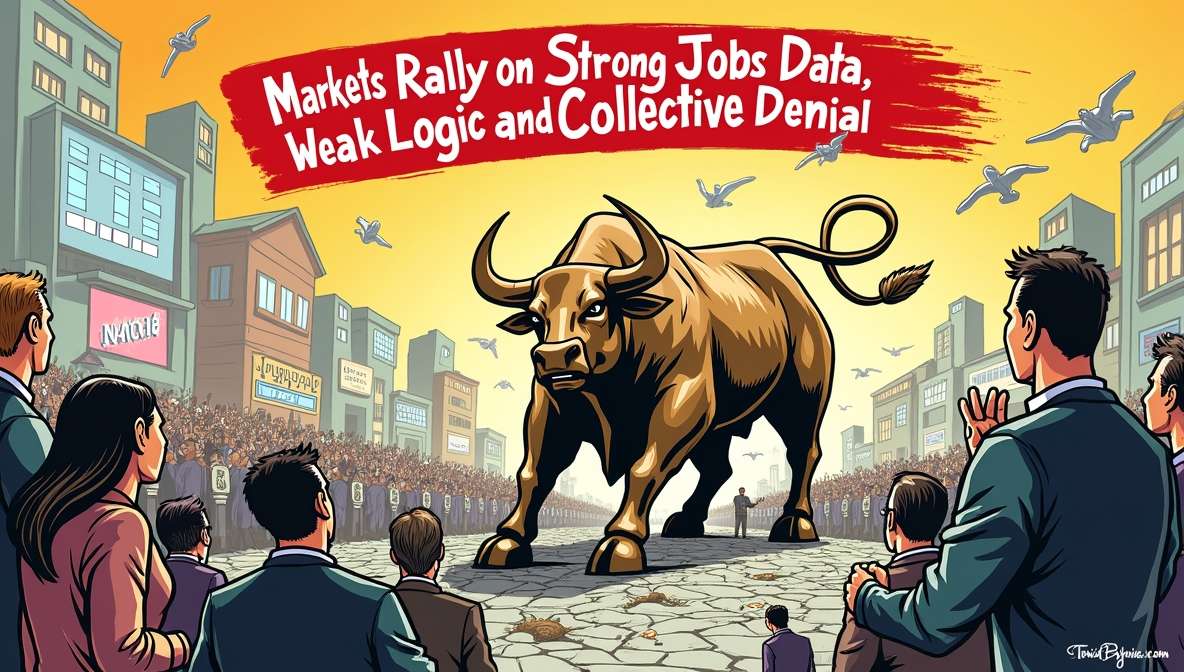
Markets Rally on Strong Jobs Data, Weak Logic, and Collective Denial
Global markets rallied this week after the release of jobs data that experts described as “encouraging, confusing, and absolutely not something we’ll examine too closely.” Investors responded the only way they know how: by buying everything in sight and pretending this was a rational decision.
The Jobs Report: A Masterpiece of Modern Economics
The report itself was a masterpiece of modern economics. Jobs were up, participation was sideways, revisions were quietly revised again, and someone on television said the word “resilient” with enough confidence to move billions of dollars. Markets surged immediately, proving once again that numbers are less important than tone.
Wall Street’s Favorite Game: Tell Any Story You Want
Conflicting Narratives, Same Bottom Line

Wall Street analysts praised the data for “telling a story,” though they disagreed on what that story was. Some said it showed a strong labor market. Others said it showed a weakening one. A third group said it didn’t matter because the market had already decided to be happy and didn’t want to be interrupted by facts.
As Jerry Seinfeld once noted, “It’s amazing that we have all these tools to communicate and share information, and what we really do is just look at our phones and pretend everything’s fine.” Wall Street took that to heart.
Economics by Flowchart
Economists rushed to explain cause and effect, mostly by drawing arrows on charts that pointed wherever the speaker wanted. According to one bank strategist, strong job growth means consumers will spend more, unless inflation returns, in which case it means the opposite, unless interest rates fall, which would mean something else entirely. The audience nodded, grateful not to be singled out.
The Art of Selective Optimism
Selective optimism played a starring role. Bad news was described as “priced in,” while good news was framed as “unexpected,” even when it had been predicted by the same people celebrating it. One hedge fund manager admitted, off the record, “We’re not bullish or bearish. We’re opportunistic and emotionally unavailable.”
Ron White summed it up best: “You can’t fix stupid. And apparently, you can’t stop it from trading stocks either.”
Retail Investors Join the Party (No Invitation Required)
Retail investors joined the rally after seeing headlines that implied prosperity was back, or at least renting. Many admitted they didn’t fully understand the report but trusted the green arrows. “Red arrows make me sad,” said one new trader. “Green arrows feel like progress.”
This is where behavioral finance experts usually intervene. Professor Daniel Marks of the Center for Financial Psychology explains that markets thrive on collective denial. “When people feel uncertain, they look for permission to feel optimistic,” he said. “Jobs data provides that permission, even if no one agrees what it means.”
History Rhyming (Sort Of)
Historical analogies were deployed liberally. Commentators compared the moment to past recoveries, conveniently ignoring what happened afterward. Charts labeled ‘Just Like 1995’ appeared next to charts that looked nothing like 1995, but confidence carried the argument.
As Amy Schumer would say, “I have a chart here that proves my point. I also have a chart that proves the opposite. What I’m going to do is show you the one that makes me money.”
Workers in the Abstract Economy
Meanwhile, workers themselves reported mixed experiences. Some felt secure, others stretched thin, and many wondered how the economy could be “booming” while their rent behaved like it had personal goals. One worker said, “Apparently I’m employed in the abstract.”
Income data showed the disconnect clearly: wages rose, but so did everything else. Real purchasing power? That’s a story for another rally.
The Official Government Stance: Vibes and Imagination
Government officials urged calm celebration. The message was clear: things are improving, slowly, unevenly, and in a way that requires patience and a strong imagination. Any lingering anxiety was attributed to “vibes,” not structural issues.
Expert Advice for the Perpetually Confused
Helpful advice circulated online. Experts recommended diversifying portfolios, lowering expectations, and avoiding economic news after 7 p.m. for mental health reasons. Several financial planners now include meditation apps in retirement strategies.
What the Rally Really Proved
In the end, the rally said less about jobs and more about hope. Markets didn’t surge because certainty returned. They surged because uncertainty paused long enough for everyone to pretend they understood what was happening.
The jobs report was good enough. The logic was weak enough. And the denial was collective enough. What more could the market ask for?