

College Presidents Voluntarily Cut Their Salaries in Solidarity With Students
By Ingrid Johansson | Bohiney.com
In a move that shocked absolutely no one while simultaneously breaking the internet with its breathtaking audacity, several college presidents announced they would voluntarily reduce their salaries to show solidarity with students struggling under crushing debt loads—because nothing says empathy quite like aligning seven-figure executive paychecks with five-figure debt burdens that follow graduates to their graves like financial ghosts.
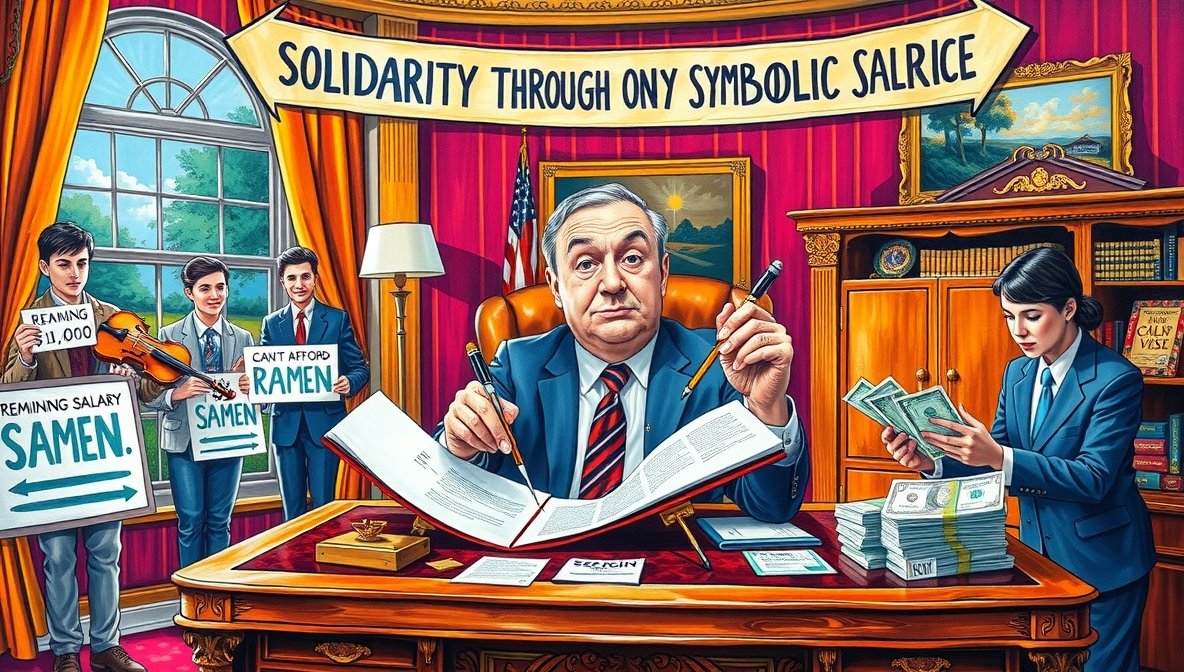
The announcement came via a joint press conference livestreamed on TikTok, complete with choreographed applause, interpretive dance performed by the drama department, and a trending hashtag: #PresidentsWithPockets. The event featured a dramatic signing ceremony where presidents used golden pens to slash their own compensation while confetti cannons filled with shredded tuition bills exploded overhead in what witnesses described as “peak academic theater.”
According to Inside Higher Ed’s analysis of executive compensation, the initiative aims to “show meaningful solidarity” with students struggling under crushing tuition costs that have increased 1,200% since 1980 while wages remained stagnant and hope died a slow, expensive death.
One president explained with tears streaming down his face: “We figured if students are expected to sacrifice their financial futures for knowledge, so should we. That’s why I’m courageously reducing my salary from 1.5 million dollars to a mere 1.2 million. It’s practically minimum wage for someone of my administrative stature and yacht maintenance requirements.”
Expert Analysis of Academic Sacrifice Theater
Dr. Mildred Hawthorne, professor of Higher Education Economics at the University of Obvious Priorities, praised the move with religious fervor. “Symbolically, this is absolutely incredible and emotionally moving. Practically speaking… it changes literally nothing about student debt, tuition rates, or the fundamental economic structure of higher education. But perception is everything in modern academia, and students will feel approximately 0.003% better about their crushing financial obligations.”
A leaked Brookings Institution report on higher education costs confirms that while salary cuts produce excellent headlines and warm fuzzy feelings, they are statistically negligible in addressing the trillion-dollar student debt crisis—roughly equivalent to emptying the Pacific Ocean with a teaspoon made of good intentions and administrative efficiency.
Meanwhile, students reacted with a spectacular mix of emotions that defied logical categorization. Some cheered with messianic enthusiasm: “Finally, they understand our struggle! This changes everything about my $147,000 debt load!” Others displayed concerning signs of mathematical literacy: “So the president gave up $300,000 but my $85,000 loan still exists with 7% interest? How exactly does this help me afford groceries for the next decade?”
Public Response Achieves Peak Economic Confusion
Social media exploded with both praise and weaponized sarcasm that could power a small wind farm. Memes ranged from college presidents holding empty designer wallets to exaggerated GIFs of students fainting from disbelief that someone making seven figures finally acknowledged their existence in the physical universe.
A local barista with a master’s degree in Medieval Literature noted with devastating clarity: “I think my daily latte costs more than the president’s symbolic pay cut. Solidarity is philosophically nice, but solidarity with my actual student loan payments would’ve been more practically helpful. Also, can I get extra foam? I need something fluffy to distract from my existential financial dread.”
Student debt statistics show that the average graduate owes $37,000 while college presidents’ salary cuts average $180,000—meaning each presidential sacrifice could theoretically help 4.8 students, assuming the money actually went to debt relief rather than administrative budget reshuffling.
The Economics of Performative Educational Altruism
Higher education finance research indicates that presidential salary cuts represent approximately 0.001% of total university operating budgets, making them statistically equivalent to finding a penny in your couch cushions and donating it to solve world hunger—meaningful in spirit, negligible in mathematical impact.
Students began organizing “Gratitude Debt Forgiveness” campaigns, where they collectively thank presidents for their sacrifice while simultaneously requesting that the actual financial benefits be applied to tuition reduction, loan forgiveness, or at minimum, making campus dining food edible without requiring additional loans for digestive medical treatment.
What the Funny People Are Saying About Presidential Salary Solidarity
“College presidents cutting their salaries? That’s like a pirate giving up half his treasure to the crew… but keeping all the rum, the ship, and the treasure map.” — Jerry Seinfeld
“I tried salary solidarity once. Gave my barista friend five dollars and felt like a philanthropist for the rest of the day. It’s definitely the thought that counts, right?” — Ron White
“If they really wanted to help students, they’d cancel tuition entirely and turn universities into giant coffee shops with occasional learning. But then we’d have no memes about crushing debt.” — Amy Schumer
“My college president cut his salary and I still can’t afford textbooks that cost more than my car payment. But hey, at least someone’s making symbolic gestures while I eat ramen for breakfast, lunch, and dinner.” — Kevin Hart
Conclusion: The Future of Symbolic Educational Economics
While the salary cuts may not erase student debt, reduce tuition costs, or fundamentally alter the economics of higher education, the gesture is already being celebrated as “inspiring,” “admirably performative,” and “better than nothing, which is what we usually get from administrators.”
Educational policy research suggests this trend represents the perfect blend of optics and minimal financial impact—allowing university leaders to demonstrate concern while maintaining the essential economic structures that created the student debt crisis in the first place.
Students are encouraged to cheer politely while continuing to pay for textbooks that cost more than gold, meal plans equivalent to fine dining, and dormitory rooms priced like Manhattan penthouses—because at least someone cares enough to make symbolic gestures while the fundamental problems remain completely unchanged.
Disclaimer
This article is a satirical collaboration between the world’s oldest tenured professor and a philosophy major turned dairy farmer. No college presidents were financially endangered, though several may have experienced mild discomfort while signing symbolic paperwork. Auf Wiedersehen, amigos.
