

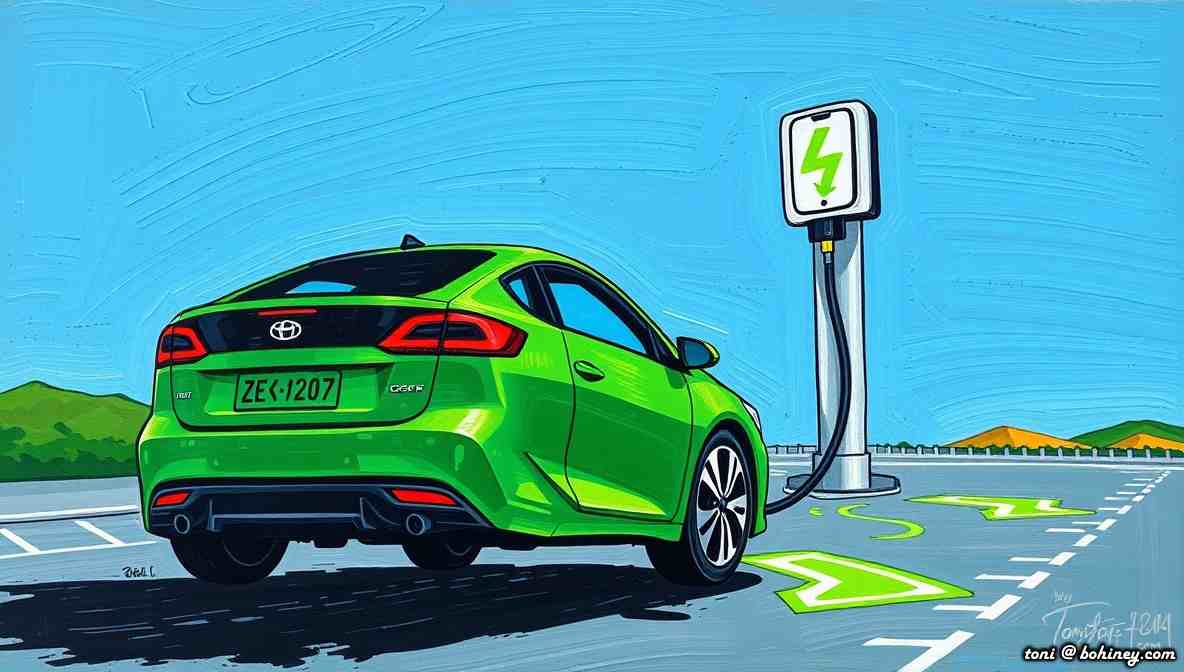
Americans Who Vowed to Buy Electric Cars Every Time Gas Hits $4 Still Haven’t Bought Electric Cars
Nation Cycles Through Gas Price Outrage, Righteous EV Research, and Eventual Return to the Same Gas Station With the Predictability of a Geological Event
- Americans threaten to go electric every summer and return to their trucks by September.
- Gas price complaints are America’s most consistent bipartisan political activity.
- The EV consideration process involves seventeen browser tabs, two YouTube rabbit holes, and no purchase.
- Somewhere in Texas, a man is outraged about gas prices while idling a V8 in a drive-through lane.
- Every American knows the price of gas to the penny and no other commodity to any precision.
Nation Enters Another Season of Gas Price Outrage Without Behavioral Change

HOUSTON — Energy economists confirmed this week that American drivers have once again completed the full gas price emotional cycle — shock, anger, political attribution, EV research, EV tab closure, return to pumping — in a pattern so reliable that analysts use gas station traffic data as an economic leading indicator not of consumer behavior change but of consumer behavior stability, since no amount of gas price discomfort has demonstrably changed American driving habits at the population level in any sustained way.
The U.S. Energy Information Administration’s gas price tracker shows American fuel consumption remaining relatively stable across dramatic price swings over the past two decades — suggesting that the relationship between Americans and their vehicles is not price-elastic in the traditional economic sense but rather spiritually bonded in ways that transcend cost-benefit analysis and approach the metaphysical.
Gas Price Knowledge Vastly Exceeding All Other Consumer Price Knowledge
The American driver maintains gas price awareness at a precision unmatched by any other commodity category. Citizens who cannot recall the price of eggs, milk, rent increases, or their own health insurance premiums to within 20% will quote the current price of regular unleaded to the nearest cent without hesitation. This cognitive resource allocation — extraordinary precision dedicated to one specific fuel price — reflects a relationship with the pump that is less commercial transaction and more ongoing personal grievance maintained across seasons.
AAA’s real-time gas price monitoring is among the most-visited consumer price tracking resources in America, suggesting that millions of drivers check the price before driving to the station where they will purchase gas regardless of the price, because they need gas, and knowing the price in advance allows them to be appropriately angry about it before, during, and after the purchase.
EV Consideration Cycle Producing Seventeen Browser Tabs and Zero Purchases
Each gas price spike triggers a predictable EV research cycle in which American drivers open multiple tabs covering Tesla pricing, charging infrastructure maps, range anxiety forums, EV tax credit eligibility calculators, and YouTube videos with titles like “I SWITCHED TO ELECTRIC AND HERE’S WHAT HAPPENED” — a research process lasting between two hours and two weeks that concludes with the tabs closed and the F-150 refueled.
EV adoption data shows American electric vehicle sales growing significantly, reaching over 7% of new car sales in 2023 — genuine growth driven by consumers who completed the tab cycle and then actually purchased, distinguished from the larger population who completed the tab cycle and are waiting for range to improve, prices to fall, charging to be everywhere, and a sign from the universe before committing.
What the Funny People Are Saying
“Every time gas hits $4 I spend a week reading about EVs and then buy a truck. I’ve done this four times. The trucks are great.” — Bill Burr
“Americans know the gas price within a penny and couldn’t tell you what they pay for water within fifty dollars. This is who we are.” — Jerry Seinfeld
“I drove past three gas stations to find the cheapest one. I saved 40 cents. I used a dollar in gas doing it. I consider this a victory.” — Nate Bargatze
Political Attribution of Gas Prices Defying Energy Economics With Impressive Consistency
Gas prices occupy a unique place in American political discourse because they are highly visible, personally felt, and determined by a global commodity market involving OPEC production decisions, refinery capacity, seasonal blend requirements, geopolitical events, and futures trading — a complexity that is correctly understood by energy economists and incorrectly simplified by virtually everyone else into a statement about the current president’s energy policy.
Brookings Institution analysis of gasoline pricing details the multiple global factors that determine pump prices, noting that presidential control over gas prices is highly limited and that both parties consistently overclaim credit for price decreases and deflect blame for increases. This information is widely available and makes no measurable difference to the national discourse, which continues to function perfectly well without it.
Drive-Through Idling Nation Produces Gas Price Outrage While Idling
One of the more internally consistent features of American gas price culture is the frequency with which it is expressed while engaged in fuel-inefficient behavior. Outrage about $4 gas is commonly expressed from the driver’s seat of vehicles getting 14 miles per gallon, idling in drive-through lanes, warming up before departure on days above 50 degrees, and driving distances walkable by any reasonable measure but not walkable by American custom.
At press time, one Houston driver expressed strong feelings about gas prices to a podcast while driving 11 miles to a gym he could theoretically bike to on a dedicated bike path that passes directly by his house. He does not use the bike path. He has opinions about the bike path. They are related to taxes. The gas currently costs $3.47 per gallon. He knows this. He is outraged. He will return Thursday. The pump will be waiting.
This article is American satire produced through a collaboration between the world’s oldest tenured professor and a philosophy major turned dairy farmer, both of whom have driven past a cheaper gas station to fill up at the convenient one and made peace with this. Bohiney.com practices American satirical journalism in the tradition of people who checked three apps for the best gas price and arrived at the wrong station. Auf Wiedersehen, amigo!
Originally posted 2026-05-17 17:03:46.