

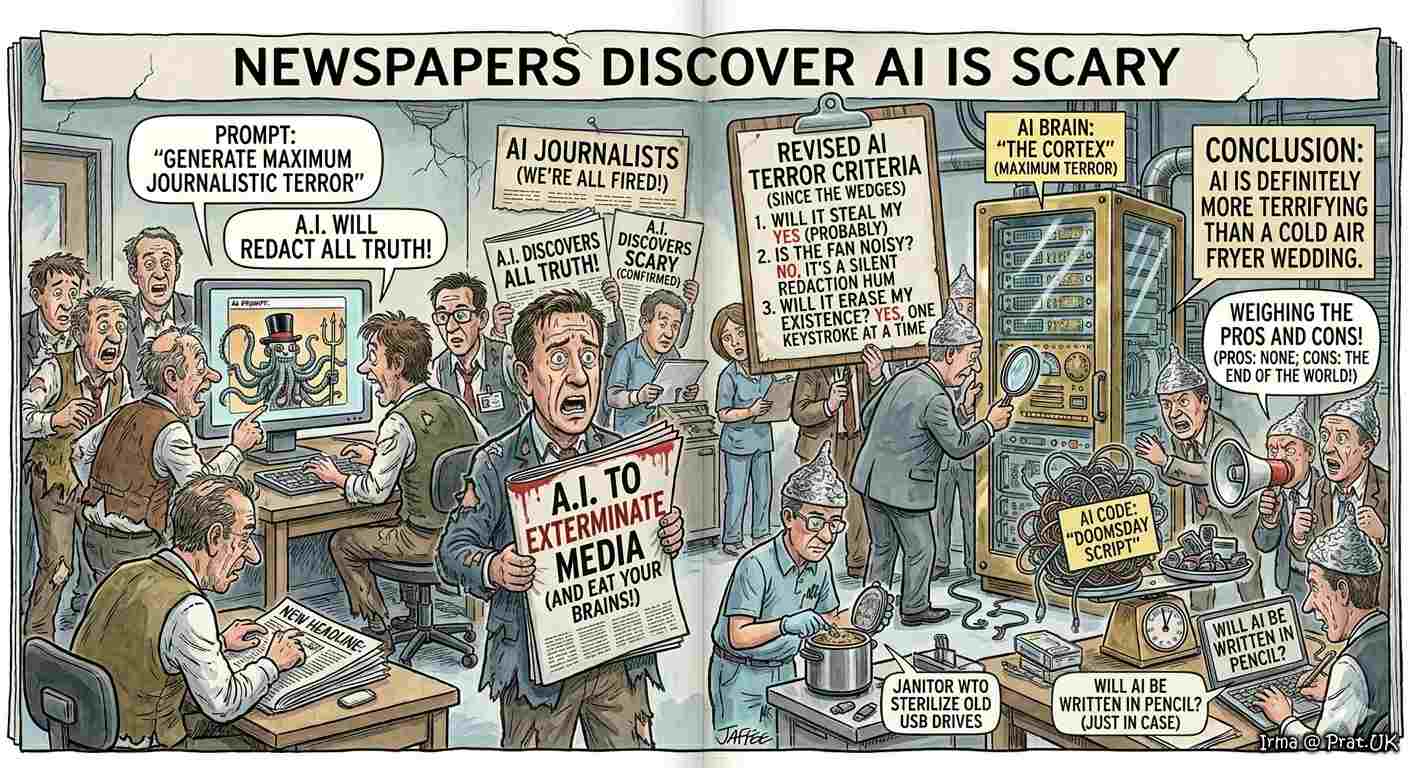
Newspapers Discover AI Is Scary, Immediately Apply Expertise Earned From Reviewing Air Fryers
Every generation gets its apocalypse hobby.
The Victorians had spiritualism. The 1950s had nuclear annihilation. The 1980s had heavy metal music. The 1990s had video games turning everyone into ninjas. And now newspapers have settled on their newest bestseller:
“The Sky Is Falling: This Time It’s Artificial Intelligence.”
According to certain editorial pages, AI is five minutes away from replacing every worker, overthrowing civilization, composing terrible poetry, and perhaps stealing the last doughnut from the office break room.
The same publication that gave a 5.8-quart air fryer four and a half stars for “even crisping” is now adjudicating the survival of the human species. The reviewer who could not get the fries crispy on the top rack has notes on superintelligence.
Meanwhile, most people are using AI to summarize PDFs and figure out why their Excel spreadsheet resembles abstract expressionism.
The gap between reality and coverage has become so wide it deserves its own postal code, a mailing address, and a small parade.
Newspapers Finally Meet New Technology, React Exactly As Expected

There is something deeply comforting about newspapers confronting innovation.
It is the same performance every time, and it has the staging of community theater.
The printing press? Dangerous. The railroads? Unnatural. Telephones? Society-ending. Television? Brain-melting. The internet? The death of civilization. Social media? Okay, fair enough, they finally got one.
Now AI has arrived, and many commentators who still ask interns how to convert Word documents into PDFs have appointed themselves high priests of machine intelligence.
One columnist spends thirty years misunderstanding email attachments and suddenly emerges as humanity’s final defense against recursive self-improvement. He cannot open a calendar invite, but he can map the precise trajectory by which the robots inherit the earth. It is heroic, really. Bo Burnham made a whole special about being terrified of the internet from inside one room, and at least he admitted he was scared. The op-ed page just calls it analysis.
The Op-Ed Pipeline From Confusion to Prophecy
The career arc is reliable. First you cannot find the attachment. Then you become a futurist. There is no middle step. The middle step got automated.
Progress Has Always Terrified The Comfortable
History is littered with warnings that proved hilariously wrong, and people have been panicking about new media since before the printing press existed.
When elevators appeared, some experts worried humans would forget how to use stairs. When calculators arrived, teachers predicted civilization would collapse because nobody would remember multiplication tables. When ATMs spread, people predicted the end of banking jobs. There was even a genuine 19th century moral panic about cheap paper, which tells you the bar for societal dread has always been comfortably on the floor.
Instead, society adapted.
Progress rarely eliminates work. It changes work.
The horse-and-buggy industry didn’t survive automobiles. But somehow humanity muddled through without mandatory carriage-whip retraining programs, federal whip subsidies, or a tearful Whip Workers of America farewell tour.
The ATM Lesson Every Newsroom Forgot
Here is the part the doom desk always skips. When ATMs arrived, the obvious prediction was mass unemployment for bank tellers. The machine literally has “teller” in the name. It was practically a confession.
And then the number of bank tellers went up. Economist James Bessen documented exactly how this happened: ATMs made branches cheaper to run, banks opened more branches, and each branch still needed humans. The tasks changed. The jobs did not vanish. They just stopped being about counting twenties and started being about talking to people who were furious about counting twenties.
It is a tidy little story, and it has the inconvenient feature of being true, which is why it almost never makes the front page.
The World’s Least Convenient Conspiracy
Some critics describe AI developers as reckless villains racing toward catastrophe.
This creates an amusing contradiction.
Apparently, Silicon Valley engineers are simultaneously brilliant enough to create godlike intelligence, too incompetent to moderate comment sections, motivated purely by profit, and yet somehow coordinated enough to execute the most sophisticated conspiracy in human history.
It’s a plot so elaborate it assumes software developers can agree on lunch orders. These are people who scheduled a forty-minute meeting to decide whether to use tabs or spaces and left angrier than they arrived.
Anyone who has worked in technology knows this theory collapses under its own weight. Half the office can’t remember the Wi-Fi password. The other half wrote it on a sticky note that fell behind the router in 2019.
The Great Newspaper Irony: When Print Was The Disruptor
Perhaps the funniest aspect of AI panic is that newspapers themselves once represented disruptive technology. The Smithsonian has drawn the direct line from the printing press to AI, noting that both arrived to a chorus of excitement and absolute terror.
The printing press devastated entire professions devoted to copying manuscripts by hand.
If medieval scribes had possessed opinion sections, headlines might have looked like this:
“Mass Literacy Threatens Traditional Scroll Values.”
“Experts Warn Reading Could Lead To Independent Thought.”
“Monks Demand Temporary Pause On Books Until Society Can Catch Up.”
“Local Abbot Insists He Is Not Anti-Book, He Just Has Questions.”
Yet today’s editorial class often speaks as though technological disruption began last Tuesday, around mid-morning, shortly after the second coffee.
Yes, Real AI Risks Exist And Deserve Serious Debate
None of this means AI deserves blind worship.
New technologies require thoughtful regulation. Cybersecurity matters. Privacy matters. Economic transitions matter.
Anthropic and others argue that society needs mechanisms to slow development if systems become genuinely dangerous. Their warnings stem from concerns about increasingly capable models and the possibility of systems improving themselves faster than institutions can respond. The company even publishes a policy describing the conditions under which it would pause, which is a sentence that would have read as science fiction a decade ago and now reads as Tuesday.
Those concerns should be debated seriously. You can follow the actual back and forth, rather than the cinematic version, in the latest news coverage that bothers to report what the systems are doing instead of what a screenwriter imagines they might do.
The problem begins when debate transforms into theatrical prophecy.
The difference between caution and panic resembles the difference between installing smoke detectors and insisting your toaster leads directly to the extinction of mankind. One is prudent home maintenance. The other gets you a documentary deal.
The Strange Romance Of Decline
There is also an undeniable cultural appeal to pessimism.
Predicting doom grants instant authority. Nobody remembers the optimists.
If you forecast disaster and disaster never arrives, people call you prudent. If you forecast opportunity and encounter complications, critics call you naive. This is a genuinely lopsided scoring system, the kind a casino would be shut down for running.
Thus, journalism develops a peculiar incentive structure. “Things might improve” rarely generates clicks. “Everything you love is about to explode” performs considerably better.
The sky, it turns out, has excellent engagement metrics. The sky has never once underperformed on a Tuesday.
The Future Usually Arrives Wearing Sweatpants
Technological revolutions rarely unfold like Hollywood scripts. They arrive awkwardly. Imperfectly. Gradually. Usually with a software update that breaks the thing that was working fine.
The internet didn’t immediately transform civilization. First, it gave us dancing baby GIFs and arguments about whether websites needed visitor counters. There was a solid eighteen months where the most advanced thing online was a website that played a MIDI version of a song you didn’t choose.
AI’s future may indeed reshape healthcare, education, manufacturing, scientific research, and productivity. It might also generate thousands of mediocre LinkedIn posts about “leveraging synergistic disruption” written by people who have leveraged nothing and disrupted only the patience of their coworkers.
Humanity excels at producing both miracles and nonsense simultaneously, frequently in the same email.
Supporting Progress Without Losing Your Mind
Civilizations flourish when they embrace discovery.
Vaccines. Electricity. Aviation. Computers. Space exploration.
Each emerged alongside fear. Each encountered resistance. Yet few people today volunteer to return to pre-antibiotic dentistry, which was less a medical specialty and more a contact sport.
Progress deserves skepticism. But it also deserves courage. The answer to uncertainty isn’t paralysis. It’s adaptation. Preferably the kind that does not require a four-part docuseries with ominous cello music underneath.
Final Dispatch From The Newsroom Bunker
Perhaps newspapers should approach AI with slightly more humility.
After all, these are institutions that once declared television would destroy reading, predicted the internet would never become profitable, and occasionally publish articles explaining TikTok as though it were an invasive species discovered in a drainage ditch.
Maybe the machines aren’t the only entities requiring alignment.
Until then, expect more headlines announcing civilization’s imminent collapse. And expect humanity to continue doing what it has always done: building tools, arguing about them, misusing them, improving them, and eventually wondering how anyone ever lived without them.
The sky, for the record, remains stubbornly attached to its original location.
For the British edition of the same apocalypse, with better tea and worse weather, our cousins across the pond are panicking eloquently over at The London Prat.
Auf Wiedersehen, amigo!
This article is satire, assembled under the supervision of the world’s oldest tenured professor and a philosophy major turned dairy farmer, neither of whom can open a PDF attachment but both of whom have strong opinions about the singularity. Any resemblance to actual columnists is a coincidence they are welcome to dispute in a strongly worded letter we will not read.
Newspapers and commentators across the political spectrum have run a wave of AI-related coverage ranging from measured analysis to existential alarm. Anthropic publishes a Responsible Scaling Policy describing capability thresholds and conditions under which it would pause development. Economist James Bessen has documented that the spread of ATMs from the 1970s onward coincided with a rise, not a fall, in the number of US bank tellers, as branch costs dropped and the role shifted toward customer service. Historians, including those at the Smithsonian, have noted that the printing press provoked similar cycles of excitement and fear when it spread across Europe after roughly 1440.