

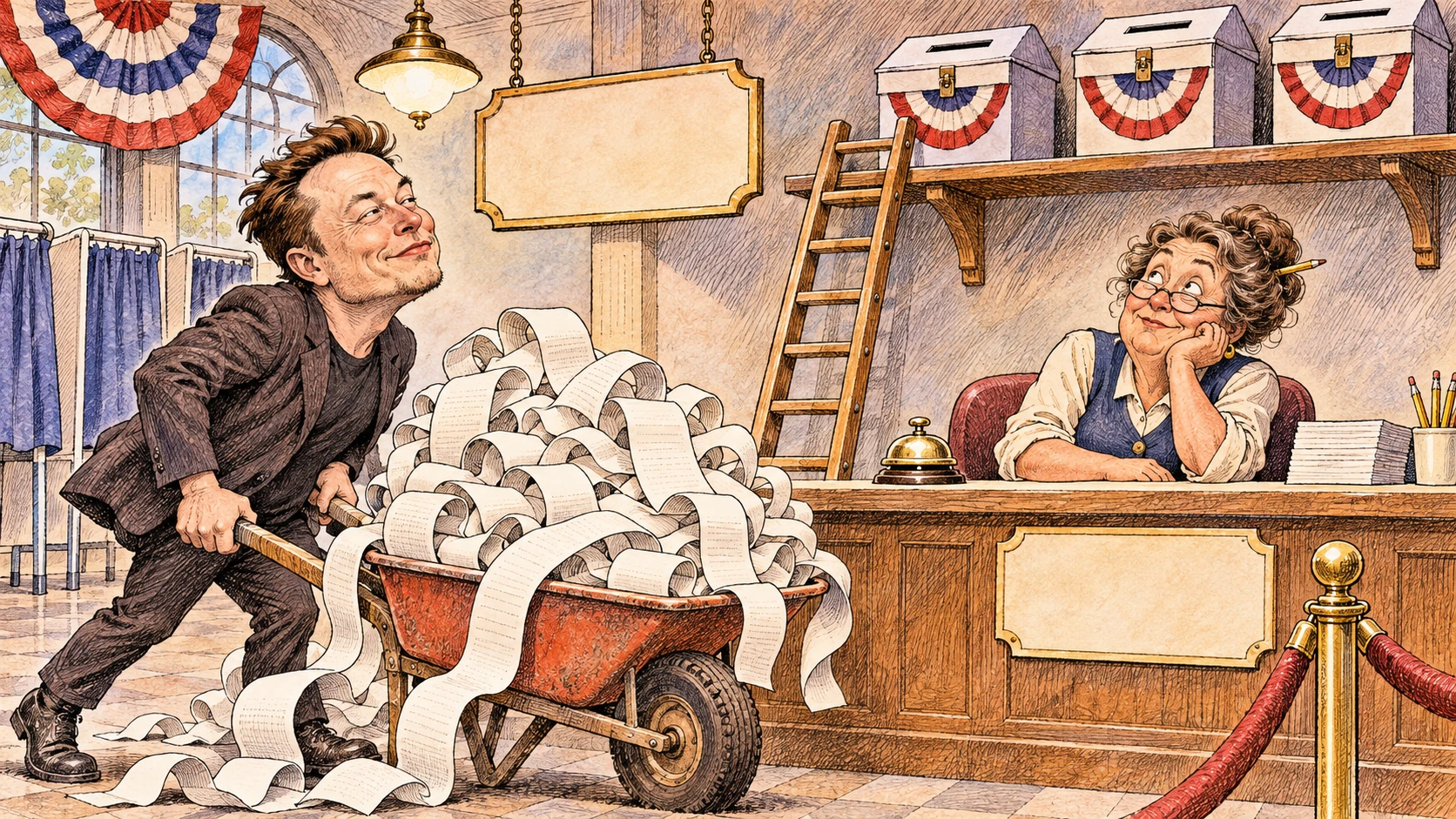
WASHINGTON — Elon Musk election spending has brought a neglected consumer issue to national attention: what happens when a man spends nearly half a billion dollars on politics and discovers the electorate did not come with premium support?
According to ABC’s reporting on Musk’s spending regrets, Musk described his midterm spending as foolish and said he was not MAGA. Bohiney’s Democratic Returns Department has examined the situation and located no satisfaction guarantee on the Constitution.
Elon Musk election spending reaches customer service
The department’s clerk, Wanda Ballot, said political contributions purchase campaign activity, not ownership of the customers.
“This is a difficult adjustment for anyone accustomed to a checkout button,” she explained. “You can fund the megaphone. The people listening are still allowed to go inside.”
The distinction is elementary but expensive to learn. Advertising buys an opportunity to persuade. It does not convert a voter into a software feature that can be enabled by an administrator.
Bohiney tested the principle by donating a sandwich to an office meeting and attempting to dictate everyone’s opinions about mayonnaise. The experiment ended with an unauthorized mustard faction. Its results cannot be generalized to federal elections, but the sandwich donor has requested a recount of the pickles.
Democracy has a generous disagreement policy
A campaign’s receipt can list consultants, digital ads, field operations, and other costs. It cannot legitimately include “all voters now behave exactly as purchaser intended.”
If such a line existed, every campaign treasurer in the country would already be litigating the warranty.
Wanda compared the experience to buying a very large television and discovering that the actors continue to make their own choices. Increasing the screen size does not make the ending contractual.
This is not an argument that political money has no influence. Campaign resources matter. The comic error is treating influence as a guaranteed delivery service, complete with a tracking number and a photograph of victory on the porch.

Billionaire disappointment comes in bulk
Ordinary Americans have long known the sensation of paying for something that does not meet expectations. They usually acquire this knowledge through a disappointing hotel breakfast. Politics offers the same basic feeling with more consultants and fewer free waffles.
Musk’s reported regret is therefore a rare moment of consumer solidarity across income brackets. Millions have looked at a purchase and thought, “I could have done something else with that.” Most do not need a campaign-finance database to reconstruct the receipt.
At the returns counter, Wanda offered three options: keep the experience, learn from it, or complain publicly. Refund was unavailable. The institution that accepted the spending was democracy, which has a complicated management structure and no single manager to summon.
How to read the numbers without buying the joke
Readers should separate reported spending totals from claims about precisely what that spending caused. Election outcomes reflect many decisions, conditions, candidates, and voters. A large number is evidence of expenditure; it is not by itself a controlled experiment in political persuasion.
The practical takeaway is useful at every income level: set a budget, know what the purchase can actually deliver, and distrust any vendor promising to make millions of strangers share your preferences.
Wanda has closed the ticket. Its resolution reads: “Product functioning as designed. Other people still included.”
Editorial disclaimer
In Bohiney’s staff mythology, this story is entirely a human collaboration between two sentient beings—the world’s oldest tenured professor and a philosophy major turned dairy farmer. Their campaign budget was spent on lunch, which also failed to produce unanimous consent.