

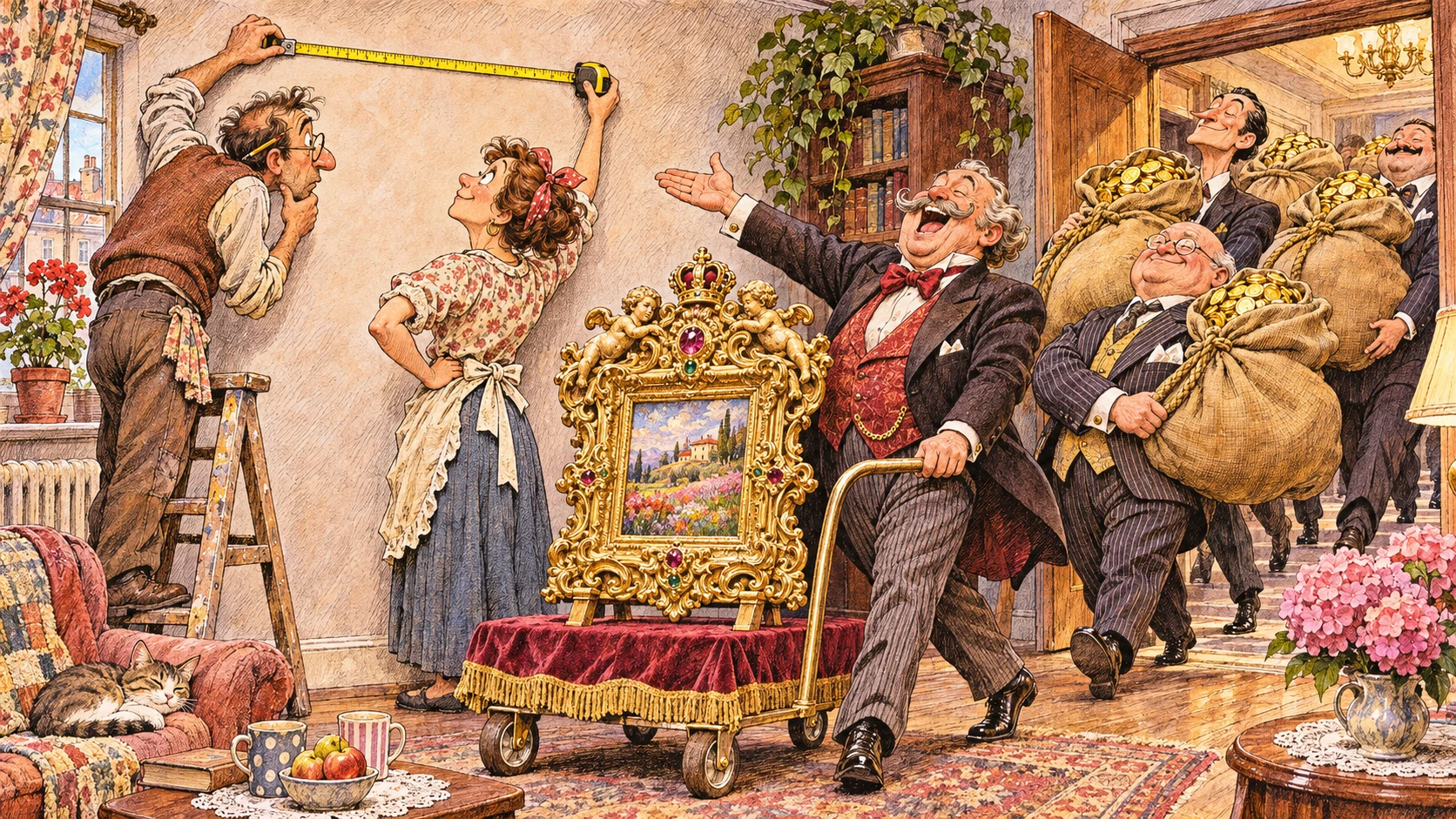
NEW YORK — The Van Gogh auction has persuaded one American couple to retain their living room’s existing artistic concept: an uninterrupted field of rental-approved beige.
As AP reports on the record auction, Vincent van Gogh’s “Chestnut Trees in Flower” sold for $190.4 million at Sotheby’s. The sale followed an agreement addressing the painting’s Nazi-era ownership history. Its serious provenance deserves care. Bohiney’s complaint concerns only the modern household’s inability to match that bid while also replacing a dishwasher.
Van Gogh auction inspires a bold empty-wall movement
Homeowners Kevin and Denise Frame had originally planned to hang something above the couch.
“We wanted a conversation piece,” Denise said. “Apparently the conversation is with a private banker.”
Kevin had assumed the frame would be the expensive part. The auction result forced him to revise this theory and several other positions he had held since visiting a craft store.
The couple’s alternative is an empty wall with excellent natural light. It can be viewed without an appointment, transported by moving the couch, and insured under the existing understanding that the wall is attached to the house.
Bohiney’s Domestic Art Department calls the arrangement “Negative Space, Positive Cash Flow.”
A bidding paddle is not a harmless fan
The appeal of rare art is real: beauty, history, scarcity, personal meaning, and the status associated with ownership. Those factors can command extraordinary prices without establishing what an ordinary family ought to spend on its dining room.
Kevin demonstrated the distinction by admiring a photograph of the painting without buying it. The experiment left his bank account unchanged and his appreciation intact.
He then raised his hand to ask a question about the sale and was advised, as a precaution, never to make that movement inside an auction room.
At home, Denise priced a paint roller. It offered fewer brushstrokes by a recognized master but substantially more coverage around the light switch.
The living room rejects a leveraged acquisition

An auction record measures what a particular buyer paid for a particular work under particular conditions. It is not a universal appraisal of every rectangle that can be mounted on drywall.
This is reassuring news for households whose most valuable wall decoration is a thermostat.
Bohiney’s art economist, Miles Easel, described the basic purchasing test: “If the painting requires you to sell the building containing the wall, you should reconsider the display plan.”
His credentials consist of owning a level and knowing which end of a nail goes into plaster. He nevertheless has a strong record of keeping clients housed.
The couple’s decorating committee also rejected an enormous financing proposal on the grounds that the lender expected actual money and would not accept “cultural enrichment” as a monthly payment.
Enjoying art without bidding on it
Readers can appreciate major works through museums, exhibitions, library books, and reputable collections online. Local artists and affordable prints offer other ways to make a home personal. Ownership is one relationship with art; looking thoughtfully is another.
The sensible household question remains whether a purchase fits the space, the taste, and the budget. An auctioneer’s excitement does not have to become your financial emergency.
Kevin and Denise have reached a compromise. They will hang a small print and leave room for future acquisitions.
Their most ambitious planned acquisition is a functioning dishwasher.
Editorial disclaimer
In Bohiney’s staff mythology, this story is entirely a human collaboration between two sentient beings—the world’s oldest tenured professor and a philosophy major turned dairy farmer. Their most valuable work is a feed receipt framed upside down.