

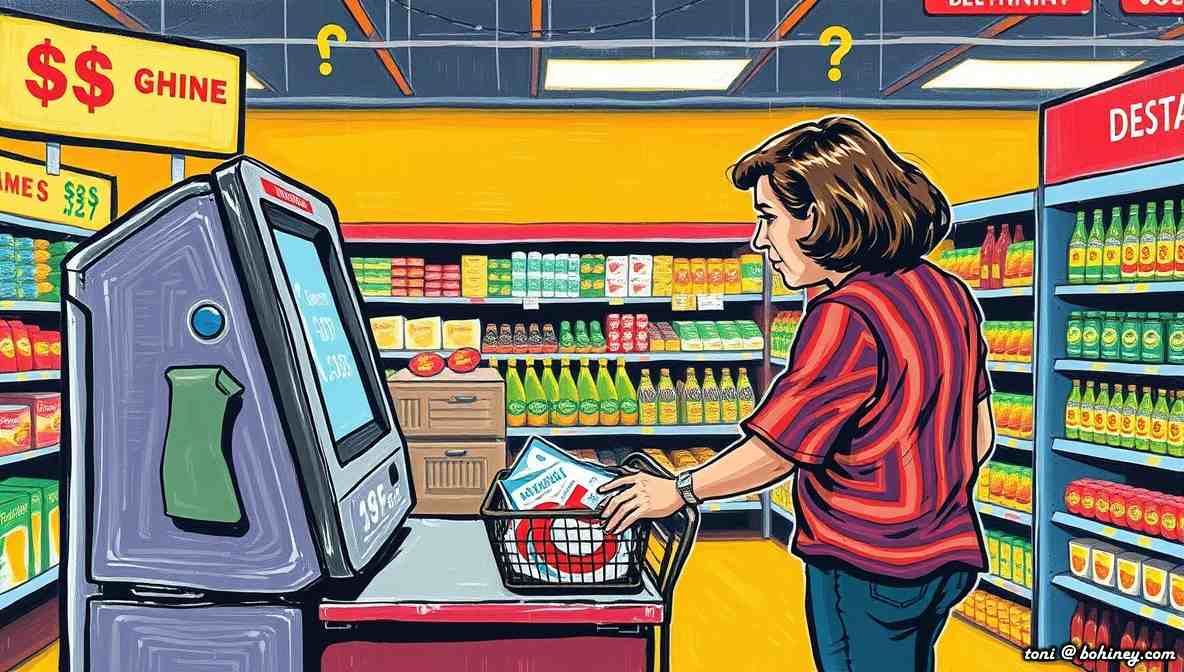
Self-Checkout Machines Have Made Americans Unpaid Grocery Store Employees With No Benefits
Nation’s Retailers Complete Transition to Customer-Operated Labor Model While Maintaining Identical Prices and Adding a Machine That Screams About Unexpected Items
- Americans now perform cashier duties for corporations that replaced their employees with kiosks.
- Self-checkout machines create the illusion of efficiency while generating infinite small humiliations.
- The unexpected item in the bagging area has become the defining anxiety of modern grocery shopping.
- Somewhere in Minnesota, a man has called for assistance seventeen times during a single transaction.
- Retail loss prevention is now handled partly by machines that accuse customers of shoplifting their own groceries.
American Consumers Complete Transformation Into Volunteer Grocery Store Labor Force
MINNEAPOLIS — Retail economists confirmed this week that American grocery chains have successfully transferred the cost of checkout labor to consumers, who now scan, bag, weigh produce, handle payment, and troubleshoot machine errors during every shopping trip — tasks formerly performed by paid employees — while paying the same prices they paid when paid employees performed those tasks. The consumer has received no wage, no discount, no union representation, and no training beyond a laminated card that says “SCAN ITEM” with an arrow pointing at the scanner in case the concept was unclear.
Retail Dive’s analysis of self-checkout economics found that self-checkout has not delivered the labor savings retailers projected, partly because the machines require constant human supervision for error resolution, age verification, and the recurring emergency known as “unexpected item in the bagging area” — a phrase that has entered American life with the same quiet menace as “your call is important to us.”
Unexpected Item in the Bagging Area Becomes Defining Anxiety of Modern Life
The bagging area sensor, calibrated to detect weight discrepancies between scanned items and placed items, triggers a machine halt when any discrepancy occurs — including when the customer breathes near the scale, sets down their purse momentarily, places an item incorrectly, or does nothing wrong at all. The machine then announces the problem at sufficient volume to inform the entire store, requires a staff override, and waits for the one employee supervising sixteen kiosks to reach the register before any transaction can continue.
Consumer Reports has published guides to navigating self-checkout successfully, including tips like “scan items carefully,” “place items immediately in the bagging area,” and “don’t rest your hands on the scale” — instructions that treat the American grocery shopper as a pilot preparing for instrument landing rather than a person buying cereal.
Produce Codes Requiring Agricultural Knowledge Consumers Were Never Given
Self-checkout produces maximum chaos at the produce section, where items must be identified by typing a four-digit PLU code or finding the item in a photo directory arranged by color and shape in a way that suggests whoever organized it has never purchased a vegetable under time pressure. The International Federation for Produce Standards maintains the official PLU code database, which contains thousands of codes for specific produce varieties — distinctions that matter to pricing systems but mean nothing to a person who just wants to buy a lime and leave.
One Dallas woman reportedly spent four minutes identifying her purchase in the self-checkout produce database before selecting “LEMON” for what was definitively a lime. She paid the lemon price. It was 19 cents less. This was not worth four minutes but also was not worth correcting at this point.
What the Funny People Are Saying
“Self-checkout is a job I never applied for that I am extremely bad at.” — Jerry Seinfeld
“They fired the cashier and gave me a machine that calls me a thief when I put my grocery bag down wrong.” — Bill Burr
“I’ve been written up by a kiosk. The kiosk was wrong. There was no appeals process.” — Wanda Sykes
Retailers Now Quietly Removing Self-Checkout After Discovering It Causes Problems
In a development that would be satisfying if it weren’t so expensive for everyone involved, several major retailers have begun quietly reducing or removing self-checkout sections after discovering that the machines generate higher shrinkage rates than staffed checkouts — meaning the machines designed to reduce labor costs are also reducing profit in ways that offset those savings.
Documented retailer pullbacks from self-checkout, including moves by Walmart, Costco, and Dollar General, signal a potential reversal of a trend that took 20 years to build — which means Americans may spend the next 20 years relearning that standing in line with a real human is faster, less stressful, and does not require knowing the PLU code for shallots.
Man in Minnesota Sets Personal Record for Assistance Requests During Single Transaction
At press time, one Minneapolis man completed a 23-item grocery transaction at a self-checkout kiosk that required seventeen staff interventions for issues including three bagging area errors, two age verifications for beer, one PLU dispute involving a squash, and one extended pause during which the machine displayed a message reading “PLEASE WAIT” without any additional context for four minutes. He completed the transaction. He left. He will return Thursday. The machine will be waiting.
This article is American satire produced through a collaboration between the world’s oldest tenured professor and a philosophy major turned dairy farmer, both of whom have strong feelings about the unexpected item in the bagging area and will not be discussing them here. Bohiney.com practices American satirical journalism in the proud tradition of people who remember when checking out was something the cashier did. Auf Wiedersehen, amigo!