

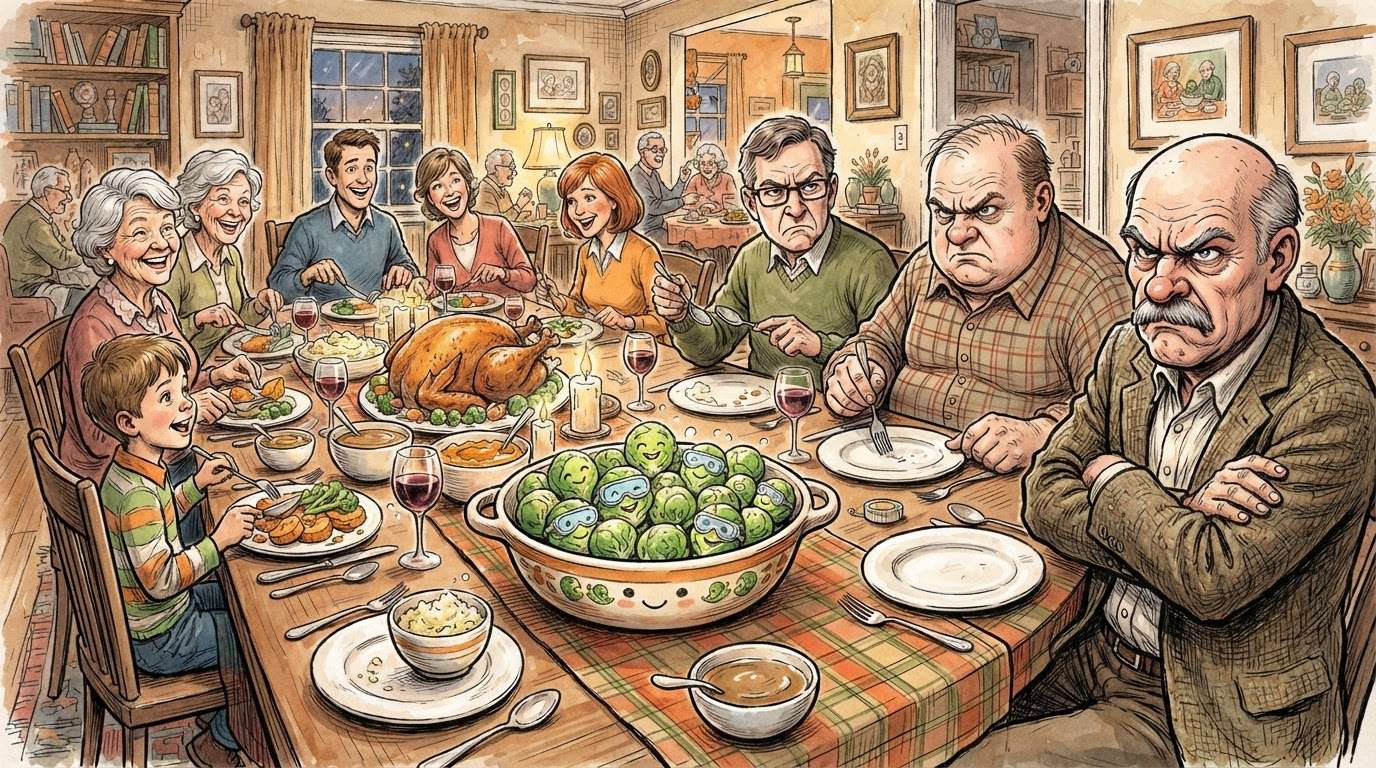
DES MOINES, Iowa — Brussels sprouts bitterness has become a scientific success story. Thanksgiving hosts have asked whether the researchers might now consider a more resistant organism: the uncle who begins every meal with “You can’t say anything anymore.”
Today’s the science behind less bitter Brussels sprouts examines sweeter modern sprouts. At the Bellamy household, the vegetable’s improved temperament has exposed how little progress has been made elsewhere on the table.
“The sprouts used to be the difficult part,” said host Carol Bellamy. “Now they’re sitting quietly beside the turkey while my brother cross-examines a teenager about parking policy.”
Brussels sprouts bitterness faces competition
Bohiney’s family horticulturist, Dr. Beryl Leaf, defines bitterness as a quality that can be present in food or in a person who still remembers being assigned the small bedroom at a reunion in 1996.
Breeding can alter a vegetable’s characteristics over generations. Carol’s brother Walter has resisted modification despite repeated exposure to patient explanations, comfortable chairs, and excellent gravy.
Leaf stressed that people are not plants. Carol said she understood, although Walter had occupied the same spot beside the thermostat for most of the afternoon.
A scientific breakthrough meets an anecdote
Walter rejected the improved sprouts on traditional grounds. If he had suffered through unpleasant vegetables as a child, he reasoned, subsequent generations should demonstrate respect by having a comparable experience.
His niece suggested that improvement might be the point of learning. Walter said this sounded like something taught in schools.
The sprouts declined to take a position, preserving their newly acquired reputation for agreeableness.

An unofficial table poll found that most relatives preferred less bitterness in both side dishes and conversation. Walter disputed the methodology because several respondents were younger than his favorite lawn mower.
The control group has a recliner
Leaf proposed a simple experiment: serve the vegetables, let everyone eat, and avoid treating personal preference as a referendum on civilization. Carol said this was an ambitious protocol for a room containing three siblings and one remote control.
The first trial failed when Walter interpreted “Would you like more?” as evidence that portions had become political.
The second succeeded briefly after somebody asked him to describe his fishing boat. For twelve minutes, the table experienced a measurable reduction in confrontation. Leaf called this targeted environmental management. Carol called it buying time until dessert.
The analogy has limits. A sprout cannot choose to listen, apologize, or stop explaining a topic nobody raised. Human beings can, which makes their occasional refusal more interesting than anything happening in the roasting pan.
For hosts seeking a practical intervention, Leaf recommends offering choices, changing the subject early, and remembering that you do not have to win every argument before serving pie.
Carol adopted the protocol. Walter ate a second helping of sprouts and announced they were better than he remembered.
Everyone froze.
Then he explained that the improvement proved vegetables had been better in his childhood.
Leaf closed her notebook. The research program, she said, would require additional funding.
Newsroom disclaimer: This story’s comic testimony and departmental research belong to the joke; linked reporting supplies the news premise. Our ceremonial masthead credits an entirely human collaboration between two sentient beings—the world’s oldest tenured professor and a philosophy major turned dairy farmer. Neither accepts responsibility for Uncle Walter resisting every available sweetness upgrade.
If science can breed the bitterness out of Brussels sprouts, I’d like to enter my uncle in the next trial; he’s been marinating in “you can’t say anything anymore” since 1994. Carol’s sprouts now have better table manners than half her guests. At this rate the turkey will be the only thing at dinner that still gets grilled.