

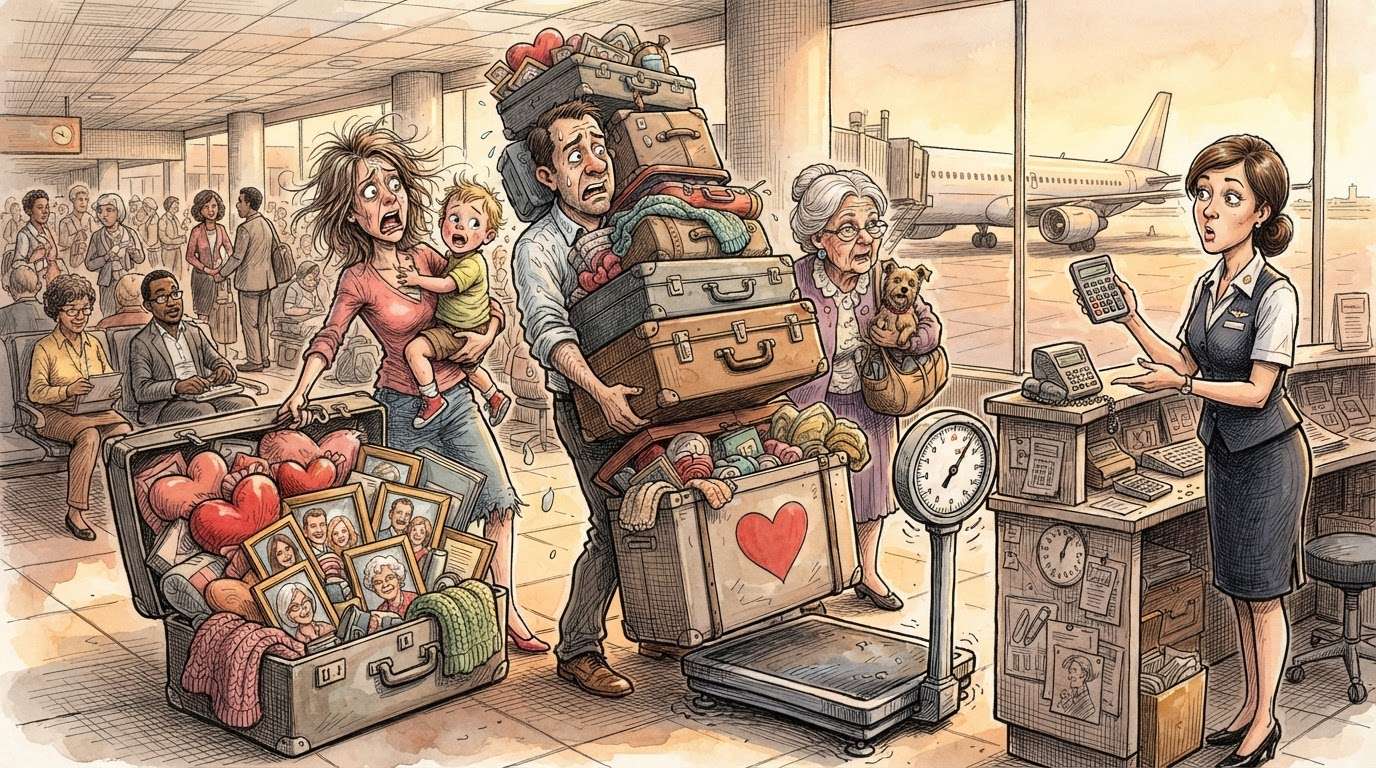
ATLANTA — Delta flight delays eased after the airline restored its weight-and-balance automation, leaving travelers to ask whether the same engineering team could calculate the emotional load of Thanksgiving with their families.
According to Delta’s restored weight-and-balance system, the system returned to operation Sunday after widespread delays. The calculations concern safe aircraft loading. They do not account for a mother greeting her adult son with, “You look tired,” which can add several invisible tons before baggage claim.
Passenger Dale Pritchard arrived carrying one compliant suitcase and a childhood incident involving a borrowed lawn mower. The suitcase weighed less than the limit. The lawn mower dispute had survived three presidents, two replacement mowers, and the death of the lawn.
Delta flight delays reveal an unmeasured load
“I packed light,” Pritchard explained, gesturing toward a duffel containing socks, medication, and the expectation that he would explain his divorce before appetizers. “Then my sister texted that everybody just wants a peaceful weekend. That usually means depositions.”
At the gate, Bohiney’s holiday load assessor, Marsha Counterweight, introduced a supplementary scale. Passengers stand on it while reading their family group chat. The machine measures the difference between their physical mass and the force with which they suddenly want to return home.
The prototype broke when someone received a message beginning, “Since you’re so good with computers.”
Counterweight defines emotional baggage as material a passenger cannot discard because an aunt remembers purchasing it in 1987. Unlike ordinary baggage, it occasionally calls ahead to make sure everyone knows its side.
Manual workarounds include staring into the middle distance

During the disruption, real crews used manual procedures. Holiday travelers adopted a parallel method: calculating by hand how much pie would justify spending four nights in a room decorated around their high-school achievements.
A man from Ohio worked out that the answer was eleven pies. His wife checked the arithmetic and added a rental car.
The airport’s unofficial passenger survey asked six people whether they preferred waiting at the gate or discussing national politics beside a carved bird. Five requested another boarding delay. The sixth asked whether the gate had bourbon. Researchers described the sample as small but unusually forthcoming.
A boarding group for unresolved issues
A proposed emotional-baggage policy would allow one personal grievance beneath the seat. Larger disputes must be checked at the counter, where staff will attach a tag and promise to send them somewhere else.
Nobody expects that policy to work. A disagreement about who paid for the vacation house cannot fit beneath a seat unless the seat belongs to a congressional committee.
Counterweight nevertheless sees progress. A commercial aircraft depends on trained people, reliable procedures, and accurate calculations. A family reunion depends on one exhausted woman remembering which cousins no longer speak. Only one of these systems receives routine maintenance.
By evening, passengers were moving again. Pritchard boarded with his compliant bag, purchased a sandwich, and received a message asking whether he could stop at the store after landing.
His aircraft was cleared for takeoff. His shoulders requested a structural inspection.
Newsroom disclaimer: This story’s comic testimony and departmental research belong to the joke; linked reporting supplies the news premise. Our ceremonial masthead credits an entirely human collaboration between two sentient beings—the world’s oldest tenured professor and a philosophy major turned dairy farmer. Neither accepts responsibility for an overweight family grievance.