

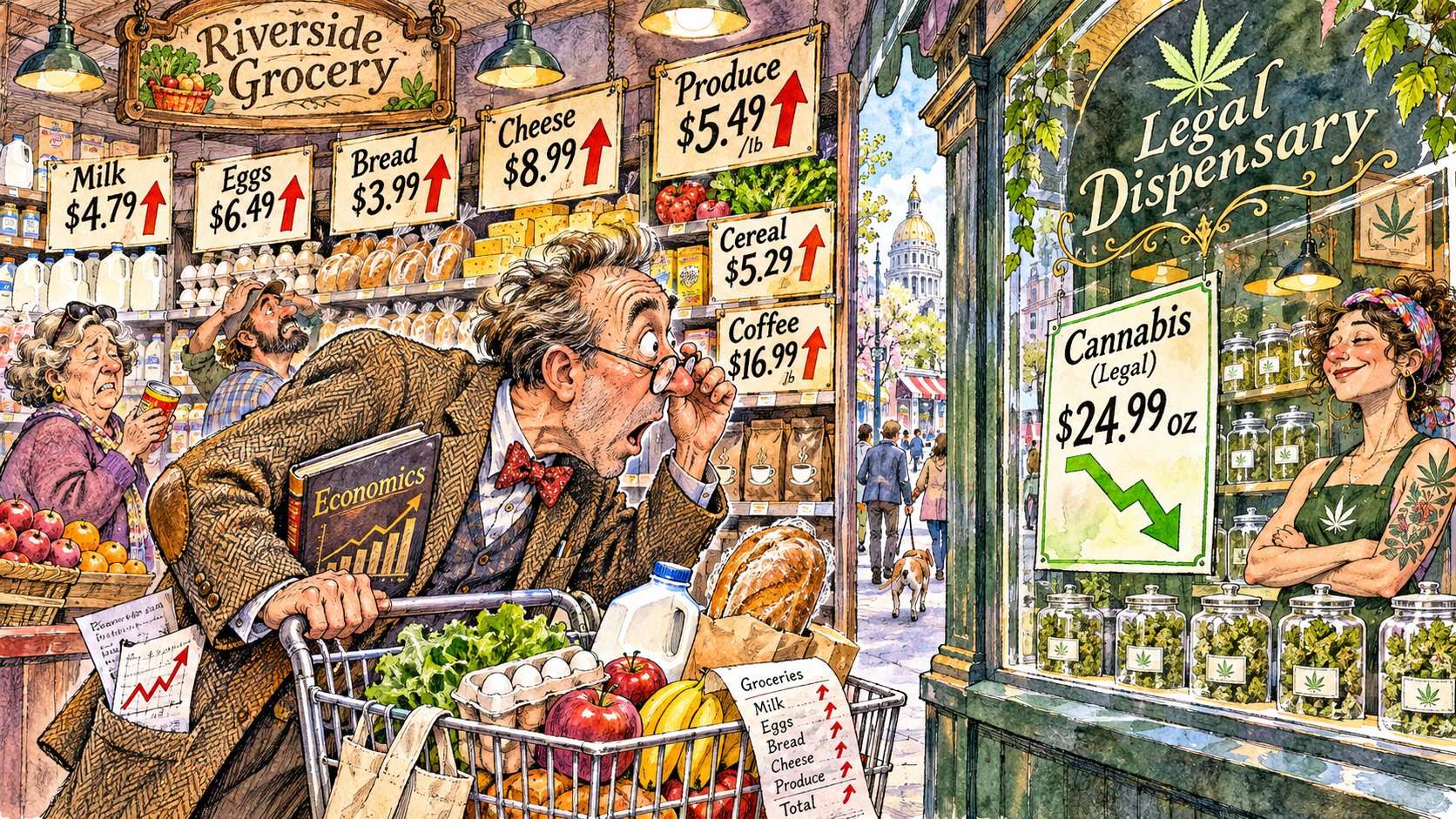
BALTIMORE — Reports of cannabis oversupply have caused a minor disturbance in Bohiney’s consumer-economics department, where analysts encountered a retail price moving downward and initially assumed the label had been installed upside down. The discovery drew a crowd of adults accustomed to discussing affordability as a treasured historical concept.
NPR reports that cannabis oversupply and persistent retail discounting have lowered prices and squeezed operators, even as many other holiday expenses rise. Customers are using some savings for necessities. See NPR reporting on cannabis oversupply and holiday discounts.
‘We had preserved downward arrows in the teaching collection,’ explained Bohiney lecturer Dr Penny Margin. ‘Mostly as examples of what used to happen in competitive markets. It is encouraging to see one operating in the wild, although the shopkeeper appears considerably less delighted than the customer.’
Cannabis oversupply brings the textbook to the counter
When supply outpaces demand, sellers can face pressure to cut prices. Customers may welcome the result while businesses struggle with thinner margins. This is a familiar economic mechanism, but its appearance on a real receipt has impressed people whose recent shopping experience consisted mainly of watching smaller packages acquire larger ambitions.
At Bohiney’s demonstration, Dr Margin placed two arrows on a table. The first pointed up and represented many household costs. The second pointed down and attracted so much attention that security considered putting a rope around it. A visitor asked whether it could be borrowed for the electricity bill.
The customer keeps the discount
The awkward discovery for sellers is that customers can save money without immediately spending it on more of the same product. A person offered a lower bill may simply pay the lower bill. This behaviour is considered intuitive inside households and has caused several unusually long meetings in marketing departments.

Our composite shopper, Robin Receipt, described the decision clearly. ‘If something costs less, the difference can help pay for something else,’ Robin said. A brand consultant called this an emerging multi-category value strategy. Robin called it buying groceries and asked whether the consultant had ever been inside a supermarket without a research badge.
Retailers face the other side of the transaction. Rent, wages and operating costs do not become smaller because a discount banner becomes brighter. Selling more at a lower margin is not automatically a comfortable business. Dr Margin drew a third arrow to explain this, then discovered that the audience had left to look for the first falling price tag.
One cheaper category does not fix the whole basket
A discount in one market does not prove that overall household costs are falling. Prices vary by product and location, and the practical benefit depends on what a person actually buys. The economic point is about supply, competition and budgets, rather than an invitation to add an unnecessary purchase to a shopping list.
Dr Margin has nevertheless arranged a small ceremony honoring the downward arrow. The shopkeeper declined to attend because he was working. Robin declined because groceries still needed buying. This left the lecturer alone with the display, contemplating a fundamental truth of economics: even good news can be distributed very unevenly across the room.
More from Bohiney’s economy desk.
Disclaimer: The world’s oldest tenured professor and a philosophy major turned dairy farmer accept no responsibility for downward price arrows becoming museum exhibits. The comic interviews are the column’s inventions; the news source is linked above.