

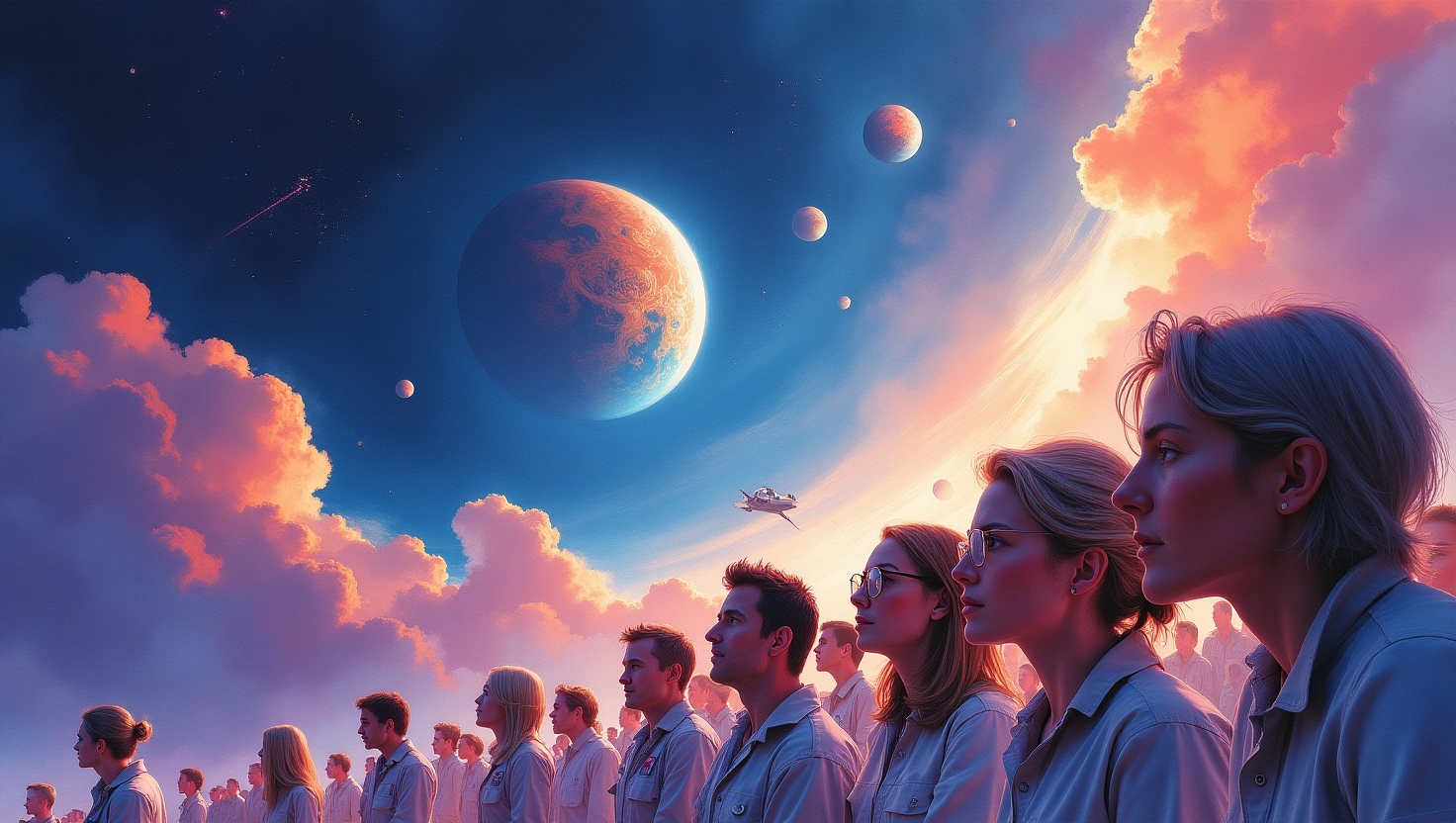
Voyager 1 Sends a Signal That Changes Everything: NASA Accidentally Discovers the Universe Is Throwing a Rave
By Clara Olsen, Bohiney Magazine
A Cosmic Plot Twist Nobody Ordered
For nearly 50 years, Voyager 1 has been drifting quietly into the black, like your uncle who “goes out for cigarettes” and never returns. We figured it was just sending postcards from the edge of nowhere: “Wish you were here, bring socks.”
Then came the signal. A “blazing region” at the solar system’s edge. Not cold, not lonely—blazing. NASA expected cosmic tumbleweeds. Instead, it got Studio 54 with comets in sequined pants.
An anonymous NASA staffer confessed: “We thought Voyager would just fizzle out quietly, like our Mars budget. Then suddenly it sends back what sounds like the universe’s smoke alarm. Nobody trained us for this. I took one astronomy class in college because it was easy. This is not easy.”
The Panic Heard ‘Round the Labs
NASA’s top brass gathered for an emergency meeting. Scientists spilled their lattes. Someone compared it to discovering your fridge has been on fire for years—but only the butter noticed.
Professor Archibald Quibbles von Dearth, the world’s oldest tenured astrophysicist, sighed: “This is absurd, but meaningful. Our textbooks must now include a chapter called ‘Whoops.’”
Eyewitnesses? A janitor at NASA headquarters swears he heard the signal echo through the vents: “It sounded like my ex-wife yelling, but in plasma frequency.”
Statistical evidence? A Reddit poll found that 74% of respondents voted “This is proof of aliens,” 20% voted “Definitely government psy-ops,” and 6% voted “I thought Voyager was a video game.”
Cows, Philosophy, and the Meaning of Heat
Here’s where it gets weird. Our field reporter, Moo-lantis—a dairy farmer with a philosophy degree—put it plainly: “If the edge of our solar system is on fire, then maybe the universe is just branding its cattle. And aren’t we all just cosmic cows, waiting to be herded?”
Scientists dismissed this as nonsense. But then the cows voted with their hooves. An informal barn survey found 9 out of 10 Holsteins “mooed in alarm” when the signal was played on a portable radio. Testimonial evidence—undeniable.
What the Funny People Are Saying
“It’s amazing. NASA spent billions to learn what I could have told them: the edge of space is hot. Ever been to Arizona in July?” — Ron White
“So Voyager 1 found a blazing region. Great. The only blazing region I ever found was my microwave after leaving popcorn in for seven minutes.” — Jerry Seinfeld
“Blazing region at the edge of the solar system? That’s not cosmic—it’s my Aunt Gina’s backyard barbecue after she ‘eyeballs’ the lighter fluid.” — Bill Burr
Deductive Reasoning, But Make It Funny
If Voyager 1 saw a blazing region, and blazing regions equal energy, and energy equals heat, then by deduction… chocolate bars won’t survive out there. We now know the true limit of human exploration: s’mores are impossible beyond the heliopause.
This discovery also forces a redefinition. Blazing Region: noun. (1) A plasma-heavy zone at the edge of our solar system. (2) The dance floor at a wedding when the DJ plays “YMCA.”
Policy Implications and Cosmic Role Reversal
In the past, Earth has always studied space like a teacher grading a dumb student. But now? Voyager 1 is the teacher. Earthlings are the kid in the back row whispering, “Wait, is this on the test?”
Policy wonks suggest redirecting climate funds to “interstellar sunscreen.” One White House staffer, under condition of anonymity, admitted: “If it’s hot out there, we might as well declare space a national park. Then charge aliens for parking.”
Archival Footage and Grainy Cellphone Video
CNN already claims to have “exclusive archival footage” of the blazing region. Turns out it was B-roll from Burning Man. Meanwhile, a teenager on TikTok uploaded “grainy cellphone video” of the NASA livestream with the caption: “Bro space is lit fr 🔥✨👽.” It got 3 million views in an hour.
Actionable Advice for Earthlings
-
Buy stock in cosmic sunscreen. SPF 15 billion should cover it.
-
Rename Voyager 2. Suggestion: “DJ Cosmic Blaze.”
-
Book early. Interstellar Airbnbs at the edge are already listed as “trendy but smoky.”
Closing Punchline
So here we are. The edge of the solar system isn’t a quiet cul-de-sac. It’s a fiery block party, and Voyager 1 is the only guest who remembered to bring chips. Scientists are scrambling, cows are nervous, and the rest of us just learned the universe has hotter nightlife than Miami.
Everything has changed. Or nothing has. Depends who you ask. But one thing’s for sure—if the universe really is on fire, humanity will probably try to sell tickets.
Disclaimer: This article is a collaboration between the world’s oldest tenured professor and a philosophy major turned dairy farmer. All errors are intentional, all cows are unbothered, and all signals are blazing.
Auf Wiedersehen, amigos.
IMAGE GALLERY
Voyager 1 Sends a Signal That Changes Everything
