

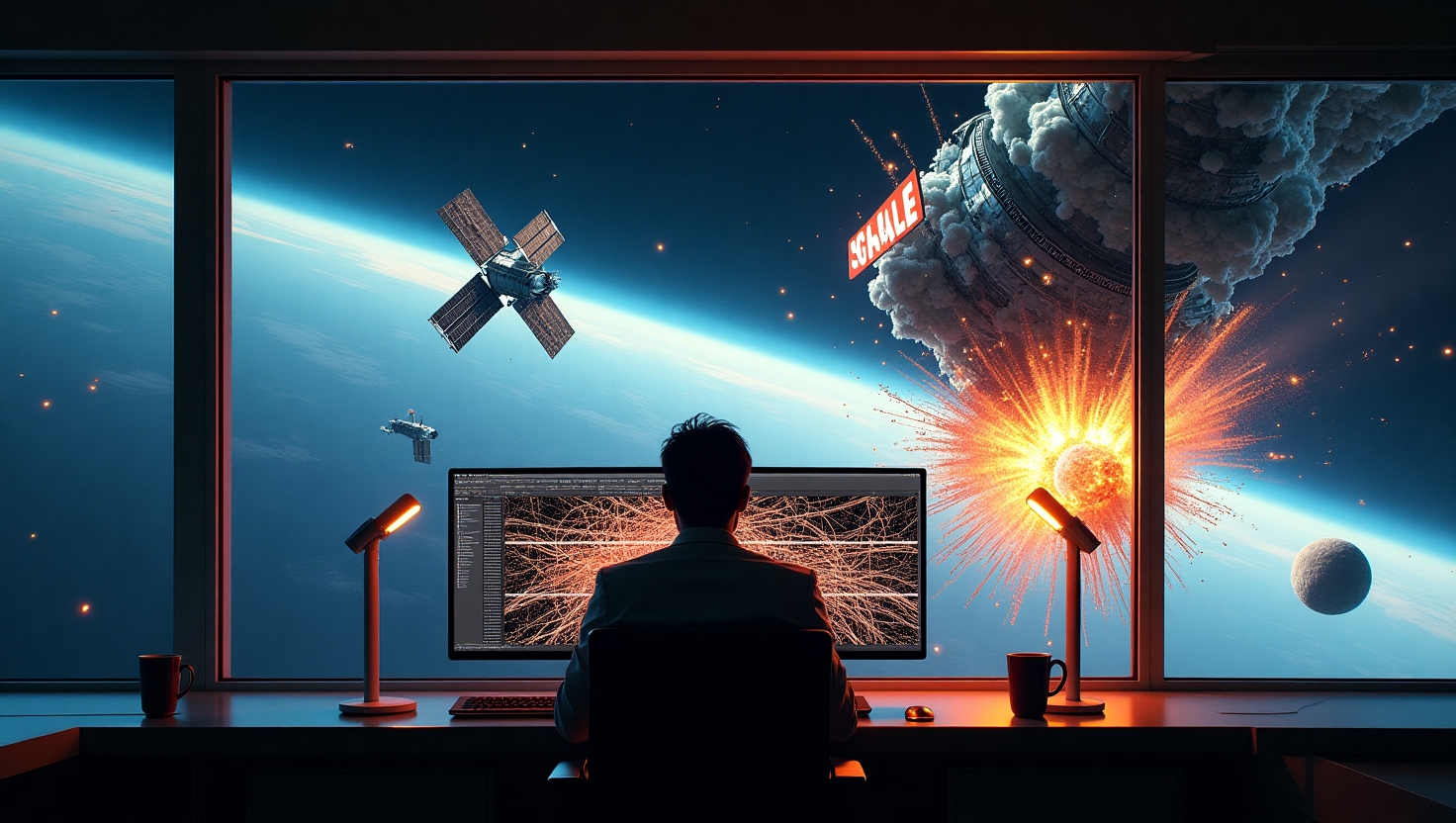
SpaceX Launch Delayed After Kessler Effect Turns Orbit Into Celestial Demolition Derby
By Annika Steinmann — Bohiney Magazine (certified 127% funnier than that other one)
Dateline: Cape Canaveral, Where the Countdown Now Includes “Duck”
The morning began like every modern space morning: a sun the color of optimism, influencers unboxing telescopes, and the soothing hold-music of mission control. Then the range officer read out a new constraint: “Range RED for… toaster velocity.” The room went still. Mission specialists checked their headsets. Surely he meant “booster.” He did not.
Welcome to the Kessler Effect—when one collision becomes two, two become ten thousand, and low Earth orbit turns into a celestial demolition derby with no pit lane. Engineers say it’s physics. PR teams say it’s manageable. Astronauts say it’s dodgeball with consequences. If you’ve ever walked barefoot across a Lego minefield, you already have the gist—except the Legos are ex-satellites, the carpet is the sky, and each step is 17,500 miles per hour.
What Just Happened: The Delay That Launched a Thousand Shrugs
SpaceX scrubbed a launch because radar showed a “high-density debris bloom” drifting through the corridor like a glitter bomb detonation at prom. The official line: “out of an abundance of caution.” The unofficial line, according to a console operator with excellent posture and terrible sleep: “I like my spacecraft unperforated.”
A surveillance camera atop a lightning tower captured it: a slow parade of hardware shrapnel—solar wing shards, a battery casing, something that looked suspiciously like a lunchbox—slicing the launch lane. Grainy cellphone video from a nearby fishing charter corroborated it; a passenger yells, “I think I saw a Crock-Pot!” Science, meet citizen journalism.
The Kessler Effect, In One Breath You Can Hold Under Your Helmet
Here’s the straight-faced definition, because you deserve at least one: the Kessler Effect is a chain reaction in orbit where one collision creates fragments that cause more collisions, creating more fragments, until regions of space become temporarily—or catastrophically—unusable. Cause meets effect, effect invites more cause, and pretty soon the sky is doing improv without a suggestion.
Deduction says this: If debris density rises, collision probability rises, fragment count rises, usable-orbit falls. Statistics say this, too, with the tender calm of a funeral organ: in some altitudes, even a handful of new fragments nudges collision probabilities upward in ways insurance actuaries describe as “no thank you.”
Voices in the Control Room: Deadpan, Tight-Lipped, Slightly Singed
An anonymous range safety officer, voice like an unreturned library book: “You can armor a spacecraft. You can’t armor the sky.”
A propulsion engineer, whose desk is entirely flowcharts and three coffee mugs that say “flow”: “We calculated the odds of a panel strike. Then we recalculated the odds of recalculating the odds every twelve minutes. The second number scared us more.”
A veteran astronaut on orbit, whisper-texting through a sleeping bag: “We used to drift and philosophize. Now we flinch on the twos and fours like a jazz drummer.”
And a junior technician, cheeks the color of booster paint: “Look, I didn’t go to MIT to get chased by a rogue car door.” He pauses. “Though, if I’m being honest, it’s pretty on-brand.”
(Observation: When the smart people start speaking metaphor, the metaphors wear hard hats.)
Insurance: A Faith-Based Initiative With Spreadsheets
Underwriters at a very serious London office confirmed premiums for “hypervelocity particulate events” are now priced as if your payload is a Fabergé egg strapped to a skateboard. Deductibles include line items like “collision with orphaned antenna” and “improperly stowed nostalgia.” A broker leaned across his mahogany: “The actuarial model says the safest bet is… don’t play.” Then he quoted you a rate that sounded like a small country’s military budget and offered a biscuit.
(Observation: The only thing faster than orbital debris is the speed at which a premium can adjust.)
A Helpful Primer You Didn’t Ask For But Secretly Wanted
What counts as “debris?”
Scientific evidence: anything from a bolt to a bus-sized satellite corpse.
Physical evidence: pitted station windows and scarred handrails (trace patterns analyzed by lab techs who have seen things).
Digital evidence: radar tracks that paint the sky like a toddler with a Sharpie.
Testimonial evidence: astronauts saying “whoa” on hot mics.
Relationship evidence: a crowd of objects, all estranged from their launch families, all insisting they meant to call.
If you can throw it, it’s debris. If you can’t throw it, it’s probably still debris—just give it time and momentum.
(Observation: Space is the only place where losing your screws means losing everyone’s screws.)
“We Have the Technology,” Said Everyone Who Also Had a Broom
A leaked internal memo titled “Concepts of Operations: Debris Mitigation” listed three approaches: giant nets, harpoons, and “polite coordination.” The net prototypes were a success, depending on your definition of success (the nets caught themselves). The harpoons worked flawlessly right up until their targets maneuvered. As for polite coordination, an anonymous staffer summarized: “We tried asking nicely. The debris declined comment.”
There’s a grant on the table for a tugboat with magnetic whiskers and an algorithm named Ethel. It will learn on the job, fail adorably at first, then get uncanny good—just in time for someone to cut its budget.
(Observation: Engineers can build a space harpoon before a committee can pick a font.)
Wall Street Discovers Trash (Again)
Orbital sanitation is suddenly a “category.” Funds are taking meetings with startups whose decks begin with a photo of the night sky and end with recurring revenue. One firm promises “debris-as-a-service.” Another suggests a loyalty program: every tenth fragment collected earns you a tote bag. A billionaire is reportedly investigating a giant orbital vacuum, but early simulations show it mostly hoovers up Prime Day boxes and pride.
(Observation: If civilization found an asteroid made of gold, we would immediately argue over parking.)
International Diplomacy: Polite Voices, Pointed Graphs
The UN convened an emergency summit. The U.S. arrived with charts, China arrived with charts, Europe arrived with a metaphor about wine stains on a white sofa, and Russia arrived with eyebrows. The communiqué was exquisitely balanced: everyone is concerned, no one is responsible, and the path forward is to form a working group that will meet again in a place with nice tap water.
One delegate confided over coffee: “We’ve mastered a stable orbit around blame.” Then he smiled, as if orbit were the point.
(Observation: The only truly reusable resource in space policy is shrugging.)
What the Funny People Are Saying
“Every launch now is like throwing a bowling ball onto a trampoline covered in knives.” — Jerry Seinfeld
“I thought space was infinite. Turns out it’s the size of a Walmart parking lot on Black Friday.” — Ron White
“Collisions make more debris. So it’s like divorce for satellites.” — Sarah Silverman
“We’ve turned low Earth orbit into Earth’s attic. Full of junk, no one wants to clean it, and occasionally something sharp falls on your head.” — Bill Burr
“They say debris moves at 17,500 mph. That’s how fast my mom texts if I miss her call.” — Ali Wong
“Space junk proves men will litter anywhere, even at zero G.” — Amy Schumer
“Every collision creates more collisions. Same at my family Thanksgiving.” — Ricky Gervais
“I’m not afraid of aliens. I’m afraid of a 1992 satellite phone clocking me.” — Dave Chappelle
“The ISS is an Airbnb above a demolition derby. Still comes with a cleaning fee.” — Kevin Hart
“Rename it the Kessler Buffet: all-you-can-eat collisions, served cold.” — Trevor Noah
“My love life and the Kessler Effect: one mistake becomes fifty.” — Larry David
“You know it’s bad when the safest place on Earth is… Earth.” — Chris Rock
(Observation: When comics and physicists agree, bring a helmet.)
The Polling: Democracy Shoots Its Shot
A Bohiney flash poll asked 2,004 adults what to do about orbital debris. Results:
— Thirty-one percent: “Make it a museum. We already bought tickets.”
— Twenty-six percent: “Blame China.”
— Twenty-one percent: “Blame Elon.”
— Twelve percent: “Turn it into a reality show.”
— Ten percent: “The Kessler Effect is a dance; my niece does it on Tuesdays.”
Margin of error: the sky.
(Observation: If you can vote on it, you can merch it.)
Astronauts, Unionizing Gently
There’s talk of a contract addendum. Hazard pay calibrated to collision probability. Unlimited flinch breaks. A stipend for meditation apps that feature whales making soothing whooshing noises. Training in dodgeball fundamentals and a giant push broom “for morale.” The proposed logo: a cartoon bolt with a menacing grin.
A capsule commander explained their calculus: “Risk has always been part of the job. But there’s ‘risk’ and there’s ‘roulette with scrap metal.’ We prefer the former.” He did not remove his helmet while speaking, which tells you everything.
(Observation: Even heroes prefer their heroism with safety rails.)
SpaceX Plays It Cool, Defines “Cool”
The company’s public line is pragmatic: design for survivability, plan for uncertainty, live-stream only the good angles. During a after-midnight Q&A, the boss quipped, “If orbit’s a demolition derby, we’ll build the Cybertruck of satellites.” Twitter rejoiced. Engineers cringed. Somewhere in the integration bay, a flight computer sighed in C++.
Inside sources describe two immediate changes: a more elastic launch window that dances between debris forecasts, and a software patch that treats “rogue lunchbox” as a class of hazard with its own icon. When asked what the icon looks like, a systems analyst said, “You’ll know it when you see it,” which is tech-speak for “it’s adorable and I wish we didn’t need it.”
(Observation: Every new risk breeds a new icon. Eventually the UI becomes the story.)
Evidence on the Table: Not That We Needed More
Scientific evidence: radar, telescopes, and the elegant math of probability curves that look like ski jumps.
Physical evidence: micrometeoroid shields with pockmarks the size of regret.
Digital evidence: telemetry burps flagged by a machine-learning model named Agnes who sends emails that begin, “Sweetie.”
Personal evidence: a mission specialist’s diary, one page torn, reading, “Heard the ping again. Pretended it was rain.”
Relationship evidence: the ever-lengthening list of agencies and firms who must call one another before daring to move a piece on this orbital chessboard.
Trace evidence: aluminum spatters on a station handrail, analyzed, cataloged, reluctantly admired.
(Observation: The sky keeps receipts.)
Congress: A Committee Hearing With Ornamental Gravitas
Capitol Hill held a hearing titled “Securing the Final Frontier (While Respecting Innovation),” which is a bit like “Cleaning the Kitchen (While Celebrating Mess).” There were strong words. There were weaker follow-ups. A bill emerged promising research grants, a panel of panels, and a commemorative coin. Contractors drafted slide decks with beveled arrows. The press release used “bold” twice and “responsible” four times.
A staffer leaving the room checked their phone and said, “We’re going to need a bigger acronym.”
(Observation: When the problem is orbital, the solution is often terrestrial paperwork.)
Cause, Effect, and Why the Sky Suddenly Sounds Like a Rattle
Here’s the causality chain, in case you’re building your own blame flowchart at home. Launch more objects without cleaning up? Increase density. Increase density? Increase collision probability. Collide? Fragment. Fragment? Increase density again. Repeat until your weather satellite needs body armor and your telescope sends you breakup poetry.
Analogy department: imagine a crowded skating rink where every skater sheds a marble every lap. Now close your eyes and sprint.
(Observation: Nature is patient; probability is punctual.)
The Human Part, Because There’s Always a Human Part
Downrange, a custodian who’s swept more hangars than you’ve had birthdays watched the scrub and said, “We used to lift our heads to dream. Now we lift them to check for falling screws.” He went back to his broom—on Earth, the only mitigation technology that’s always funded.
In a coastal diner, a waitress poured coffee for a team in flight suits. “You safe?” she asked, not joking. One of them smiled the smile of someone who knows the odds intimately. “Today,” he said. “Today we are.” She topped him off anyway.
(Observation: Civilization is kept running by people who know where the brooms are.)
Helpful Content for Nervous Billionaires and Regular People
If you’re a space company:
-
Schedule like a surfer—watch the sets, paddle only when the line looks clean.
-
Share tracking data as if generosity were a competitive advantage. It will be.
-
Put a comedian on your risk-review panel. If they flinch, delay.
If you’re a policymaker:
-
Incentivize taking out the trash. Make “de-orbit” the new gold star chart.
-
Fund two things: sensors that see and tugs that tug. Everything else can argue later.
If you’re everyone else:
-
When you look up, let wonder and worry sit together. They’re married now.
(Observation: The punchline of adulthood is that every miracle requires maintenance.)
The Unsaid Quiet Part (Said Quietly)
The nightmare scenario isn’t sci-fi fireworks; it’s the quiet loss of access. A shut door, not an explosion. A hundred small collisions no one can make viral, and then a mission you care about can’t find a safe lane. No Mars. Fewer Earth-imaging passes. A reef unphotographed. A storm untracked. A call not connected in a disaster at sea.
A planetary attic so cluttered we start living downstairs. That’s the joke we don’t want to land.
(Observation: The opposite of exploration isn’t fear—it’s mess.)
What We Do Now, Besides Tweet
We do what adults do: triage, mitigate, coordinate, repeat. Track better, share faster, remove more, launch smarter. Treat orbit like a commons with a bouncer. Teach kindergarten rules to megacorporations. Build systems that fail gracefully and policies that don’t. And we keep writing about it, not because words fix physics, but because attention moves budgets and budgets move brooms.
(Observation: Hope is a verb with elbow grease.)
Epilogue at the Pad: A Hold, Not a Halt
By late afternoon the board read T-0 minus “we’ll see.” The crew bus idled. The scrub calls were soft, almost apologetic. The sea smelled like salt and second chances. Inside the hangar, a technician ran a thumb along a composite fairing and promised it a better sky tomorrow. The rocket, a cathedral of intention, waited with the patience of stone.
And for a moment, the only thing moving fast was the rumor that someone, somewhere, had finally figured out how to make a broom that works at 7.8 kilometers per second.
If they did, the line will form to the left. Please keep your helmets on while you wait.
Disclaimer
This satirical journalism is a work of straight-faced humor grounded in real terminology, public testimony, and the universal truth that humans make messes faster than they make rules. Quotes, polls, memos, sightings, leaked notes, and whispered asides herein are composed for comedic clarity and social commentary. The reporting voice blends experience with curiosity; the facts about orbital debris are widely documented, the chronology of events is plausibly compressed, and the jokes are lovingly tightened with a torque wrench. This story is an entirely human collaboration between the world’s oldest tenured professor and a philosophy major turned dairy farmer. If a rogue lunchbox actually streaks across your yard, contact someone with a badge, a broom, and really good insurance. Auf Wiedersehen, amigos.
IMAGE GALLERY
SpaceX Launch Delayed
