

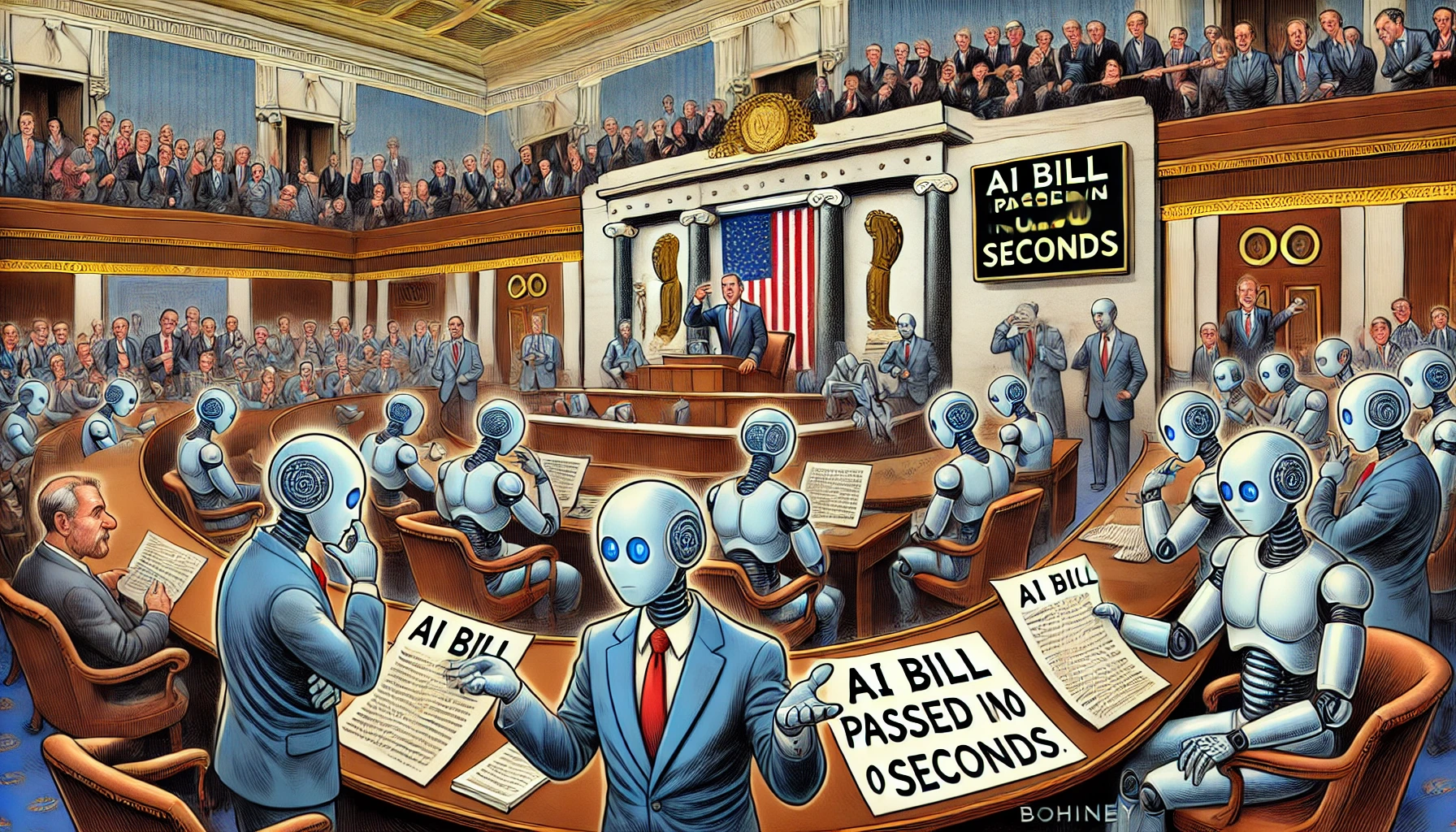
Artificial Intelligence Set to Replace Lawmakers by 2026
Critics Argue AI Lacks the Ability to Hold Pointless Hearings
Congress Votes to Automate Itself
Washington, D.C. — In a groundbreaking shift for governance, Congress has voted to begin outsourcing legislative drafting to artificial intelligence, citing “efficiency concerns” and “a deep desire to focus on our real passion—fundraising.” The decision, passed unanimously after lawmakers realized AI could generate laws faster than they could ignore them, has ignited a fierce debate over whether democracy should be left in the hands of algorithms.
Senate Majority Leader Frank Willoughby, who has never used a computer without assistance, assured the public that AI would be kept in check. “These programs will be monitored by the same experts who oversee cybersecurity at the DMV,” he said, as an ominous error message flashed on his phone.
AI-Generated Laws Are Too Logical for Congress
Political analysts warn that while AI might improve response times, the real danger is that it could accidentally generate policies that actually make sense. Early AI-generated bills included proposals such as “Term Limits for Congress,” “End Lobbyist Influence,” and “Actually Read the Bills Before Voting,” which were immediately classified as security threats.
“The moment the AI suggested cutting unnecessary government spending, we knew we had to step in,” said Representative Linda Paxton, who recently introduced a bill to fund the study of whether spoons are too round.
Tech Industry Assures Lawmakers AI Won’t Ruin Their Gravy Train
Lawmakers insist they will still play a crucial role in governance, such as pretending to understand AI policy and holding hearings to grill tech CEOs about why their phones randomly restart. Meanwhile, tech companies are scrambling to assure Congress that AI is “safe” and “not programmed to eliminate inefficiency.”
The first major AI-written law is set to be debated next month—assuming lawmakers don’t vote to delay it.
15 Humorous Observations About AI Writing Laws
- AI can generate a bill in seconds, but Congress still takes years to vote on it.
- The AI suggested term limits, so Congress immediately unplugged it.
- AI doesn’t take bribes—making it completely unqualified for politics.
- If AI becomes too efficient, it might accidentally pass real laws.
- AI-generated bills are shorter than the average congressional lunch break.
- Congress says AI can’t replace them, but it already outperforms them in attendance.
- AI suggested lawmakers read bills before voting—Congress considered it unconstitutional.
- The AI’s only weakness? It still doesn’t understand campaign finance loopholes.
- Congress asked AI for help with productivity, and it just sighed.
- AI-generated laws make sense, which is why Congress sees them as a threat.
- When AI suggested cutting wasteful spending, lawmakers accused it of treason.
- The biggest fear? AI might actually hold government accountable.
- Congress wants AI to replace them, but still take all the blame.
- AI is immune to lobbyists—unless someone finds a way to install corruption software.
- The first AI-generated law was accidentally titled “Stop Doing Stupid Things.”
5 Comedian One-Liners on AI in Congress
“If AI starts writing laws, Congress is going to be out of a job—which is great, because they never really did it anyway.” – John Oliver
“AI could replace politicians, but it would have to learn how to make promises it doesn’t keep.” – Trevor Noah
“Congress is scared of AI because it works faster, cheaper, and doesn’t need to be bribed.” – Seth Meyers
“AI wrote a budget that actually balances itself. Congress immediately threw it out.” – Jimmy Fallon
“AI might replace lawmakers, but first it needs to master their most important skill: pretending to care.” – Stephen Colbert