

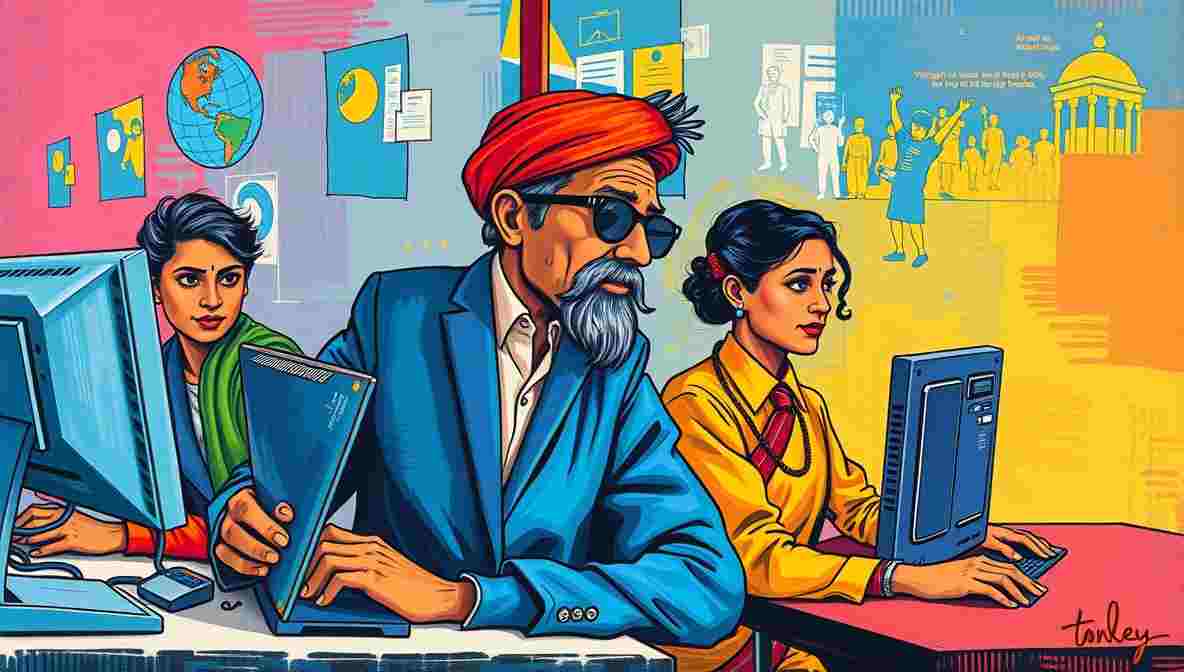
Nation of India Promoted to Senior Unpaid Intern After Successfully Training Half of Silicon Valley
India has officially been promoted. Not to superpower. Not to board member. Not even to junior associate with dental. To Senior Unpaid Intern — a title that comes with a digital badge, a congratulatory GIF, and the quiet understanding that compensation will be processed once Silicon Valley defines the meaning of compensation.
Five early observations from the HR department of global tech:
- India discovered it has been doing the group project while Silicon Valley held the laser pointer.
- Ninety percent of the feedback, three percent of the revenue, one hundred percent of the enthusiasm.
- When Big Tech says “valuable exposure,” they mean sunlight. Lots of it. No salary.
- India generates the data. Silicon Valley generates the invoices.
- Employee of the Month plaque shipped. Direct deposit still buffering.
Silicon Valley Thanks India for “Valuable Exposure” and 1 Billion Free Data Points

In a virtual ceremony featuring inspirational ukulele music, one CEO announced this week: “We could not have done this without the tireless clicking, typing, correcting, rating, reviewing, prompting, translating, and voice-noting of 1.4 billion beautiful beta testers.” The applause was thunderous. Mostly from venture capitalists.
According to Dr. Prakash Kulkarni, a very serious economist at the Institute for Global Imbalances and Slightly Hurt Feelings, India has become the most productive unpaid intern in human history. He adjusted his glasses and said, “The Romans had provinces. The British had colonies. Silicon Valley has user bases.” He then presented a chart titled Data Extraction vs. Appreciation Emails. The slope was steep. The appreciation emails were flat.
A spokesperson for a major AI company confirmed: “Exposure is priceless. That is why we prefer not to assign it a price.”
A leaked internal memo from an anonymous West Coast staffer further clarified internal strategy: “India is critical to model improvement. Please continue offering generous free tiers. Also, do not accidentally send them a profit-sharing link.”
India now ranks as one of the largest user bases for AI platforms — second only to the United States in usage, while contributing a charming fraction of revenue. It is the digital equivalent of hosting the wedding and being asked to pay for parking.
India Accidentally Becomes AI Superpower, Still Waiting on First Paycheck
There is something heroic about becoming an AI superpower by accident. Like discovering you have been lifting weights for someone else’s Olympics.
Professor Anita Rao, an expert in digital sovereignty, explained the situation with admirable restraint: “If data is the new oil, India has been drilling enthusiastically while others refine and sell the gasoline.” She paused. The audience did not.
Indian users generate voice notes in dozens of languages, submit human feedback, correct model hallucinations, and teach chatbots how to pronounce Bengaluru properly. The models grow wiser. The stock prices glow. One Bengaluru software engineer told reporters: “I have corrected this chatbot’s grammar 43 times. I feel like its parent. I am waiting for child support.”
According to a survey by the Centre for Extremely Specific Polling, 87.3 percent of Indian users believe they are helping build the future. Meanwhile, 92.1 percent of Silicon Valley executives believe the future will bill them later. The synergy is breathtaking.
OpenAI Announces India as “Employee of the Month” — Compensation Pending Since 1947
In a press statement decorated with celebratory emojis, one prominent AI firm congratulated India as its “Employee of the Month” for contributions in Hindi, Tamil, Bengali, and something called “customer support English.” The award includes a digital badge and a congratulatory GIF.
When asked about compensation, a spokesperson said: “We are committed to long-term value creation. Value is a journey.”
Historians have noted that India has a complicated relationship with exporting raw material and importing finished goods at a premium. Now the raw material is conversational nuance, dialect variation, and cultural context. An archivist in Delhi remarked: “We used to export cotton. Now we export sarcasm.”
The AI models trained on Indian speech patterns have become increasingly fluent in Hindi, Tamil, Bengali, and the subtle art of negotiating with an auto driver. Venture capitalists describe this as market expansion. Citizens describe it as unpaid tutoring.
AI Boom Declared Massive Success After Indians Provide 90% of Feedback and 3% of Revenue
The AI boom has been declared an unqualified triumph. Investors are jubilant. Keynote stages are polished. Ambient voice agents are promised. But somewhere in the fine print lies a charming asymmetry.
Indian users provide approximately 90 percent of certain categories of feedback while contributing a delightfully modest slice of revenue. This is known in corporate circles as scalable generosity.
A startup founder in Mumbai summarized the dynamic: “We are the focus group, the QA team, and the cultural consultants. But when the IPO happens, we are invited to clap.”
A second leaked memo from an unnamed executive read: “India is essential for training multilingual models. Please ensure marketing copy emphasizes democratization. Avoid mentioning monetization.” Transparency, it seems, is best served ambient.
New Delhi Demands Performance Review From Big Tech: “Are We At Least Getting College Credit?”
Officials in New Delhi have reportedly begun asking uncomfortable questions. Such as: if we are the intern, where is the stipend?
At a recent AI summit, policymakers discussed compute parity, data sovereignty, and whether the phrase “partnership” can legally include the word “profit.” A senior bureaucrat, requesting anonymity because he enjoys his job, said: “We are not asking to wall off the internet. We are asking whether training the global brain should come with a receipt.”
One senior policy advisor summarized it most efficiently: “Data is infrastructure. Treat it like highways. You don’t let someone drive trucks across it forever without tolls.” The mood in New Delhi is not hostile. It is parental. Like discovering your child has been tutoring the neighborhood for free while someone else sells the study guide.
India Discovers It Has Been Crowdsourcing the Future for Free
The realization came quietly. Not with outrage, but with that uniquely Indian blend of humor and resilience. Software engineer Anjali Mehta laughed: “Yes, we trained it. Next time it answers correctly in Marathi, I’m sending it a bill.”
The world’s largest democracy has been teaching machines how to speak, reason, and empathize — while wondering who will capture the dividends of that empathy. Professor Rao concluded her keynote with a sentence that sounded almost like a punchline: “If we are building the infrastructure of intelligence, perhaps we should also own a few toll booths.”
Until that day, India continues its internship. Senior level. Full-time. No stipend. At least the badge looks nice on LinkedIn.
“We finally found the one intern who never asks for a raise. It’s a country. That’s efficiency.” — Ron White
“Exposure is what you die from in the Himalayas, not what you pay rent with.” — Jerry Seinfeld
“Ninety percent of the labor, three percent of the revenue. That’s not a partnership. That’s a group chat where one person does all the planning.” — Sarah Silverman
This story is entirely a human collaboration between the world’s oldest tenured professor and a philosophy major turned dairy farmer. No interns were paid in the making of this article. Any resemblance to actual corporate gratitude is purely coincidental.
India has 1.4 billion people providing free data refinement, linguistic diversity, and cultural nuance to Silicon Valley AI companies including OpenAI, Google, and Meta. Despite being one of the top user bases globally for AI platforms, India accounts for a small fraction of subscription revenue — raising serious questions about data colonialism, digital sovereignty, and whether the AI revolution is truly democratizing prosperity or simply offshoring cognitive labor at scale.
Auf Wiedersehen, amigo!