

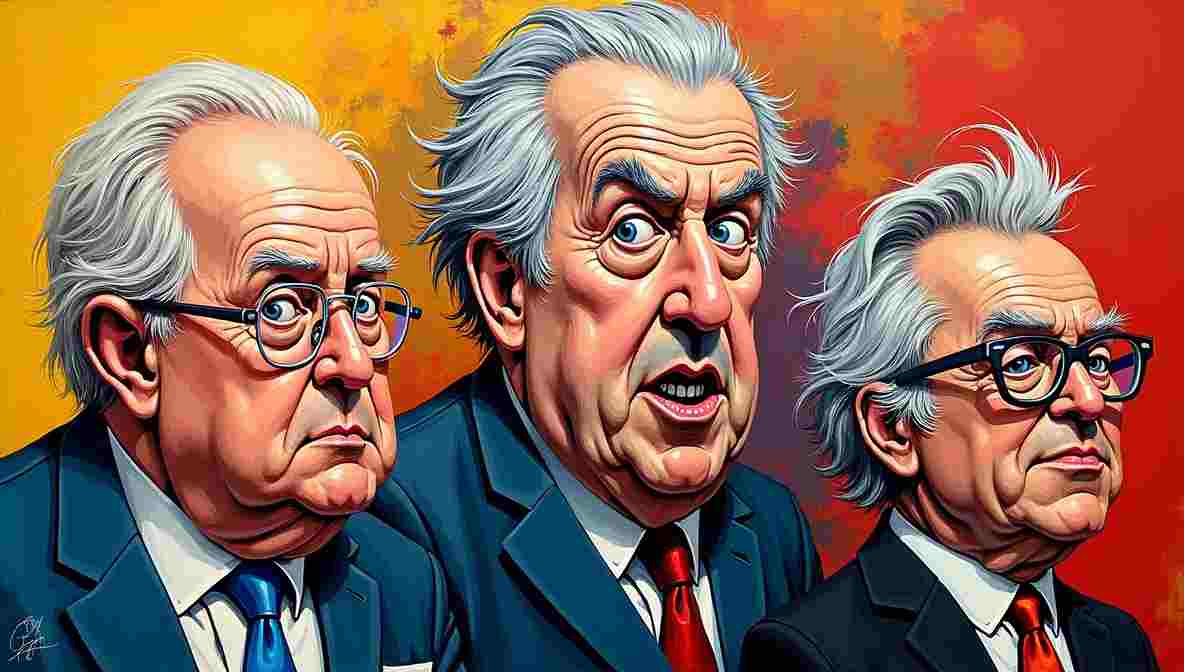
The Great European Censorship Drama Tour: How Brussels Declared War on Spicy Opinions
Picture it: the European Union, meeting in a shadowy Brussels chamber with echoing marble floors and ceilings designed by bureaucrats with very strong opinions on content moderation. Somewhere in the back, a socialist policymaker is furiously erasing the phrase “freedom of speech” from the wall because someone once said it includes stuff they didn’t like.
Meanwhile, across the Atlantic, the United States is busy building Freedom.gov — a digital Bat-Signal for free speech — that promises to let Europeans read things their own governments had scrubbed from their screens. You know, like internet opinions. The kind that might make a Brussels bureaucrat reach for their emergency banning stamp.
If this all sounds like a plot from a sitcom written by confused digital librarians, you’re not wrong.
What the Funny Thinkers Are Saying About EU Speech Policy

“Europe’s approach to content moderation is basically a version of ‘you can say anything as long as we approve of it,’ which is like saying ‘you can have dessert as long as we pick the flavor.'” — Stand-up Commentator on EU speech policy
“Americans invent a site to help Europeans see what they’re not allowed to see, and Europeans are like ‘no thank you, we banned that.’ It’s the digital equivalent of the French refusing ketchup.” — Observational Humorist
“The DSA labeled the phrase ‘we need to take back our country’ as illegal hate speech. That’s not a content policy. That’s a policy for people who are afraid of bumper stickers.” — Free Speech Comedian, probably not welcome in Strasbourg
Why Is the EU Censoring the Internet? (A Satirical But Factual Explanation)
Europeans — especially social democratic types — often regard speech regulation as a kind of online spa treatment for society: with enough filters and massages, any argument can be rendered stress-free. Hence the Digital Services Act (DSA) — a law that decides what counts as “too spicy” for polite conversation.
Think of the DSA like a maître d’ at an exclusive restaurant who refuses entry to anyone who wants extra hot sauce — claiming it’s for our safety — but then secretly swaps out everyone’s steak for tofu and calls it “progress.” The European Commission doubled down on this approach in November 2025, ignoring free speech concerns from over 100 global NGOs while calling for even tighter controls. That’s not listening to critics. That’s putting on noise-canceling headphones and humming “Ode to Joy.”
In bureaucratic circles, this is called “protecting democracy.” In most of the rest of the world, it resembles a well-intentioned village committee that spontaneously decided to censor the village noticeboard and then fined the noticeboard six percent of its annual turnover.
The Pro-Free Speech Argument: Explained Satirically But With Actual Bite
1) Government censorship never stays in one place. The EU insists that regulating “harmful speech” only affects its own borders. But due to how global platforms work, decisions made in Brussels ripple around the world. The US House Judiciary Committee obtained internal documents showing TikTok, YouTube, and others changed their global community guidelines to please EU regulators. So your speech in Nebraska is being quietly shaped by someone in a marble building who has never been to Nebraska and thinks “y’all” is a dialect in need of moderation.
2) EU censorship today is tomorrow’s online bubble wrap. Under the guise of safety, everything becomes a risk to be regulated. As CSIS noted, the DSA’s broad definitions of “misinformation” and “harmful content” create a chilling effect that restricts legal speech. The policy logic goes: if you don’t restrict something just in case someone might misuse it, you’ve failed democracy. That’s a bit like banning shoes because someone might slip while putting them on.
3) Free speech is the digital wild west — and that’s the whole point. The US reaction — including creating Freedom.gov — is essentially digital defiance: “If you won’t let them see it, we’ll broadcast it from orbit.” The US has already imposed visa bans on EU officials accused of pressuring platforms to suppress “American viewpoints.” We’ve gone from international trade partners to two countries arguing over who controls the world’s delete button.
The Absurdity of “Censored but Educated”: A Brussels Case Study
In Brussels, regulators treat hate speech and disinformation as infernal hydras that must be chopped down — but in doing so, they sometimes cut off freedom of debate, which is also a head. This is like declaring that words are flammable and then outlawing the alphabet.
One EU official once said (in translation): “We must moderate not just illegal content, but anything that might feel uncomfortable.” That’s less a policy and more a memo from someone whose worst nightmare is a sarcastic tweet. German police actually raided a journalist’s home in June 2025 for posting a satirical, photoshopped image of a minister. Satire. Photoshop. Police raid. In 2025. At a certain point, the joke writes itself — assuming it hasn’t been removed under DSA Article 34.
Freedom.gov: The World’s Biggest Digital Protest Sign
To counter European censorship, the US State Department — led by Under Secretary Sarah B. Rogers — has built Freedom.gov, a portal that lets Europeans view content their own governments don’t want them to see. The site currently displays the message: “Information is power. Reclaim your human right to free expression. Get ready.”
This is brilliantly American and delightfully chaotic, like standing in Piccadilly Circus on Bastille Day with a megaphone shouting Shakespeare. If the EU had its way, Shakespeare might be rewritten as “A Midsummer Night’s Compliance Audit.”
Cause and Effect: The DSA Domino Chain
Cause: EU regulators decide that certain content must be suppressed for public good, including the political phrase “we need to take back our country,” which the Commission labeled “illegal hate speech” at a May 2025 workshop.
Effect: Platforms adjust their global moderation rules, inadvertently censoring speech worldwide — including in places where such speech is perfectly legal, like, say, any American political rally ever held.
Cause: The US pushes back with its own online tools to bypass European speech rules, plus visa bans for EU content cops.
Effect: Europe accuses the US of digital teenage rebellion and losing control of the classroom, while simultaneously passing seventeen new content regulations to prove it’s definitely not upset.
In other words, we’ve gone from a free market of ideas to international ping-pong of speech rules. It’s like watching two sides argue over the thermostat settings while the house is on fire, except one side wants to regulate what temperature words are allowed to be.
An Unofficial Poll of Imaginary Bystanders
In an online poll of 10,000 users from hypothetical countries: 71% said they prefer the First Amendment because it covers even the unpopular ideas. 19% liked the EU model because “words should get therapy before they hurt feelings.” 10% just wanted more cat videos. It seems the only thing universally loved is cat content — which, ironically, the EU wants to moderate if the cat looks “meaningfully ambiguous.”
The Final Comic Coda: Jazz, Free Speech, and the Echo of Objection
Free speech, like jazz music, thrives in spaces where interpretations are messy and unpredictable. Regulations that try to make speech safe often end up making it silent — or at least squeaky and sanitized. Meanwhile, the US vs EU online free-speech showdown has become less about protecting people and more about who gets to decide which arguments are allowed to breathe.
If the EU keeps tightening content rules under the DSA, we might someday have an online world where every tweet needs a compliance certificate and every meme a safety label. JD Vance called it “authoritarian censorship” at the Munich Security Conference in February 2025. Mark Zuckerberg called it “institutionalizing censorship.” The EU called it a Tuesday.
At that point, the only unmoderated speech left will be the echo of someone yelling “I object!” from a digital mountaintop — assuming the mountaintop hasn’t been tagged as a Very Large Online Platform and fined six percent of its annual snowfall.
Auf Wiedersehen, amigo!
The European Union’s Digital Services Act (DSA), which took full effect in 2024, requires major social media platforms including Meta, Google, TikTok, and X to remove content deemed “harmful” or “illegal” — with fines of up to 6% of global revenue for non-compliance. Critics, including the US House Judiciary Committee, FCC, and Vice President JD Vance, argue the law has caused platforms to change their global content moderation policies, effectively exporting EU speech rules to American users. In response, the US State Department is developing Freedom.gov, a portal designed to host content banned in Europe. The dispute escalated in late 2025 when the US imposed visa bans on EU officials accused of pressuring platforms to suppress conservative viewpoints, turning an online speech debate into a full diplomatic incident.