

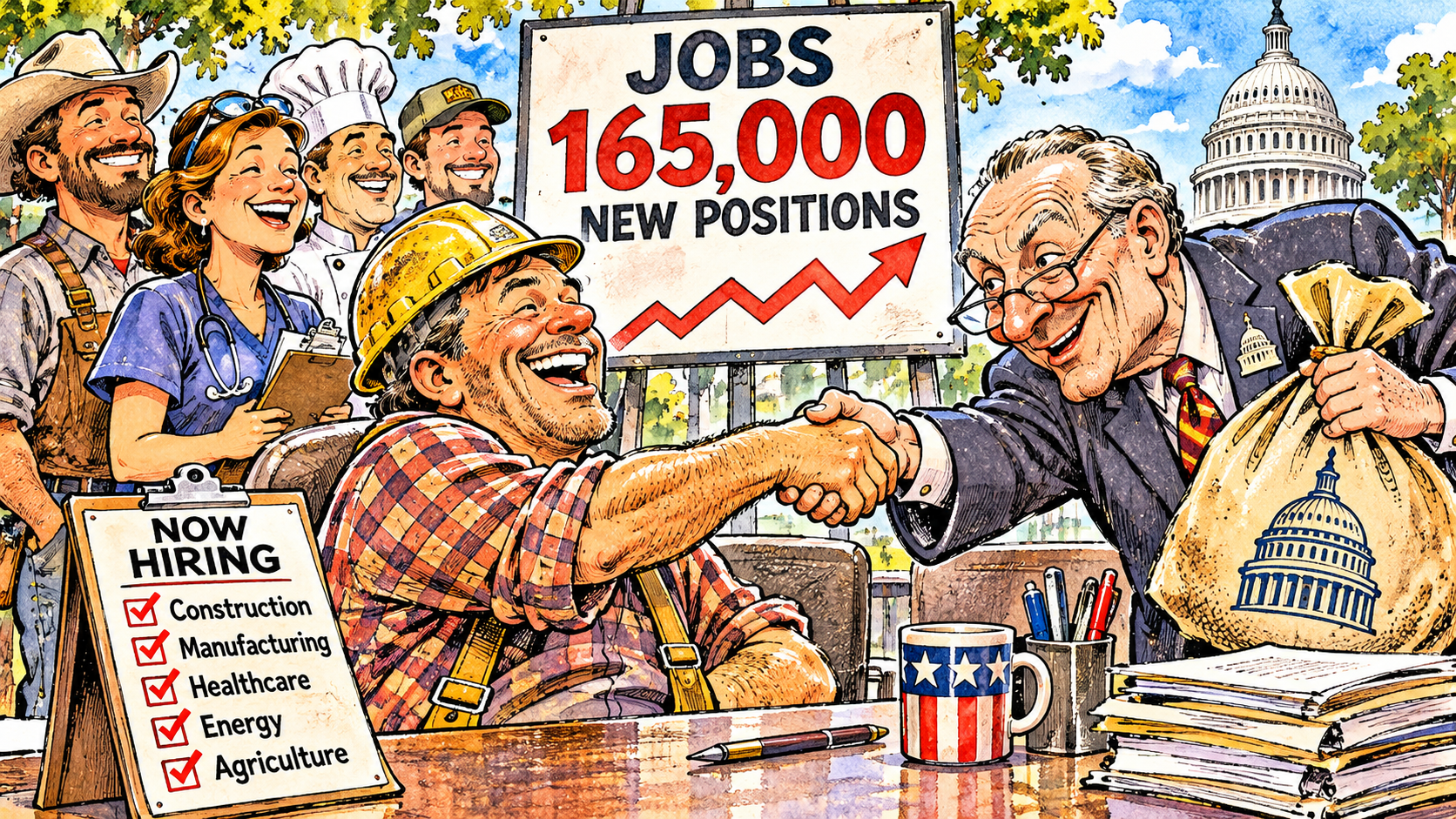
Everyone claims credit for hiring, nobody offers to take less
WASHINGTON, D.C. – America’s economy added 165,000 jobs last month, prompting progressive politicians to congratulate themselves for employment created largely by businesses they routinely accuse of exploiting workers.
According to the Bureau of Labor Statistics, unemployment remained near 4.1%, and average hourly earnings increased 3.1% over the previous year. Fox Business noted that economists had expected only 65,000 new jobs, so the economy beat the forecast by 100,000, a margin that generally earns a bonus unless the forecasters work for the government. Indeed’s Hiring Lab found some tarnish beneath the headline shine, which is its way of saying the news is good but the paychecks are still shopping for a lawyer.
Unfortunately, inflation continued eroding purchasing power. Traders put the odds of a Federal Reserve rate hike at its next meeting at better than three in four, which suggests the central bank also read the report and did not hold a party.
Washington responded by explaining that Americans should appreciate having jobs, even when their paychecks increasingly resemble introductory offers.
Jobs Report: Socialists Discover Workers Are Useful Until Payday
“Employment is wonderful,” declared economic adviser Cynthia Collectmore.
“But we must ensure workers contribute their fair share.”
Asked what a fair share meant, Collectmore proposed income taxes, payroll taxes, additional investment taxes and a new National Workplace Contribution Assessment.
A factory employee asked how much of his earnings he could keep.
“Whatever remains after funding society’s priorities.”
“And who decides those priorities?”
“Government.”
The employee asked whether the government could prioritize leaving him alone.
Collectmore described this as a dangerous misunderstanding of democracy.
The employee’s most recent pay stub, a copy of which he shared with this newspaper, shows gross pay of $1,486.00 and net pay of $1,141.38. The difference is itemized across seven lines, the last of which is labeled “Other.” He has stopped asking what “Other” is and started thinking of it as a coworker.
Private Businesses Create Jobs, Government Creates Announcements
Last month’s employment gains included strong hiring in professional services, healthcare and transportation. Private payrolls grew by 159,000, according to the same report, while the government added 6,000, or about as many as the Department of Education’s hallway committees.
Business owners welcomed the numbers.
Politicians immediately began explaining how their respective policies had created the jobs.
A Texas contractor challenged both parties.
“I hired three people because customers needed work done and I expected to make enough money to pay them.”
He said no federal official had appeared with a toolbox.
“No congressman laid the concrete. Nobody from Washington installed the windows. But they’ll all send newsletters taking credit.”
A government economist responded that public policy creates the environment for private investment.
The contractor agreed.
“Sometimes they create so much environment I can’t get a building permit.”
Employers who want to see what the numbers actually say can read the Bureau of Labor Statistics’ full employment situation release, which contains no newsletters and no claims of credit.
Workers Discover Inflation Doesn’t Care About Political Parties
Wages rising 3.1% sound encouraging until households remember that prices have risen faster.
A supermarket worker described receiving a raise.
“First, the government took some. Then my landlord took more. Then the insurance company found out I was still breathing.”
His wife suggested asking for another raise.
He explained that his employer was struggling with rising costs too.
A progressive organizer recommended increasing the minimum wage to $35 an hour.
The store owner asked whether customers would pay the higher prices required to cover the increase.
The organizer replied that businesses should absorb the costs.
The owner suggested the organizer absorb the next month’s payroll.
She accused him of changing the subject.
Government Discovers Productivity Isn’t a Grant Program
Strong employment depends on investment, skills, innovation and customers willing to purchase products and services.
Government can help by maintaining stable rules and avoiding unnecessary obstacles.
It can also complicate employment through excessive taxation, unpredictable regulation and spending that contributes to economic instability.
Neither political party is exempt from these failures.
A small-business owner offered a straightforward economic program.
“Let me keep more of what I earn, make it easier to hire people and stop changing the rules every time somebody in Washington needs a campaign slogan.”
A congressional aide asked whether the program required a new department.
“No.”
“Then who’s going to administer it?”
“Nobody.”
The aide fainted.
America created 165,000 jobs. Washington’s next challenge is allowing the people who fill them to keep enough money to enjoy having one.
Five Observations on the Jobs Report
- A hundred and sixty-five thousand jobs and every politician in Washington says he made them. Not one showed up with a hammer. Congress takes credit for jobs the way my dog takes credit for the mailman leaving.
- National Workplace Contribution Assessment. That’s what they call a tax when they want you to feel like you’ve been invited to a party.
- First the government took some, then my landlord took more, then the insurance company found out I was still breathing. That’s not a paycheck, that’s Hungry Hungry Hippos and you’re the marbles.
- The organizer says raise the minimum wage to thirty-five bucks. The owner says who pays for that? She says you absorb it. He says you absorb next month’s payroll. She says he’s changing the subject. Everybody says that right before they lose.
- The aide asked who’d administer the program. “Nobody.” And he fainted. First time in Washington history somebody’s passed out from hearing about savings.