

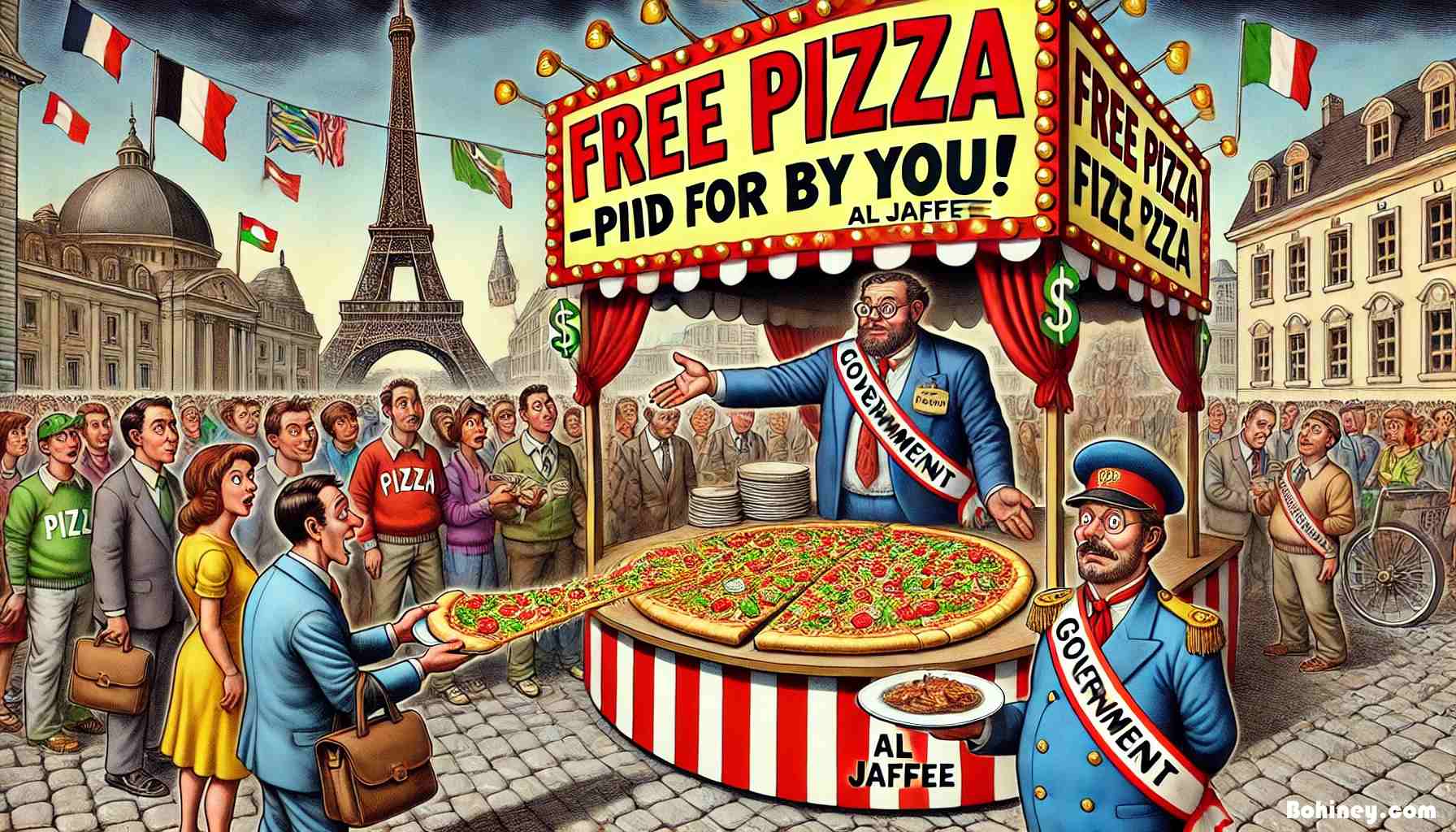
The Darkening Skies Over Europe’s Economy: The Grand Socialist Buffet: All You Can Eat Until the Food Runs Out
Believing socialism will meet all your needs is like trusting a vending machine to dispense wisdom; it’s just not designed for that.
BRUSSELS—Europe, long admired for its historic castles, cobblestone streets, and ability to regulate the curvature of bananas, now finds itself in an economic quagmire. The dream of a socialist utopia, where everyone gets everything for free—except the people who actually pay for it—appears to be crumbling faster than a French baguette left out in the rain.
For years, European bureaucrats have reassured the public that their elaborate social safety nets would catch everyone before they fell. Yet, as inflation spikes, industries collapse, and unemployment rises, one can’t help but notice that the safety net has more holes than an overused fishing net in the Mediterranean.
Socialism: The Perpetual Motion Machine of Economic Nonsense
European policymakers have mastered the art of economic fantasy, where governments can print money indefinitely, tax the wealthy into oblivion, and still expect businesses to invest and create jobs. The problem? The wealthy have a habit of leaving, businesses have a tendency to close, and money loses value when the government treats the economy like a Monopoly game gone rogue.
“It’s a fundamental principle,” said Dr. Klaus von Bureaucrat, an economic expert at the European Institute for Government Overreach. “If we tax corporations at 75%, implement 42-hour work weeks that are mostly coffee breaks, and regulate businesses to the point where they can only operate in theory, we’ll finally achieve prosperity.”
Strangely enough, businesses have reacted to this plan not by hiring more workers, but by packing up and relocating to more hospitable economic climates. But fear not—European leaders have a solution: more regulation, more taxation, and perhaps a new ministry devoted to studying why businesses keep fleeing to Singapore.
The People’s Paradise: Where Everyone Is Equal (Except the Elites)
In a truly socialist system, everyone is supposed to have equal access to resources. In practice, however, it means equal suffering for the masses while government officials enjoy private jets, climate summits in five-star resorts, and subsidized foie gras.
Take the United Kingdom, where government officials in multimillion-pound townhouses lament the struggles of the working class. “We must do more to help the poor,” declared one Member of Parliament, sipping a taxpayer-funded glass of 1982 Château Margaux. “That’s why we’re introducing a new tax on heating—so people can experience the authentic struggle of our ancestors during medieval winters.”
Meanwhile, in France, President Macron recently proposed a sweeping wealth tax to ensure that “the rich pay their fair share.” As an added bonus, he was kind enough to define “rich” as “anyone who can afford a croissant without taking out a loan.”
Economic Freedom? No, Thanks—We’ll Take the Free Stuff Instead
Many Europeans remain firm believers in socialism, insisting that economic hardship is just a temporary setback on the road to utopia. “We just need to redistribute more wealth,” says Pierre Dubois, a sociology student at the University of Paris, who has never held a job but has strong opinions on why workers deserve more vacation time. “It’s simple: the government just needs to print more money and give it to people.”
This level of economic wisdom is why the European Central Bank is currently grappling with record-high inflation. Basic goods like eggs and milk have become luxury items, but at least college students can still get government-subsidized degrees in feminist pottery studies.
The Netherlands recently rolled out a “Basic Income for All” pilot program, in which citizens receive free money for doing absolutely nothing. The result? An immediate rise in beer consumption and a drop in job applications. Shockingly, economists are still trying to figure out why businesses are having trouble finding workers.
The Myth of the Self-Sustaining Welfare State
European leaders maintain that their welfare states will thrive indefinitely, as long as there are enough workers to fund them. There’s just one problem: birth rates have plummeted, and younger generations are more interested in becoming TikTok influencers than factory workers.
“In the past, we had people working in agriculture, manufacturing, and engineering,” said one German official. “Today, we have people live-streaming themselves eating pickles for tips on the internet. This is not a sustainable economic model.”
The European Union, never one to shy away from a brilliant idea, has proposed a new solution: importing millions of migrants to fill the labor gaps. However, many of these migrants seem far more interested in collecting social benefits than actually working. Perhaps the EU should consider that when you offer free housing, healthcare, and education, some people might take advantage of it.
Austerity for Thee, but Not for Me
Whenever Europe faces an economic crisis, its leaders respond with bold new policies—usually involving austerity for the people and lavish spending for the government.
Take Spain, for example, where the government is struggling to pay for its social programs. The solution? Taxpayers must cut back on energy usage, meat consumption, and travel—while politicians continue flying private jets to climate summits.
“It’s a small sacrifice,” explained Spanish Prime Minister Pedro Sánchez, adjusting his designer suit. “The people must learn to live without excessive luxuries. Now, if you’ll excuse me, I have a meeting at the Ritz.”
Meanwhile, in Italy, the government has proposed an additional wealth tax to ensure that everyone contributes their fair share. The plan is so effective that Italy’s wealthiest citizens are currently “contributing” by moving their bank accounts to Switzerland.
The Swedish Model: A Fairy Tale with No Happy Ending
Socialists often point to Sweden as proof that their system works. What they fail to mention is that Sweden’s success is largely due to its past embrace of free-market capitalism.
For decades, Sweden thrived because it allowed businesses to flourish. Now, as it leans into higher taxation and expanded welfare, the cracks are beginning to show. Crime is rising, employment is shrinking, and Sweden’s government is struggling to maintain its generous benefits.
“The state will take care of everything,” reassured one Swedish politician, moments before announcing new budget cuts.
When Reality Comes Knocking, Socialists Blame Capitalism
Despite socialism’s repeated failures, its defenders remain undeterred. Whenever an economy collapses under socialist policies, the excuse is always the same: “It wasn’t real socialism.”
Germany is currently experiencing an energy crisis due to over-reliance on government-mandated green policies, yet some politicians still blame “capitalist greed” for rising prices. Similarly, France’s economic downturn is being attributed to “market failures,” rather than decades of unsustainable government spending.
One European official even blamed the United States for Europe’s economic woes, stating, “If America didn’t embrace capitalism so aggressively, we wouldn’t have to work so hard to resist it.”
Lessons from the Past? No Thanks, We Prefer to Repeat Mistakes
History is filled with examples of socialism failing, from the Soviet Union to Venezuela. Yet, Europe remains convinced that this time will be different.
“We just need better implementation,” insists Jean-Pierre Lefevre, a French economist who has never run a business but writes extensively on how businesses should be run. “If we can just find the right balance between government control and economic freedom, we’ll finally achieve utopia.”
Of course, “balance” in this case means the government controlling everything while the private sector foots the bill.
The Future of Europe: A Socialist Wonderland or a Slow-Motion Train Wreck?
With industries collapsing, businesses fleeing, and inflation soaring, Europe is at a crossroads. The path forward is clear: either embrace free-market reforms or continue doubling down on failed socialist policies.
Given Europe’s track record, it’s likely they’ll choose the latter—because nothing says “economic recovery” like taxing businesses out of existence and then wondering why unemployment is rising.
As the darkening skies loom over Europe’s economy, the continent’s leaders remain hopeful. “Yes, our policies haven’t worked so far,” they admit. “But that just means we need more of them.”
Auf Wiedersehen, prosperity. It was nice knowing you.
