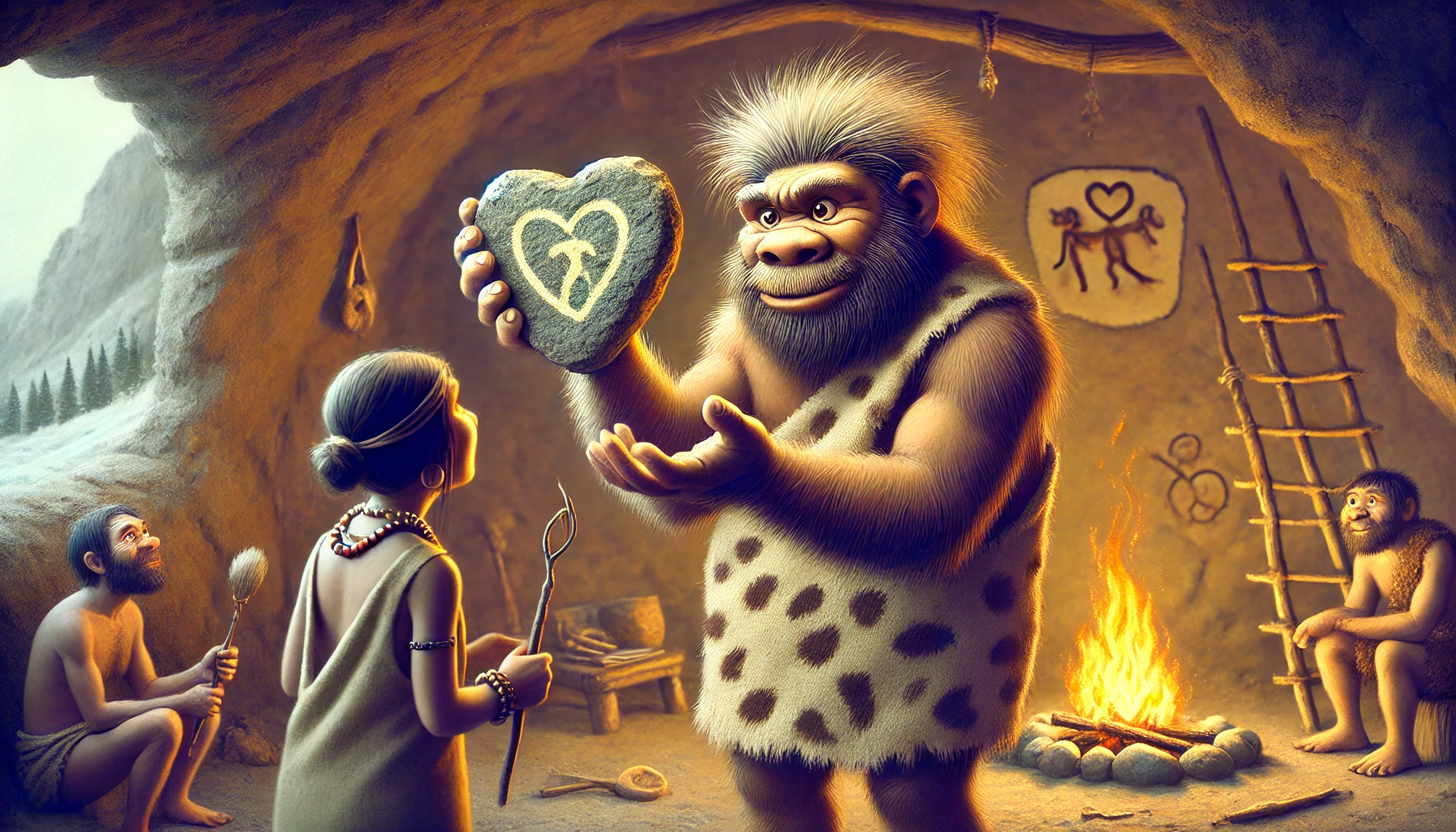
Cave Lovin’: How Neanderthals Invented Romance, Ghosting, and All Our Modern Problems
In a time before dating apps, candlelit dinners, or awkward small talk about Netflix shows, our Homo sapiens ancestors and Neanderthals embarked on one of history’s most scandalous romances. Forget about Romeo and Juliet—this was the original forbidden love story, and it came with a lot more grunting and significantly worse hygiene. But unlike modern flings, this one left behind evidence—roughly 1-2% of non-African human DNA is Neanderthal, proving that sometimes, what happens in the cave doesn’t stay in the cave.
Researchers recently pieced together the sordid details of this ancient hookup, and the results are both fascinating and hilarious. Let’s explore how this prehistoric affair shaped modern humans—and maybe ruined everything in the process.
The Original Swipe Right
Around 47,000 years ago, the Middle East was where all the action happened. Forget New York or Paris—this was the prehistoric hotspot where humans and Neanderthals first crossed paths. Archaeologists speculate the attraction was instant. One Neanderthal with a particularly thick brow ridge might have caught the eye of a wandering Homo sapiens, and boom—nature took its course.
“Interbreeding likely occurred because of geographic overlap,” said Dr. Priya Moorjani of UC Berkeley. “But it wasn’t just proximity; there was probably some level of choice involved.” Translation: even Neanderthals had standards.
And what were those standards? It’s anyone’s guess, but the first pickup line might have been something like, “Do you come here often, or is this your first migration out of Africa?”
Ghosting Gone Extinct
While humans and Neanderthals did manage to hit it off, this relationship was doomed from the start. Over the next 100 generations, natural selection systematically deleted most Neanderthal DNA, leaving only the bits that helped us survive. The rest? It got ghosted harder than a bad first date.
Johannes Krause from the Max Planck Institute summed it up: “The majority of Neanderthal traits were eliminated quickly.” It’s like evolution had its own version of “red flags” and said, “Nope, not keeping that.”
But what did survive is remarkable. Neanderthal DNA still influences traits like immune response, skin pigmentation, and metabolism. In other words, that one Neanderthal fling might be why you can eat an entire pizza without immediate regret—or why you sunburn after five minutes outside.
The First Family Drama
Two of the individuals recently unearthed in German caves were a mother and daughter, proving that family dynamics have always been messy. Imagine trying to explain to your mom why your new boyfriend had the posture of a boulder. “But Mom, he’s great at hunting woolly rhinos!”
Adding to the intrigue, DNA evidence from a nearby cave in Czechia revealed that these people were all distant relatives—fifth cousins, give or take. This means prehistoric family reunions were as awkward as they are today, only with fewer potato salads and more saber-tooth tiger threats.
“It’s rare to have such a clear family connection in ancient remains,” said Krause. “It gives us a snapshot of what life—and love—looked like back then.” Spoiler: It wasn’t pretty.
Denisovans: The Wallflowers of Prehistory
While humans and Neanderthals were busy hooking up, Denisovans were off somewhere doing… well, not much. These mysterious cousins of Neanderthals left behind only a few fossils, but their DNA lingers in modern Asians and Pacific Islanders. They’re like that one friend who never shows up to the party but sends a cryptic text at 2 a.m.
Denisovans are the unsung heroes of human history—or maybe just the unsung. “They had less of an impact than Neanderthals,” said one researcher. “But they’re still part of the story.” Barely.
The Evolutionary Bachelor
Natural selection turned out to be the ultimate Bachelor, ruthlessly handing out roses—or in this case, genes. Traits that helped Homo sapiens thrive made the cut, while others were eliminated faster than you can say, “Survival of the fittest.” Strong jawlines? Check. Limited social skills? Bye.
Modern humans ended up with about 20% of Neanderthal DNA spread out among us, like a genetic family heirloom we didn’t ask for but can’t get rid of. Thanks to this, your awkward small talk at parties or your ability to tan might just be the remnants of a prehistoric romance gone wrong.
Why We Can’t Quit Neanderthals
Despite their extinction, Neanderthals left an indelible mark on humanity. Some of the quirks we associate with modern life might trace back to those early encounters. Here are a few:
- Awkward Small Talk: Struggling to keep a conversation going? Blame your Neanderthal DNA. Social skills weren’t their strong suit.
- Body Image Issues: Thick brows and wide noses were the height of prehistoric beauty. Imagine trying to live up to those standards.
- Fear of Missing Out (FOMO): Neanderthals didn’t travel far, leading to a chronic fear of missing out. Modern humans turned this into Instagram.
What Neanderthals Taught Us
Believe it or not, there are lessons to be learned from this ancient love story. If nothing else, it proves that even 47,000 years ago, relationships were complicated. They involved family drama, ghosting, and the occasional saber-tooth tiger. But they also shaped who we are today—literally.
So next time you’re dealing with awkward relatives or feeling weirdly attached to your eyebrows, remember: it’s all thanks to some prehistoric romance that didn’t stay in the cave.
Disclaimer: This article is a collaboration between a sentient cowboy and a very curious strand of Neanderthal DNA. All satire is intentional, and no prehistoric feelings were hurt in the making of this piece.