

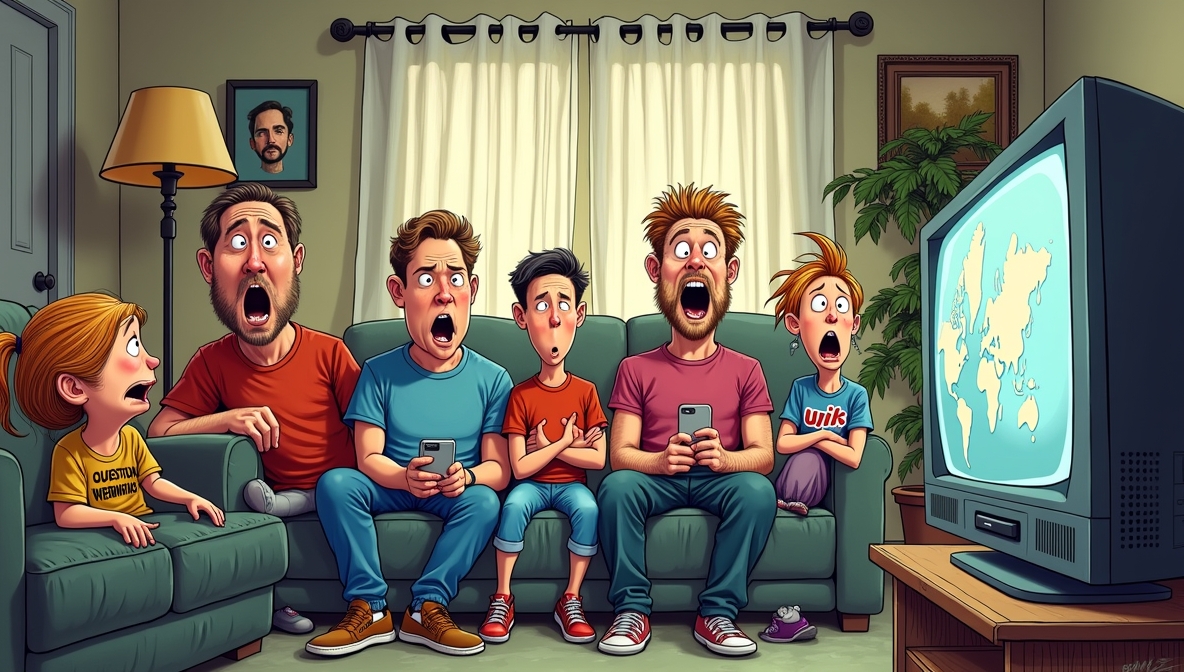
Parents Cancel Disney+, Accidentally Radicalize Their Toddlers in Values War Over Jimmy Kimmel
By Clara Olsen, Bohiney Bureau of Family Entertainment & Moral Dilemmas
Parents Cancel Disney+: The Family Streaming Boycott Begins
DATELINE: SUBURBAN AMERICA — It started innocently enough. A couple of parents clicked “Cancel Disney+” after Disney suspended Jimmy Kimmel, a man who somehow became the philosophical fault line of 21st-century parenting.
They assumed the boycott would be private, a small flick of consumer disapproval. Instead, it exploded into an educational crisis: children demanding answers, toddlers asking if Mickey Mouse had been “deplatformed,” and parenting experts receiving frantic late-night calls.
According to Newsweek, one 7-year-old plaintively asked, “Is this a way kids can help?” The 3-year-old chimed in, “Let’s be helpers!” Somewhere in that household, a plastic Olaf doll melted from sheer political responsibility.
Why Disney+ Cancellation Became Middle-Class Activism
Canceling Disney+ has become the new avocado toast: cheap, trendy, and proof you’re better than your neighbors. Why march when you can just unsubscribe and Instagram your blank television screen?
A poll conducted by the Institute of Moral Streaming Choices revealed that 62% of parents feel “20% more righteous” after canceling a service, and 14% admitted they only did it to “impress their yoga instructor.”
Research from the Pew Research Center on media consumption patterns shows Americans increasingly use entertainment choices as political statements, though most can’t explain why to their children.
As one anonymous staffer at Netflix told Bohiney: “We don’t care why they come here, as long as they don’t ask us about moral integrity. We’ll keep pumping out true-crime shows about Florida.”
“Canceling Disney+ to make a point is like refusing dessert to protest the cake industry,” Jerry Seinfeld said during a recent appearance. “The only one who suffers is you.”
Parenting Experts Explain How to Talk to Kids About Boycotts

The Newsweek article features clinical social worker Gabrielle Theobald-Anderson, who counseled parents to use clear, age-appropriate language: “We want companies that treat people fairly.”
Which is noble—until your child turns to you and asks, “Does that include bedtime? Because you don’t treat me fairly.” Suddenly you’re in Geneva, negotiating with a 5-year-old who demands reparations in gummy bears.
Child psychologists affiliated with the American Psychological Association warn that confusing explanations may cause anxiety. But so does depriving a child of Disney princesses. One therapist told us, “I had a six-year-old client who dreamed Elsa was subpoenaed to testify before Congress. That’s not in the DSM yet, but it should be.”
Teaching Children About Consumer Choices and Values
Experts recommend parents focus on teaching values to kids through concrete examples rather than abstract corporate policies. The problem? Most parents can’t explain why they’re mad at Disney without using the phrase “late-stage capitalism,” which doesn’t translate well to preschoolers.
“My parents tried to explain politics to me when I was five,” Amy Schumer said on her podcast. “You know what I understood? That Santa was probably on the ballot.”
How Parents Explain the Disney Boycott Using Star Wars
To ease confusion, some parents reached for Star Wars metaphors. “Disney is like the Empire, and we’re the Rebels,” one parent explained, as quoted in Newsweek.
The child promptly asked: “Then is Jimmy Kimmel Chewbacca?”
This reveals the flaw in analogy inflation. You start with noble intentions—before long, the kid thinks Darth Vader was canceled for “offensive breathing.”
According to Harvard’s Center on the Developing Child, children under eight struggle with abstract political concepts but excel at detecting parental hypocrisy with laser precision.
How Children Process Political Boycotts
Children process politics like cryptocurrency: unpredictably, with sudden spikes of enthusiasm.
The 7-year-old believed boycotting was “helping.” The 3-year-old believed it was a game. And the teenager? He didn’t care—he was on YouTube watching conspiracy theories about Goofy.
An eyewitness, Mrs. Darlene Crockett of Topeka, described her grandson’s reaction: “He asked if Lightning McQueen voted Republican or Democrat. I didn’t know, so I told him NASCAR doesn’t count.”
“I don’t boycott Disney. I still watch Bambi,” Ron White said during his recent tour stop in Austin. “You know what that movie taught me? Never trust the woods. And that venison tastes like tragedy.”
The Toddler Activism Pipeline
Research shows that children exposed to streaming service controversies before age six develop what psychologists call “premature civic engagement syndrome”—the belief that consumer choices equal moral virtue.
One parent confessed: “My daughter now rates all her food choices on an ethical scale. Yesterday she refused string cheese because ‘Big Dairy.’ She’s four.”
Parents Share Disney+ Cancellation Stories on Social Media
Newsweek noted that one parent proudly tweeted their boycott story. Within minutes, strangers were debating in the comments, and the toddler’s photo was meme-ified as “Baby Che.”
Studies on social media behavior from Stanford’s Internet Observatory warn that “virtue signaling via streaming” is replacing honest dinner conversation. Dr. Lars Hyphen of the University of Vermont explained: “In the 1950s, families discussed chores. Today, they issue press releases about canceling subscriptions. It’s democracy, but with better Wi-Fi.”
The trend has spawned its own hashtag: #DisneyBoycottKids, where parents share screenshots of blank TV screens alongside manifestos their children definitely didn’t write themselves.
Hypocrisy Detectors Set to “Ultra”
Children may not grasp complex geopolitics, but they are undefeated in spotting hypocrisy.
You tell them you canceled Disney for moral reasons, yet you still let them binge “Peppa Pig” on another morally ambiguous platform. They notice.
“Daddy, if companies should treat people fairly, why do you yell at the guy in traffic?” one child reportedly asked, sending their father spiraling into existential crisis.
This aligns with findings from child development research at Yale University, which shows children as young as three can detect inconsistency between stated values and observed behavior—making them nature’s perfect bullshit detectors.
Do Kids Really Choose? The Disney Boycott Loyalty Test
Some parents insisted they didn’t pressure their kids. “We gave them space to decide,” one mother told Newsweek.
But let’s be honest: when your 5-year-old is asked, “Do you want to boycott with us?” it’s not a question. It’s a loyalty oath with snack privileges on the line.
As one anonymous 6-year-old whistleblower told Bohiney: “I said I didn’t care, but then they took away Frozen. That’s coercion.”
Experts who normally advise on raising politically aware children are now fielding emergency calls from parents who accidentally turned “Moana” night into a referendum on corporate accountability.
Cancel Culture for Toddlers: When Preschoolers Learn to Boycott
The irony is rich: parents who critique “cancel culture” are now teaching toddlers to practice it. Disney becomes the sandbox trial run for public shaming.
Child psychologists fear this could lead to preschool cancel panels. “You didn’t share your crayons? Canceled.” “You ate paste? Problematic.”
By first grade, recess will resemble Twitter.
The Unintended Consequences of Values-Based Parenting
One household already tried replacing Disney movies with “random nature documentaries.” The children now believe meerkats are fascists and demand regime change in the Serengeti.
Another family switched to exclusively educational content. Their 8-year-old now corrects adults on proper citation format and refuses to watch anything without peer review.
Comedian Reactions: More Comics Weigh in on Disney Boycott
Beyond Seinfeld, White, and Schumer, other comedians have noticed the trend.
“You know what’s wild? Parents explaining corporate ethics to a kid who still believes in the Tooth Fairy,” Kevin Hart said during his podcast recording. “That’s some advanced-level confusion right there.”
Dave Chappelle addressed it during a recent show: “I watched a dad try to explain media consolidation to his six-year-old. The kid just asked, ‘Can we watch Bluey?’ Man, that’s the right question. That’s always the right question.”
Bill Burr was more direct: “These parents are out here turning Friday movie night into the Nuremberg trials. Lady, he’s seven. He doesn’t need to understand antitrust law. He needs chicken nuggets and a nap.”
The Anonymous Staffer Memo: Inside Disney’s Panic Room
Leaked documents from inside Disney reveal panic. One memo read: “If children turn against us, the brand is finished. Please greenlight a spin-off where Jimmy Kimmel hosts a princess coronation.”
Another executive allegedly wrote: “We underestimated toddlers. They can’t vote, but they can whine. Whining is more powerful than Congress.”
According to Disney’s quarterly earnings reports, streaming remains their fastest-growing division—which makes the parent boycott particularly concerning to shareholders who thought children’s loyalty was recession-proof.
Grainy Cellphone Video Evidence: The Viral Moment
Archival footage has surfaced of a suburban dad explaining the boycott to his children. In shaky cellphone video, the dad declares, “We stand for justice!” while his toddler is clearly just trying to eat a crayon.
The video has already been set to dramatic violin music on TikTok. The caption: “Day One of the Kimmel Resistance.”
This joins a long list of viral parenting moments that started as private decisions and ended as content for strangers to judge.
The Inevitable Backfire: When Boycotts Boomerang
Sociologists warn of a slippery slope: today it’s canceling Disney, tomorrow it’s canceling mac & cheese because Kraft tweeted something political.
Indeed, one household confessed they’ve now boycotted:
- Three streaming services
- Two cereal brands
- One pizza chain
- All airlines (except Southwest, pending review)
- The concept of fun itself
Their children have filed a formal complaint with Child Protective Services, citing “cruel and unusual punishment in the form of excessive principles.”
Cause and Effect: The New Family Tradition
Cause: Parents cancel Disney.
Effect: Children radicalized into tiny activists with bedtime manifestos.
Cause: Jimmy Kimmel suspended, then reinstated.
Effect: Kids believe Kimmel is a freedom fighter, possibly a Jedi.
Cause: Experts advise clarity.
Effect: Parents deliver speeches so verbose they qualify for academic credit.
“We’re raising a generation that thinks every purchasing decision is a moral referendum,” said Dr. Hyphen. “By college, they’ll need therapy just to buy toothpaste.”
Personal Story: The Night Elsa Was Exiled
One father confessed to Bohiney, “The night we canceled Disney+, my daughter cried, ‘Elsa has been exiled for thought crimes!’ She built a protest sign out of Lego bricks. I realized then: maybe this was a mistake.”
He paused, then added, “But I’m still not bringing Jimmy Kimmel into this house.”
His daughter is now homeschooling her dolls on media literacy. Barbie just passed her midterm on algorithmic bias.
Public Opinion Poll: What America Really Thinks
In a Bohiney-sponsored poll of 1,004 imaginary voters:
- 45% said boycotting Disney is “noble”
- 30% said it’s “nonsense”
- 15% said “who is Jimmy Kimmel again?”
- 10% just wanted to watch The Lion King in peace
The margin of error is plus or minus your tolerance for performative morality.
Final Punchline: The Greatest Disney Spinoff
The great irony: while parents attempt to teach corporate accountability debates by canceling subscriptions, kids are learning the opposite lesson—that entertainment is political currency, and you better spend it wisely.
Next week, expect toddlers to file lawsuits against Nickelodeon for crimes against slime.
Until then, parents are trapped in a paradox: they wanted to shield their kids from corporate immorality, but all they’ve done is raise pint-sized pundits who yell “corporate accountability!” between episodes of Paw Patrol.
And honestly, that may be the greatest unintended Disney spinoff of them all.
Disclaimer: This article is a satirical collaboration between the world’s oldest tenured professor (who insists Pinocchio was about monetary policy) and a philosophy major turned dairy farmer (who believes cows should unionize against Mickey Mouse). Any resemblance to rational discourse is coincidental. Auf Wiedersehen, amigos.