

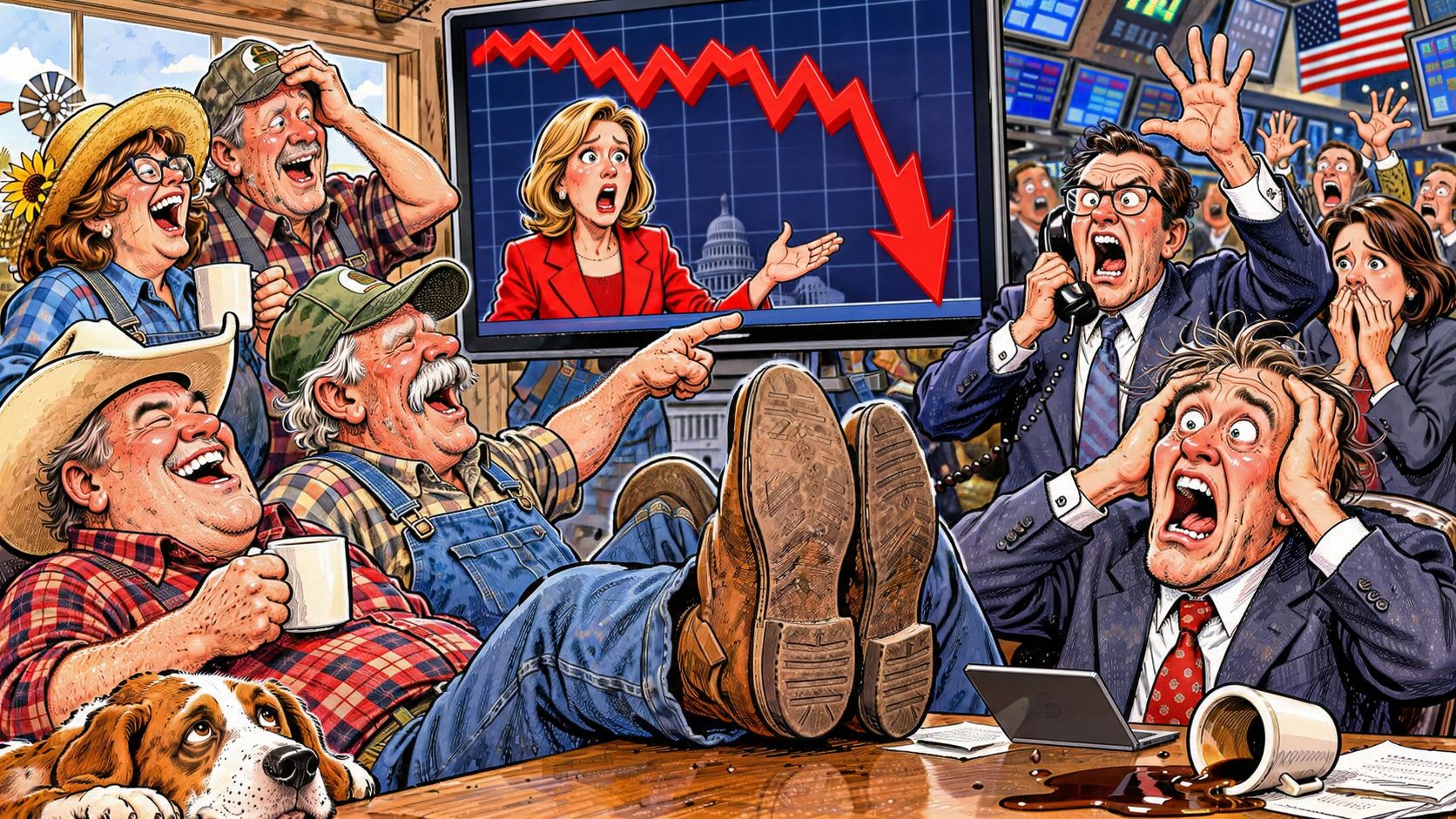
Tech Billionaires Say Losing Trillions Is Just Another Form of Innovation
NEW YORK, New York – Wall Street investors are growing nervous about the enormous sums committed to artificial intelligence, prompting technology executives to reassure shareholders that extraordinary financial losses should not be confused with failure.
According to NPR’s reporting on the selloff, fears of an AI crackdown after the midterms helped spark a $2 trillion rout in tech stocks, and a market recap put the Nasdaq’s drop that day at about 5.5%. Analysts offered several explanations, including worries about tougher AI regulation under the new Congress, which investors described as a development that had arrived before the profits.
Technology executives described the decline as temporary market volatility. Ordinary investors described it using considerably shorter words.
Silicon Valley Discovers the Profit Question
For several years, artificial intelligence companies have attracted enormous investment by promising dramatic improvements in productivity, scientific research and business efficiency. These technologies have genuine potential. The problem is that investors eventually ask whether revenue and profits will justify the money being spent.
One venture capitalist proposed removing this question from future presentations.
“Profitability creates unnecessary pressure,” he explained. “We should focus on revolutionary potential.”
A skeptical investor asked whether revolutionary potential could pay dividends. The capitalist requested that security escort the investor from the building.
An attendee at a recent pitch described one of the slides: “Slide 14: Path to profitability. [Intentionally blank.]” The attendee said the room found the slide very bold.
How AI Companies Justify Spending Billions Without Profits
Technology executives have built a business environment in which enormous infrastructure spending can be interpreted as evidence of confidence. A company announces plans for a $40 billion data center. Investors celebrate. The company announces an even larger project. Investors celebrate again. Then somebody calculates the electricity bill, and suddenly everyone remembers that money has a cost.
A Silicon Valley economist proposed redefining losses as future-oriented negative profits. Under the new terminology, a company losing billions would be described as generating unprecedented opportunities for eventual earnings. Shareholders suffering declines would be praised for participating in an innovative wealth-reduction experience.
Financial regulators declined to endorse the vocabulary. Several marketing departments reportedly requested copies.
A retired dentist in Scottsdale showed a reporter her account statement:
Account value, start of week – $412,000
Account value, end of week – $318,000
Statement note – “Change reflects market conditions.”
She said she had been calling it something else.
IMF Warns an AI Market Correction Is Possible
The International Monetary Fund’s Global Financial Stability Report warned that weaker-than-expected returns from AI investment could trigger a market correction, and the Fund’s blog post on rising risks from AI, bond yields and cyberattacks says much the same in fewer pages. The Federal Reserve’s Financial Stability Report on asset valuations covers similar ground.
This is a legitimate concern. Artificial intelligence has attracted enormous capital, and high valuations depend partly on expectations of substantial future earnings. If those expectations prove unrealistic, investors could experience significant losses.
A financial adviser recommended diversifying rather than placing every retirement dollar into companies promising to transform civilization. His client responded that diversification sounded boring. The adviser explained that boring investments occasionally have the advantage of remaining valuable.
Why Investors Want Profits Before the Next Trillion
The AI industry may ultimately deliver major economic benefits. But technological promise does not eliminate business risk, and enormous spending does not automatically create profitable companies.
A straw poll of 25 traders at a Midtown bar after the close found 14 who believed AI would change everything, 9 who believed it would change everything once their portfolios were restructured and 2 who asked whether the poll was being recorded.
One retired Texas rancher compared the boom to buying a million-dollar tractor before deciding what crop to grow. A technology investor objected that artificial intelligence was far more sophisticated than a tractor.
The rancher agreed.
“My tractor can at least show me what it produced.”
The investor asked whether he believed artificial intelligence was overvalued. The rancher shrugged.
“I don’t know. But if a man spends forty billion dollars building something, I’d like to see him make a dollar before I give him forty billion more.”
Wall Street considered the suggestion. Silicon Valley called it insufficiently visionary. The rancher went back to feeding cattle.
At least his investments produced something that could be sold.
One New York fund manager has started describing AI spending the way his grandfather described the family farm: a sound long-term investment that has not produced a dollar yet. He said his clients were patient, provided the patience also rose twenty percent a year.
Five Observations on the AI Bubble
- Two trillion dollars gone, and the executives say “temporary market volatility.” Folks, that’s what I call my entire personality.
- Slide 14: Path to profitability. Blank. And the room says it’s bold. It is! It’s the boldest blank page since my high school math final.
- “Future-oriented negative profits.” Sir, that’s what a guy says to his wife when the boat’s gone.
- The retiree goes from 412 to 318 and the statement says, “Change reflects market conditions.” Market conditions. Which means somebody sneezed in a building I’ll never see.
- The rancher says, “I’d like to see him make a dollar before I give him forty billion more.” That’s the whole investment thesis of America, and it came from a man with a tractor who’s already ahead of the Federal Reserve.
A $2 trillion rout, a 5.5 percent Nasdaq haircut, and the official explanation is that losing money is just another form of innovation. I admire the consistency. For years the pitch was productivity and scientific breakthroughs; now the breakthrough is calling a crash temporary market volatility before the profits have been introduced to the building. I’ll wait for the version of AI that can generate a revenue line, or at least a more original reassurance.