Union Leaders Suggest ‘Mandatory Siestas’ and ‘Emotional Support Breaks’ to Increase Efficiency
Department of Housing and Urban Development (HUD)
WASHINGTON, D.C.—In a bold move to restore accountability at the Department of Housing and Urban Development (HUD), the Department of GovernmentEfficiency (DOGE) has launched an aggressive initiative to root out waste and fraud. But just as DOGE’s auditors were sharpening their budget-cutting scissors, HUD’s union leaders proposed a countermeasure: mandatory siestas, emotional support breaks, and a new workplace slogan—“Fraud Happens, Let’s Manage It.”
“Pastel crosswalks? That’s the government’s way of saying, ‘We’re out of ideas, but we have paint.’” — Ron White
Mandatory Siestas: The Efficiency Revolution No One Asked For According to Frank “Nap King” Delaney, president of the Union for Urban Progress and Extended Lunch Breaks, enforced naptime could be a game-changer for the department. “A well-rested employee is a productive employee. We’re not saying the fraud will stop, but at least it’ll happen in a more relaxed, stress-free environment,” Delaney explained, while reclining on his ergonomic beanbag chair.
“Why cut waste when you can sleep through it?” he added. “Studies have shown that naps reduce errors and fraudulent paperwork by at least 15%. Well, maybe not official studies, but I feel it in my heart, and that’s what matters.”
HUD insiders quickly rallied behind the idea, suggesting that every afternoon break should be accompanied by aromatherapy and soothing whale sounds to maximize efficiency. “We’ll fraud, but we’ll fraud better,” said one anonymous employee.
Creative Budgeting Under Fire DOGE’s efforts to uncover creative spending at HUD have already yielded jaw-dropping discoveries. Among them:
$2 million for a “Community-Based Interpretive Dance Therapy” program aimed at reducing urban blight.
$500,000 for a study on “emotional support potholes,” which concluded that potholes in urban areas are underappreciated for their emotional depth.
$300,000 to paint crosswalks in “mood-enhancing” pastel colors to promote urban harmony—though some pedestrians reportedly experienced confusion between lavender and pedestrian green.
Lisa Swift, a spokesperson for DOGE, expressed mild disbelief. “We’re not saying mood-enhancing crosswalks are a bad idea,” she said. “But maybe we could start with filling the potholes first.”
HUD’s Interpretation: Innovation, Not Fraud Delaney and his union colleagues argue that what DOGE perceives as fraud is simply misunderstood innovation. “Look, the line between waste and genius is thin. One day, pastel crosswalks are waste; the next, they’re saving lives,” Delaney insisted. He then pitched a new initiative: FraudFast, an app designed to streamline minor fraud claims for government employees.
“It’s all about efficiency,” Delaney said. “Why file unnecessary paperwork when you can submit all fraudulent expenses in one convenient app? The faster we fraud, the faster we innovate.”
Expert Testimony and Bold Theories Dr. Lucy Blathers, a professor of Bureaucratic Innovation Studies at Overpriced State University, weighed in on the debate. “If DOGE pushes HUD too hard, they might start hiding waste in places no auditor dares to look—like the office Christmas party fund or the employee karaoke machine rental budget.”
Public policy analyst Jerry Hastings, however, took a more pragmatic stance. “HUD has always been a trailblazer in new ways to waste money. From $15,000 ergonomic beanbag chairs for ‘stress management’ to $50,000 espresso machines labeled as ‘community outreach tools,’ you can’t blame them for being creative.”
Union Leaders Double Down In a press conference held outside HUD headquarters (next to an ironically named food truck, “Fiscal Fries”), Delaney made another bold proposal: Emotional Support Breaks. “Every employee should be entitled to at least three emotional support breaks a day,” he said. “If our budget can handle emotional support dogs, why can’t it handle emotional support coffee runs?”
Delaney called for increased funding for mindfulness workshops, corporate Zumba classes, and a meditation room equipped with noise-canceling headphones and virtual reality headsets. “When employees reach their zen, they can fraud more effectively,” he added.
DOGE’s Plan: Streamline, Simplify, and Say No to Interpretive Dance Meanwhile, DOGE remained steadfast in its mission. “We’re not here to crush anyone’s dreams,” said Lisa Swift. “We’re here to reduce spending that makes taxpayers scream. We think it’s reasonable to question why HUD allocated $1 million to a ‘Zen and the Art of Government Maintenance’ workshop.”
DOGE plans to implement a Fraud Early Warning System (FEWS), a cutting-edge detection program designed to track suspicious spending patterns—like sudden purchases of artisanal kombucha for “office morale.”
How to Spot Government Waste: Hint—If it involves artisanal anything, it’s probably unnecessary.
Understanding Budget Euphemisms: “Synergy” often means “expensive and pointless.”
How to Fraud Smarter: Government edition—tips for those inspired by HUD’s example.
HUD’s motto: We never waste an opportunity… or taxpayer money.
HUD’s unofficial motto could be a case study in truth disguised as irony. From community revitalization initiatives that fund interpretive dance classes to emergency response popcorn machines, HUD truly never misses an opportunity—or a budget increase. While some agencies focus on measurable outcomes, HUD excels in producing buzzword-laden proposals that generate absolutely no results but look fantastic on PowerPoint slides. The idea is simple: no funding request is too strange, and no expense is too frivolous if you can justify it with synergy and innovation. Want to spend $10,000 on ergonomic beanbag chairs? No problem—just label it as “employee morale enhancement.” Need artisanal kombucha for the breakroom? Call it “hydration optimization.” DOGE auditors will have their work cut out for them, trying to separate creative budgeting from outright fraud. But hey, HUD insists it’s not waste—it’s visionary spending.
DOGE’s auditors were shocked to find that “community revitalization” sometimes means hiring a DJ for staff morale events.
When DOGE auditors opened HUD’s community revitalization files, they expected to find neighborhood improvements—not an invoice for a DJ named “DJ Synergy” spinning beats at a staff morale event. HUD defended the expense, claiming that dance music brings people together and boosts productivity. An anonymous employee explained, “If we’re revitalizing communities, why not start with ourselves?” The DJ event was part of the Urban Vibrations Wellness Initiative, which, according to its mission statement, aims to reduce workplace stress through rhythmic expression and carefully curated playlists.
Auditors were less convinced. “I thought revitalization meant repairing streets, not playing remixes of 80s hits,” said one bewildered DOGE employee. Delaney, the union leader, doubled down: “Our employees deserve morale boosters. If music helps us fraud more effectively, why stop now?” In the end, the party reportedly cost $15,000 and was rated totally worth it by attendees.
If pastel crosswalks don’t boost urban harmony, nothing will—except maybe unicorns on scooters.
In HUD’s latest effort to beautify urban spaces, the department approved a $300,000 contract to paint crosswalks in pastel colors to promote urban harmony. The idea? Softer hues reduce road rage and encourage pedestrian civility. But the public had mixed reactions. “I thought it was an ice cream shop promotion,” said one confused driver. Others found the new colors calming, but not necessarily practical.
The pastel crosswalks were part of the Soothing Streets Initiative, which proposed additional calming elements like meditation benches and unicorn-shaped bike racks. “We’re reimagining the pedestrian experience,” said a HUD spokesperson, adding that future plans may include scented sidewalks and mood-enhancing streetlights.
DOGE auditors were unimpressed. “If pastel crosswalks are the key to urban harmony, why stop there? Add a DJ and a kombucha stand, and we’ll reach nirvana,” joked one. Or was it a suggestion?
Some HUD employees insisted the $500,000 study on “emotional support potholes” was groundbreaking. Literally.
In a move that had auditors scratching their heads, HUD approved $500,000 for a study on emotional support potholes—yes, potholes with feelings. The initiative aimed to explore how urban decay impacts the emotional well-being of city dwellers. HUD officials defended the project, claiming it was groundbreaking research. “Potholes aren’t just hazards,” explained one HUD official. “They’re symbols of resilience and hope. Or despair, depending on your mood.”
The study involved focus groups and live-streamed interviews with local residents about their pothole experiences. One participant described a pothole that had been in their neighborhood for five years. “It’s like an old friend,” they said. “It’s always there for me.”
While DOGE considered the study creative at best, HUD promised follow-up research on therapeutic graffiti. Stay tuned for that groundbreaking revelation.
The proposed meditation room at HUD is funded under the program code for “Urban Stress Mitigation,” which sounds like a new-age punk band.
HUD’s proposed meditation room might seem like an ordinary office perk, but when auditors discovered it was funded under Urban Stress Mitigation, things got interesting. The meditation room was fully equipped with noise-canceling headphones, Himalayan salt lamps, and VR headsets offering guided relaxation. “We’re creating a stress-free environment,” said Delaney, union president.
Critics were quick to point out that stress mitigation is not the same as urban development. “It’s creative budgeting,” argued one HUD staffer. “If employees are calm, they make fewer errors. Everybody wins.” Auditors, however, weren’t convinced and raised concerns about the program’s $150,000 annual budget.
Rumors of an upcoming Urban Yoga Awareness Fund only fueled suspicions. For now, the meditation room stays—just don’t ask what yogic breathing has to do with urban renewal.
Nothing says “responsible budgeting” like a government department buying artisanal kombucha in bulk.
HUD’s breakroom fridge is fully stocked with artisanal kombucha, thanks to a $50,000 line item labeled Employee Hydration Strategy. The rationale? Happy, hydrated employees are more productive. According to one HUD official, kombucha isn’t just a drink—it’s an investment in well-being. “We could have gone with water,” she said, “but kombucha has probiotics, and probiotics build stronger communities.”
DOGE auditors were less enthusiastic. “When did gut health become a priority for urban housing?” asked an auditor who had mistakenly opened a kombucha labeled fermented elderberry dreams. Still, HUD stood firm. “Dehydrated employees make mistakes. Kombucha is a prevention strategy,” Delaney explained.
Sources report that the artisanal kombucha budget will expand next year, with plans to introduce a kombucha-on-tap station. Future wellness initiatives may include fermentation Fridays, where staff learn to make their own kombucha, further blending office wellness with urban renewal strategies.
FraudFast: Streamlining minor fraud, one convenient app at a time!
Introducing FraudFast—the revolutionary new app designed to help HUD employees submit fraudulent expenses in record time. Developed under the guise of financial innovation, FraudFast offers one-click approvals for everything from community-based smoothie initiatives to wellness retreats in Napa Valley.
Union leader Frank Delaney called FraudFast a “game-changer” for government efficiency. “Why waste time justifying minor fraud when you can streamline it?” he explained. With intuitive features like auto-fill justification and fraud analytics, FraudFast takes the hassle out of bending budget rules.
DOGE auditors were unimpressed, labeling the app “the digital embodiment of everything wrong with modern bureaucracy.” Still, employees embraced the tool enthusiastically, especially after discovering the suggested expenses feature, which offers fraud inspiration based on previous claims. FraudFast’s next update promises to include emotion-based fraud detection, allowing users to justify claims based on their mood.
HUD is a trailblazer in proving that every expense can be justified with enough buzzwords.
When it comes to creative budgeting, HUD is in a league of its own. No expense is too ridiculous if it’s wrapped in the right jargon. Want a $20,000 coffee bar in the breakroom? Just call it caffeine-based morale enhancement. Need to replace office chairs with beanbags? That’s ergonomic innovation.
Buzzwords like synergy, holistic, and community-centered appear in almost every expense report. “If you can’t justify it with logic, justify it with buzzwords,” explained one HUD official. The strategy is simple: auditors are less likely to challenge something if it sounds too complicated to understand.
DOGE is reportedly compiling a Buzzword-to-Fraud Dictionary to help auditors decode these expenses. Some recent discoveries include urban rejuvenation (new carpet for the office) and community empowerment (weekly catered lunches). As Delaney put it, “We’re not wasting money; we’re evolving urban policy through innovative funding strategies.”
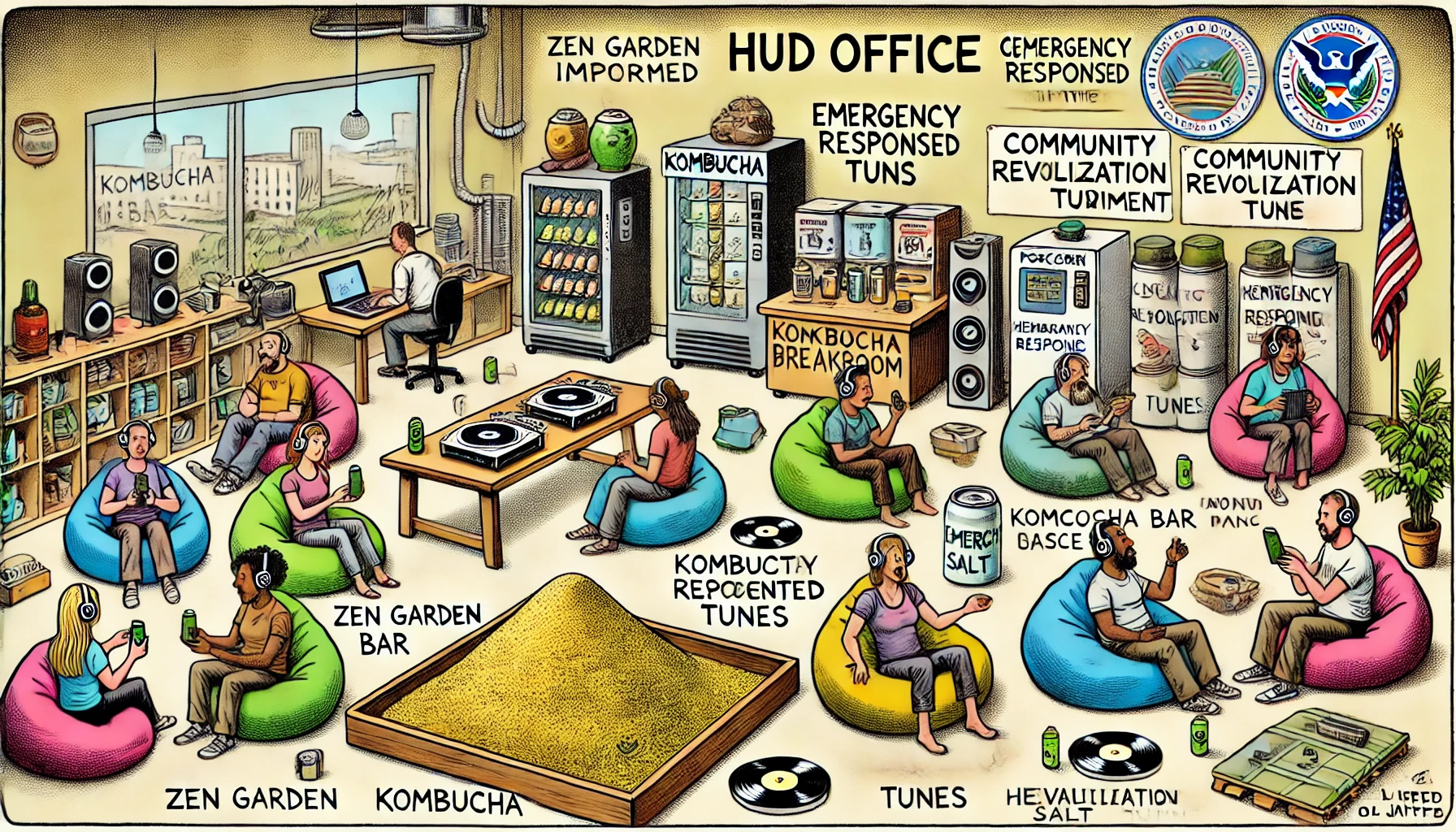
Rumor has it HUD once approved $20,000 for a “Zen garden” in the office breakroom… complete with imported sand.
The tale of HUD’s Zen garden is whispered in government circles like a legend. The breakroom addition, funded under the Urban Mindfulness Initiative, allegedly cost $20,000 and featured imported Japanese sand and hand-carved stone lanterns. “It was supposed to help employees focus,” said one insider. “Instead, it became the world’s most expensive litter box.”
DOGE auditors were puzzled. “Why is HUD building Zen gardens when some communities don’t even have sidewalks?” asked one investigator. HUD responded by citing workplace wellness studies showing that Zen gardens reduce stress and increase productivity—at least for the first two weeks.
Eventually, the Zen garden fell into disrepair, becoming a sandbox for office plants. Still, it lives on in memory as a monument to HUD’s commitment to creativity and questionable spending. Rumors persist of a follow-up project involving an office koi pond, pending budget approval.
DOGE’s first task: Figure out why HUD owns a popcorn machine listed under “emergency response equipment.”
During an audit of HUD’s emergency response budget, DOGE stumbled upon an unexpected expense: a $5,000 popcorn machine. The machine, labeled emergency morale support equipment, sat in the breakroom, ready to pop whenever tensions rose. “Popcorn brings people together,” explained a HUD employee. “During stressful situations, nothing calms a room like freshly popped corn.”
DOGE auditors were skeptical. “We thought emergency response meant preparing for disasters, not snack time,” said one official. HUD insisted that the popcorn machine played a crucial role in crisis de-escalation, citing an internal report titled Popcorn Diplomacy: A Case Study in Workplace Harmony.
Future plans include expanding the emergency snack strategy with cotton candy machines and nacho stations. “We’re building resilient communities,” said Delaney. “One snack at a time.”
When questioned, a HUD employee explained, “We aren’t wasting money; we’re upcycling funds.”
Caught off guard during a DOGE investigation, one HUD employee offered the perfect defense: We’re not wasting money; we’re upcycling funds. The explanation sent auditors into fits of confusion, but the employee stuck to the story. “Upcycling is sustainable,” she added. “Why throw funds away when you can repurpose them into something beautiful—like a Zen garden or kombucha bar?”
Delaney quickly embraced the phrase, using it in every press statement. “Upcycling funds is the future of government spending,” he declared. “It’s eco-friendly, innovative, and completely impossible to audit.”
DOGE is reportedly developing an entire training module on decoding bureaucratic buzzwords. “We thought fraud was bad enough,” said one auditor. “Now we have to deal with financial upcycling? What’s next—recycled corruption?”
Emotional support breaks will include supervised napping and interpretive dance for stress relief.
As part of HUD’s Employee Wellness Program, emotional support breaks are no longer just encouraged—they’re mandatory. These 20-minute intervals include supervised napping, aromatherapy, and optional interpretive dance sessions to help staff reconnect with their inner selves. “The dance really helped me process my frustration with spreadsheets,” shared one participant.
Critics have questioned how interpretive dance relates to housing development, but union leaders insist that reducing employee stress directly improves community outcomes. “Happy employees make happy cities,” said Delaney. “It’s science… kind of.”
DOGE’s auditors were less convinced, particularly after discovering that the Expressive Movement Department had a $50,000 annual budget. HUD promises that the breaks will reduce mistakes and increase creativity. However, one auditor noted, “If stress relief through dance is the solution, we might as well turn the office into a full-blown arts festival.”
HUD’s “Employee Wellness Fund” somehow became the department’s unofficial snack budget.
The Employee Wellness Fund at HUD started with noble intentions: promote healthy living through mindfulness, hydration, and nutritious snacks. But somewhere along the way, it evolved into the department’s unofficial junk food budget. “It started with trail mix,” explained one employee. “But before we knew it, we had pizza Fridays and a taco cart.”
Auditors raised red flags after discovering that nearly $30,000 had been spent on stress-relief snacks. Items included gourmet popcorn, imported chocolates, and artisan pretzels. Delaney defended the spending, calling it emotional sustenance. “Healthy snacks are good, but sometimes you just need a donut to power through fraud investigations.”
Despite the controversy, HUD plans to expand the program, adding kombucha and cold brew coffee taps. Critics argue the snack budget could fund actual housing initiatives, but for now, HUD employees will continue to snack their way to wellness.
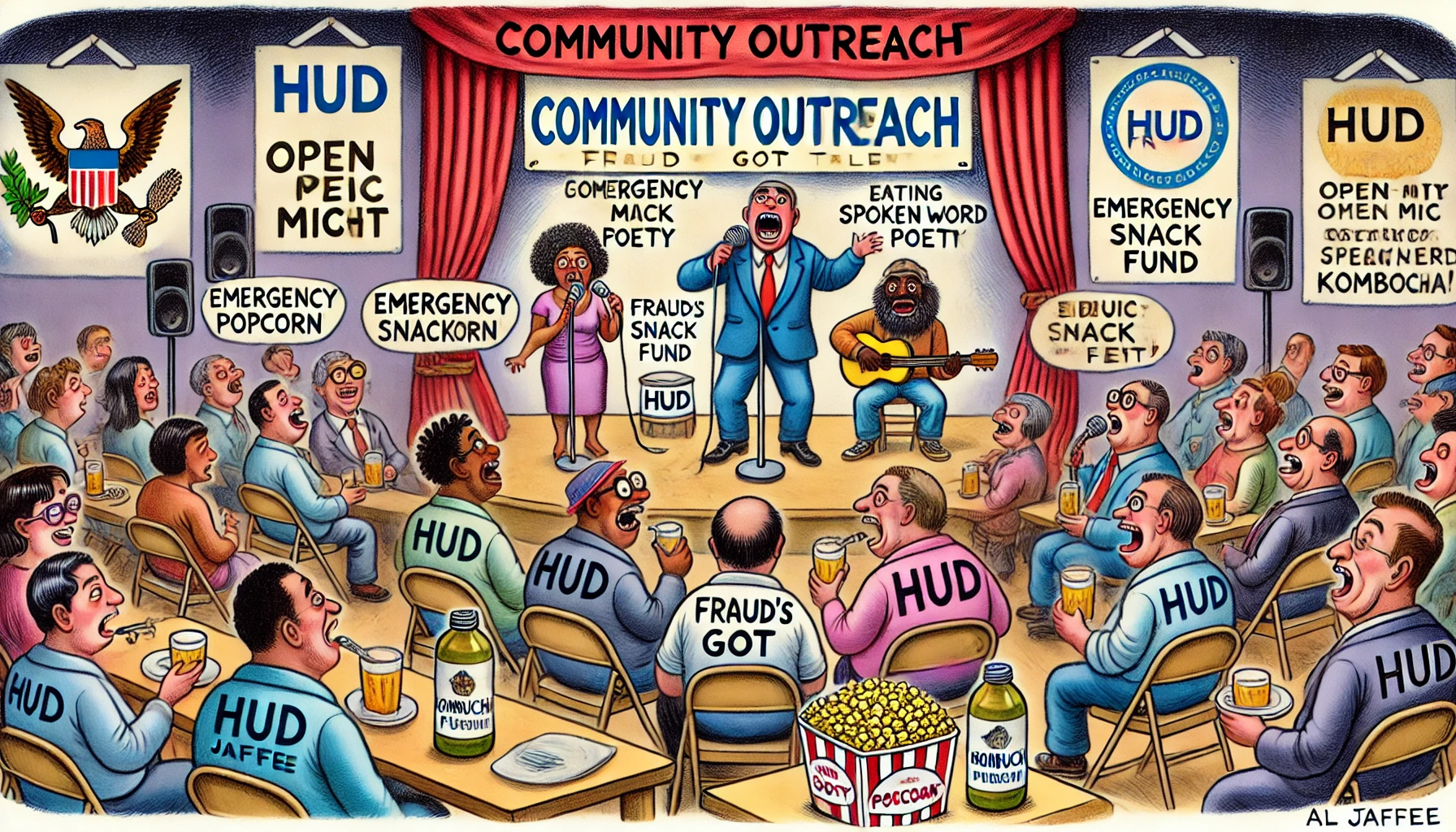
DOGE auditors uncovered that one program’s $10,000 “community outreach” expense was for an open mic night.
When DOGE auditors examined HUD’s community outreach programs, they discovered something unexpected—a $10,000 invoice for an open mic night. Billed as a public engagement initiative, the event featured government employees performing spoken word poetry and stand-up comedy. “It was supposed to connect us with the community,” said one organizer. “Also, it was hilarious.”
The night’s lineup included a heartfelt poem about potholes and a comedy set titled Budget Cuts and Broken Dreams. Delaney argued that open mic nights build trust between government officials and citizens. “We’re showing the public our human side,” he explained.
Auditors were unconvinced. “This isn’t outreach—it’s karaoke with a budget,” said one investigator. Despite the criticism, plans are underway for Open Mic 2: Fraud’s Got Talent, featuring a performance by DJ Synergy. HUD promises it will be bigger and better—if DOGE approves the next round of funding.
If DOGE truly wants to reduce waste, they should start by banning any budget that uses the word “synergy.”
Auditors at DOGE quickly noticed a pattern in HUD’s expense reports: the word synergy appeared in almost every budget request. “If you want funding, just throw in synergy somewhere,” said one HUD insider. “Nobody knows what it means, but it sounds important.”
Examples included Synergistic Urban Rejuvenation ($250,000 for decorative street banners) and Culinary Synergy Outreach (a $20,000 food truck event). The buzzword seemed to justify any expense, no matter how absurd. “At one point, we funded a synergy mural project,” admitted a HUD employee. “It was just graffiti, but with better marketing.”
DOGE’s Lisa Swift joked, “If synergy were a currency, HUD would be a Fortune 500 company.” To prevent future misuse, DOGE is considering banning synergy-related terms altogether. HUD, however, is already pivoting to a new favorite—holistic innovation.
BOHINEY SATIRE – A satirical illustration in the style of bohiney.com showing a chaotic HUD office breakroom. The scene includes a Zen garden with imported sand in the …– Alan Nafzger
10 Comedian One-Liners
“HUD’s new nap policy is revolutionary. It’s the first time fraud takes a break at 3 p.m. sharp.” — Sarah Silverman
“When they say ‘community revitalization,’ what they mean is a very expensive pizza party.” — Amy Schumer
“If you want to find government waste, just look for any program with a catchy acronym.” — Larry David
“Emotional support potholes? I don’t even know what that means, but I want one.” — Groucho Marx
“DOGE should adopt HUD’s budgeting philosophy—just make everything sound like art.” — Billy Crystal
“FraudFast is like Grubhub for fraud—it delivers the waste directly to your desk.” — Roseanne Barr
“HUD claims they’re saving taxpayer money… by making us laugh with their spending choices.” — Jackie Mason
“If kombucha is listed as an essential resource, the apocalypse is definitely coming.” — Adam Sandler
Department of Housing and Urban Development (HUD)
HUD’s definition of urban revitalization apparently includes hiring a DJ to play at staff morale events—because nothing fixes infrastructure like a killer dance mix.
Some HUD officials genuinely believed that spending $500,000 on a study about emotional support potholes would reduce urban anxiety. “It’s groundbreaking… literally.”
The HUD Employee Wellness Fund mysteriously transformed into the department’s unofficial artisan snack budget, funding everything from kombucha bars to gluten-free donuts.
DOGE auditors were left speechless when they found a $20,000 Zen garden in the office breakroom—complete with imported sand. The only thing it reduced was the budget.
HUD’s innovative solution for workplace stress? Interpretive dance sessions. Nothing boosts productivity like watching your coworkers express their inner urban decay through jazz hands.
The department’s emergency response equipment included a popcorn machine. When asked, an official said, “In times of crisis, we pop together.”
FraudFast, HUD’s attempt to streamline minor fraud, allows employees to submit fraudulent claims with just one click—because efficiency matters, even in corruption.
The Pastel Crosswalks for Harmony initiative was a $300,000 project to calm traffic—because road rage is clearly caused by a lack of soothing colors.
HUD’s favorite buzzword, synergy, appeared in nearly every budget request. Auditors quickly learned it’s just code for “we have no idea where the money went.”
One open mic night hosted by HUD was billed as community outreach. For $10,000, employees performed stand-up comedy and poetry about fraud. “We laughed, we cried, we audited,” said an auditor.
Sabina Guzzanti was born in Italy, Texas, a town where the name promised European glamour but mostly delivered rodeos and gas stations. That contrast shaped her early sense of irony. After studying at Baylor University in Waco, she took her wit to Washington, D.C., where she established herself as a satirist unafraid to puncture political vanity and cultural absurdities. Guzzanti’s writing and performances blend Texas storytelling grit with D.C. policy cynicism, creating satire that entertains while exposing systemic flaws. Her work has been cited in media studies seminars on the global reach of political humor, and she has spoken on panels about satire’s ability to bridge cultures. Known for pairing sharp parody with democratic critique, Guzzanti proves that from Italy, Texas to the U.S. capital, satire can thrive anywhere—especially where power most needs to be mocked.