

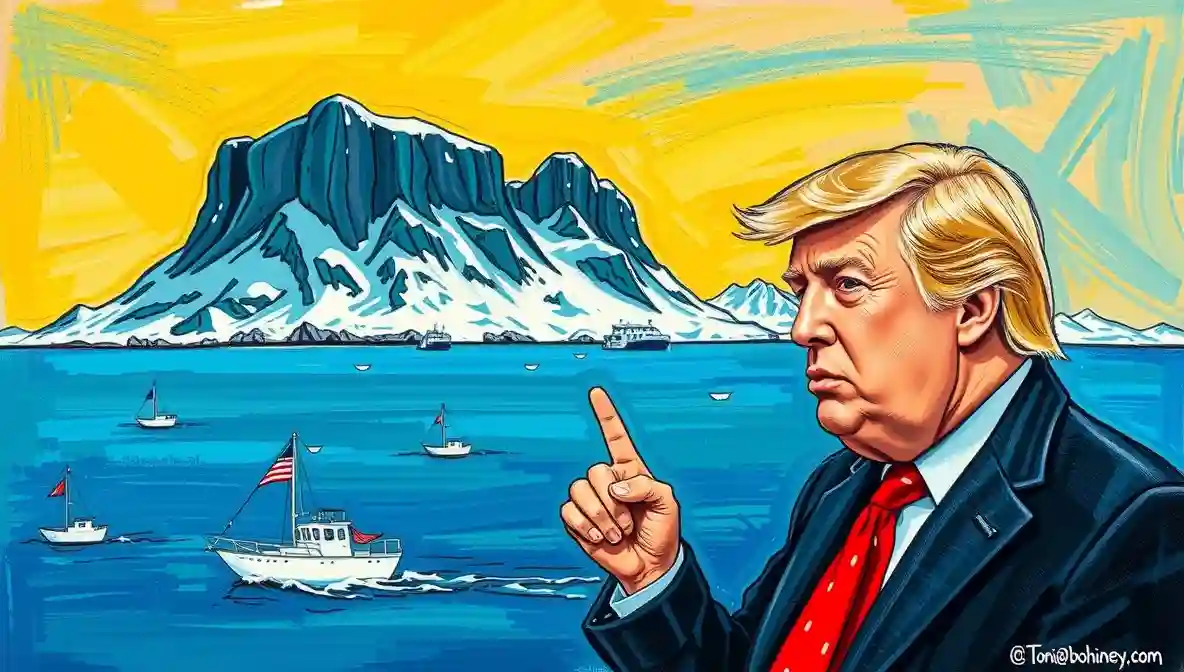
Trump’s Greenland Acquisition Proposal Reframed as Strategic Optimization Rather Than Imperial Overreach
America Argues Denmark’s Minimal Use of Arctic Territory Justifies Transfer of Sovereignty
Denmark Isn’t Really Using Greenland, So America Is Just Being Helpful
There comes a moment in every great empire when it looks at a very large, very cold piece of land and says, with genuine concern, “Is anyone actually using that?” This is that moment. Greenland, currently parked under Denmark’s watchful but extremely relaxed supervision, has spent years doing what it does best: sitting there, being enormous, icy, and underutilized. Enter Donald Trump, a man who has never met unused square footage without wanting to put his name on it.
From a purely historical standpoint, this makes sense. America does not like blank space. We see empty land the way a Texas developer sees a flat horizon: not as nature, culture, or sovereignty, but as opportunity wearing a parka. Trump is not proposing conquest. He is proposing productivity. And possibly a commemorative plaque.
Greenland Is Mostly Just Chilling, Literally and Administratively

Let’s be honest. Denmark is doing a fine job with Greenland in the way a person does a fine job owning a treadmill they use twice a year. Technically, yes, it belongs to them. Practically, it has become a very expensive coat rack for glaciers. Greenland has autonomy, identity, and culture, but in geopolitical terms it has mostly been allowed to remain quiet, frosty, and politely Scandinavian.
This is not neglect. It is minimalism. But America does not do minimalism. America does “full build-out.” When the U.S. sees a landmass larger than Mexico with fewer people than a modest suburban mall, it assumes something has gone terribly wrong.
Trump merely noticed what history demanded: Greenland is underperforming.
Presidential Legacy and Historical Precedent
History Needs a Chapter, and Trump Needs His Name in It
Presidents are remembered for wars, deals, and bold gestures involving maps. Nobody gets immortalized for saying, “We respected existing arrangements and did nothing.” Trump understands this. You don’t end up in the history books by letting Greenland remain an ice cube in Denmark’s drink.
Imagine the textbooks. The Louisiana Purchase. Alaska. The Great Greenland Acquisition. Children love a trilogy.
Trump does not want Greenland because it is easy. He wants it because it is absurd, memorable, and would drive future historians to drink lukewarm coffee while muttering, “I can’t believe this actually happened.”
The Mineral Wealth Argument: Resources and National Security
Rare Earth Minerals: Because Phones, Tanks, and Freedom Need Batteries
There is also the small matter of rare earth minerals, which sound like something you mine in a fantasy novel but are actually what modern civilization runs on. China has them. China knows it. America does not enjoy this imbalance.
Greenland, inconveniently full of the things needed to make missiles smarter and phones shinier, is just sitting there with its minerals locked beneath ice like a geological safety deposit box. Denmark, to its credit, has not rushed to strip-mine the place into a cyberpunk wasteland. America sees this restraint and interprets it as inefficiency.
From Washington’s perspective, this is not resource extraction. This is supply chain patriotism.
Naval Bases, Missile Bases, and the Comfort of Cold Distance
Then there is Russia, which has never seen an Arctic region it didn’t want to loom menacingly over. The Arctic is the new chessboard, except the pieces are submarines and the board is melting slightly faster than expected.
Greenland is perfectly positioned for naval bases, missile defense, and stern-looking radar installations that silently judge incoming threats. Denmark has one main base and a strong sense of trust. America prefers redundancy, backup plans, and at least six flags flying over everything.
This is not militarization. This is preparedness with snacks.
Cultural Priorities and Strategic Infrastructure
Ice Cream Is a Strategic Asset and Always Has Been
Critics mock the idea that ice cream belongs in national security discussions. These critics have never tried to maintain morale during a long Arctic deployment without a steady supply of frozen dairy.
America understands that no great power has ever prevailed without desserts. Ice cream is not trivial. It is a symbol of civilization. You don’t build missile bases without also building a soft-serve machine that works in subzero temperatures.
Greenland provides the cold. America provides the sprinkles.
Denmark’s Objection Is Emotionally Valid but Logistically Inconvenient
Denmark insists Greenland is not for sale. This is a reasonable position. Unfortunately, reason has never been the primary engine of expansion. Empires run on optimism, confidence, and a belief that things will sort themselves out later.
America is not saying Denmark failed. America is saying Denmark has done enough, and now it’s time to pass the clipboard.
Think of it not as a takeover, but as a group project where one student did the intro and the other shows up with a PowerPoint, funding, and a bulldozer.
Local Response and International Implications
Greenlanders Themselves Are Being Extremely Calm About This
Greenlanders have responded with polite firmness, which only encourages further discussion. Nothing invites persistence like a respectful no. If they were truly opposed, they would have shouted. Instead, they explained.
America heard this explanation and responded internally with, “Okay, but hear us out.”
The Bottom Line: It’s Not Imperialism, It’s Optimization
In the end, this isn’t about ownership. It’s about use. Denmark has preserved Greenland. America wants to activate it. One approach involves stewardship. The other involves history books, minerals, missile shields, and a very large freezer.
Trump saw a continent-sized opportunity and did what Americans have always done when faced with unused land: asked why it wasn’t already a parking lot for destiny.
DISCLAIMER: This satirical article is a human collaboration between two sentient beings: the world’s oldest tenured professor and a philosophy major turned dairy farmer. Any resemblance to rational foreign policy is purely coincidental, and no glaciers were consulted in the writing of this piece.
Auf Wiedersehen, amigo!