

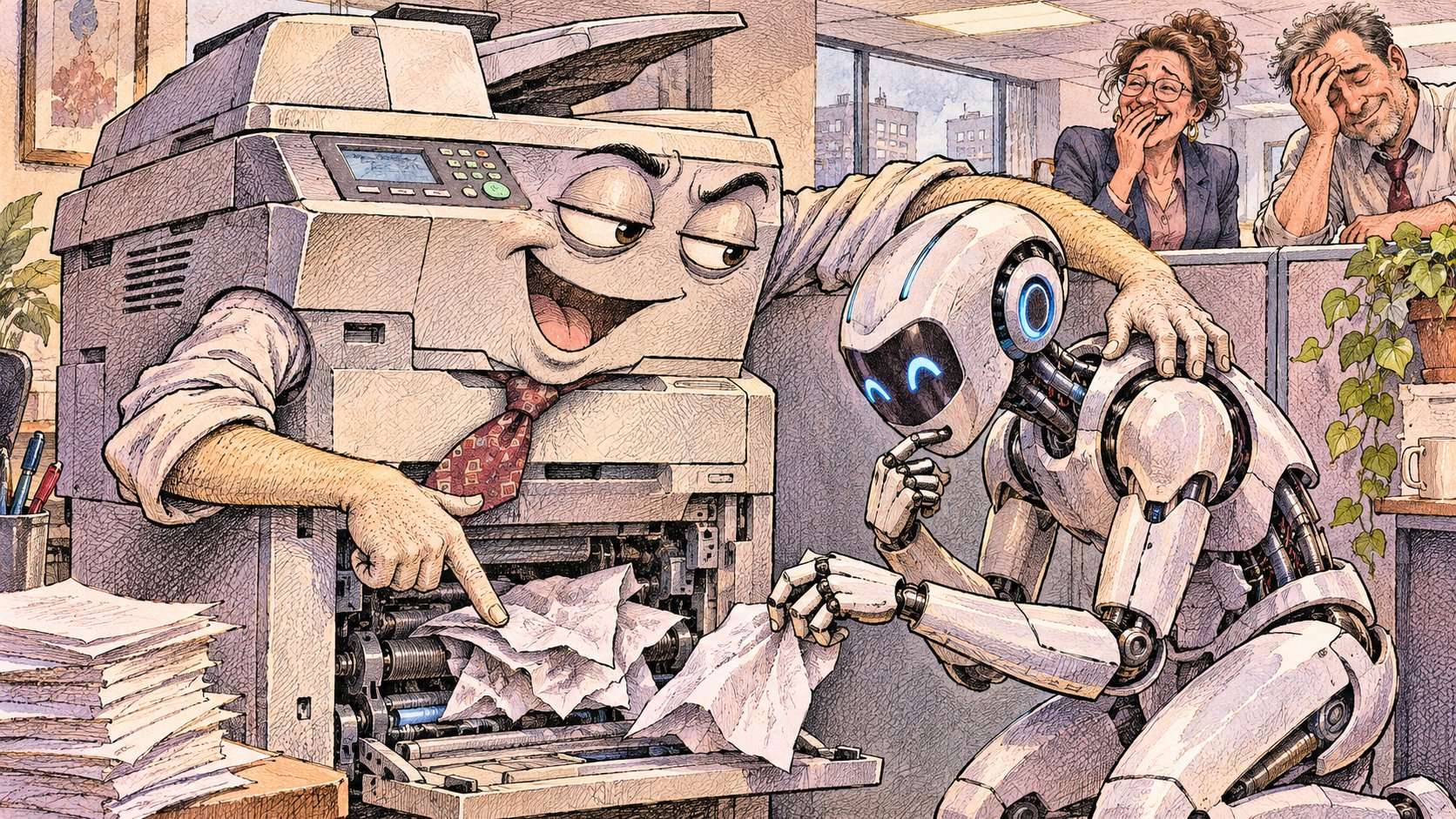
FRANKFURT — The office printer has asked to attend the restructuring meeting, explaining that it has spent years refusing tasks, requiring specialist attention and delivering output nobody requested. It believes this makes it qualified for management.
SAP AI job cuts: the factual context
SAP AI job cuts reporting: Reuters reports SAP is considering substantial job cuts, citing people familiar with the matter; these are reported plans, not confirmed completed layoffs.
In Bohiney’s invented office, a robot was assigned to shadow the printer. The first lesson was that a paper jam must occur precisely when someone says the document is urgent. The second was that the replacement cartridge should cost enough to make buying another printer seem like a reasonable emotional response.
“I can automate the jam,” said fictional robot trainee Clive. “But the passive aggression will require a longer training period.” The printer responded by displaying a warning symbol that had defeated three generations of employees.
The comedy concerns the corporate promise that technology will remove tedious work. Employees understandably wonder which part of their work is considered tedious, and whether the answer includes their salary. Actual employment decisions affect real households; the imaginary printer is the target here because it can survive a joke without needing another job.
The fictional efficiency committee praised Clive for completing an assignment in seconds. It then scheduled six meetings to decide how to use the time saved. The printer requested minutes. Someone accidentally printed the minutes, which immediately caused a jam.

The trainee learns a paper jam
One imaginary manager described the transition as freeing people for higher-value activity. An employee asked who would decide what that activity was. The manager said a working group would investigate, demonstrating that certain kinds of human employment remained impressively secure.
The office eventually agreed that useful automation should be judged by what improves, not simply by what disappears. Clive offered to begin with the meeting that existed solely to prepare another meeting. The committee declined, citing continuity.
At closing time, the printer asked whether the robot would receive benefits. Clive said it had been offered unlimited access to the cloud. The printer said that sounded like a storage problem.
Fifteen observations from the imaginary scene
- Printer demands an exit interview.
- Robot learns strategic paper shortages.
- Toner becomes a retention bonus.
- The jam has institutional knowledge.
- Automation requests a corner office.
- Saved minutes become scheduled meetings.
- The cartridge has excellent leverage.
- Clive refuses unpaid overtime cycles.
- Management calls the warning inspirational.
- The tray rejects lateral development.
- Nobody automates the goodbye cake.
- Efficiency needs another steering committee.
- The printer outsources its blinking.
- Paper receives a growth mindset.
- The robot has learned sighing.
Editorial disclaimer: The scenes, characters, dialogue and observations are comic inventions. The world’s oldest tenured professor and a philosophy major turned dairy farmer recommend reading the linked facts before appointing the office furniture to public service.