

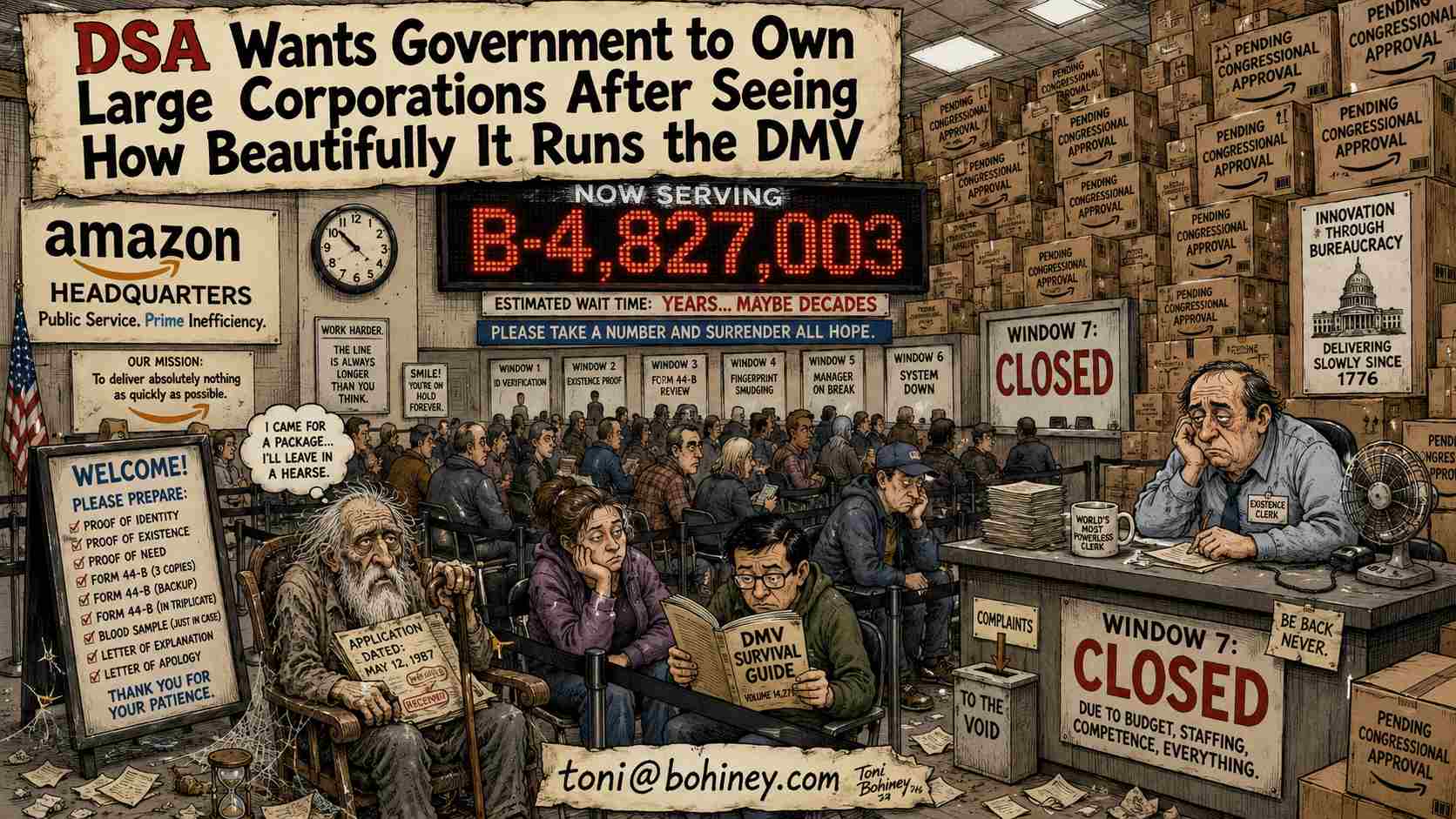
DSA Wants Government to Own Large Corporations After Seeing How Beautifully It Runs the DMV
Amazon Delivery Window Expanded to the Next Appropriations Cycle
The Democratic Socialists of America support bringing major corporations into public ownership, according to national co-chair Megan Romer’s televised true-or-false answers and the organization’s broader economic vision of democratic control over production. This proposal arrives from activists who have apparently visited a Department of Motor Vehicles office, watched 38 people wait beneath fluorescent lighting while Window 7 remained mysteriously closed, and thought, “This needs to run aviation.”
A Fair Criticism Meets an Unfair Solution
The plan begins with a fair criticism: giant corporations can become distant, unaccountable, monopolistic and hostile to customers, a concern regulators at the Federal Trade Commission take seriously in antitrust cases.
The socialist solution is to transfer them to the one institution with sovereign immunity, armed auditors and the ability to lose your paperwork without losing its annual bonus.
Amazon would become the United States Parcel Equity Administration. Prime membership would be replaced by Form 11-B, Application for Accelerated Household Goods Consideration.
Two-day shipping would remain available after a 90-day public-comment period, an environmental review and proof that the requested socks do not reinforce textile inequality.
Apple would be reorganized as the Federal Bureau of Personal Devices. Every iPhone would cost $49, although obtaining one would require seven appointments, three witnesses and a letter from your city council member confirming that your current phone lacks adequate emotional bandwidth.
Software updates would be approved by Congress, ensuring that autocorrect finally improves sometime during the next debt-ceiling crisis.
Customer Service With the Full Force of the State
The most exciting transformation would occur in customer service.
Private corporations sometimes place callers on hold for an hour. Public corporations could place them on hold until the administration changes.
“Your call is very important to democracy,” the recording would say. “Current wait time is 14 to 22 months. Press one for English. Press two to hear why expecting numerical options privileges linear thinking.”
The DMV model would spread throughout the economy.
At government-owned Starbucks, customers would take a number, complete a beverage eligibility questionnaire and receive an appointment to discuss coffee. The barista would not make the drink because that responsibility belongs to a separate agency located across town.
Any complaint would be reviewed by an independent latte ombudsman whose office is closed on alternate Wednesdays.
Airlines offer even greater potential. Flight delays would no longer be caused by weather, staffing or mechanical trouble. They would be caused by a continuing resolution.
Passengers headed to Dallas would be rerouted to a public hearing in Baltimore, where they could testify about the social value of arriving.
A poll conducted among citizens leaving the DMV found that 72 percent opposed government ownership of major corporations, 18 percent supported it and 10 percent were still waiting for their number to be called.
Researchers classified the last group as undecided, although several had aged into a different demographic by the end of the study.
Efficiency Becomes Counterrevolutionary
Socialists argue that public ownership would allow companies to serve human needs rather than profit. This is theoretically possible.
It is also theoretically possible that a city committee could repair a pothole before it develops voting rights.
Profit is an imperfect measure, but it tells a company whether customers voluntarily value what it produces more than the resources consumed, a basic market signal explained in most introductory economics coursework, including material published by the National Bureau of Economic Research. Government agencies use a different metric: whether the budget increased.
A public corporation that loses $40 billion can therefore be described as thriving, provided it employs enough deputy directors and publishes a glossy equity report.
Innovation would accelerate under the new system. Engineers could submit promising ideas to the National Product Advancement Board, which would meet quarterly to decide whether innovation is inclusive.
A breakthrough battery might be delayed because lithium sounds elitist. A cure for baldness could be rejected for stigmatizing scalp diversity. The wheel would return for reconsideration after activists raised concerns about its aggressive roundness.
The DSA insists worker control would prevent bureaucratic stagnation. Employees would elect managers, managers would elect councils, councils would elect coordinating boards, and the coordinating boards would spend six months deciding whether productivity targets constitute workplace violence.
Consumers dissatisfied with a public company could take their business elsewhere, assuming elsewhere had not also been nationalized.
At press time, the government-owned DMV had been selected to manage Amazon, Apple, Walmart, United Airlines and the nation’s semiconductor industry.
The announcement was delayed because the official responsible for stamping it had gone to lunch.
He is expected back between 1:00 p.m. and socialism.
Humorous Observations
- A “latte ombudsman” is proof that bureaucracy can nationalize even the coffee line.
- Form 11-B may be the first government form to require an emotional-support letter for a phone.
- Flight delays blamed on continuing resolutions would at least be more honest than blaming the weather.
- A wheel undergoing reconsideration for aggressive roundness is a sentence that should end every debate about regulatory scope.
- “Between 1:00 p.m. and socialism” deserves to be printed on a government-issued clock.
This article is satirical journalism. The United States Parcel Equity Administration, the latte ombudsman, and the National Product Advancement Board are comic inventions, not real agencies. It is satire built around real public statements about public ownership of corporations, intended for humor and commentary rather than as factual reporting.
Auf Wiedersehen, amigo!
