

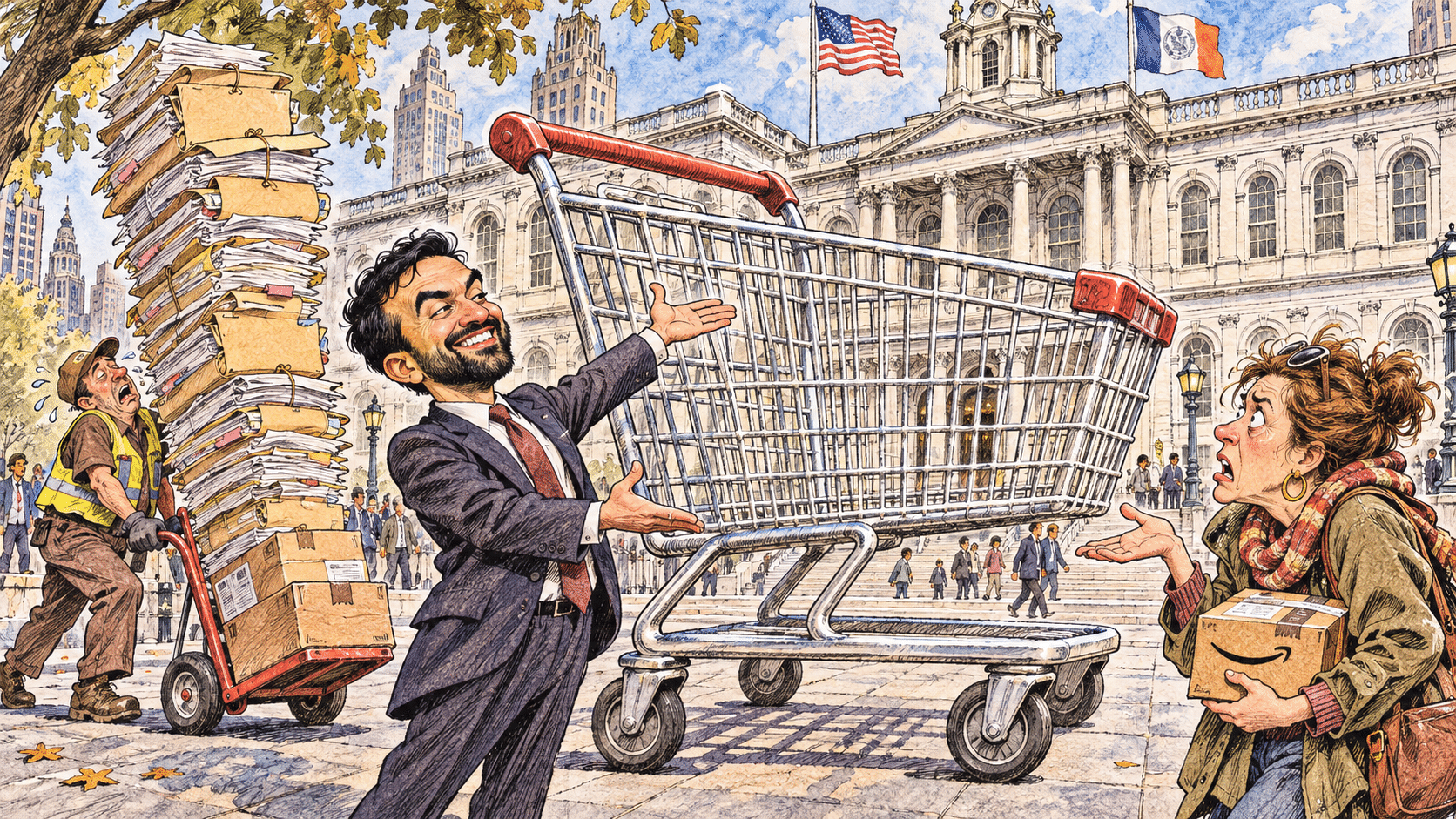
NEW YORK — Mayor Zohran Mamdani’s affordability agenda has reached the shopping cart, where residents are discovering that the cheapest item in New York remains the thing they eventually decide they can live without.
With the mayor pushing delivery regulations and Amazon warning about higher costs, the city has entered a promising new phase of economic relief: explaining to shoppers why the extra charge is somebody else’s fault. The explanations are free. Delivery of the explanations may require a separate account.
Mamdani’s Affordability Plan Meets the Checkout Button
At Bohiney’s imaginary municipal checkout counter, a city affordability specialist demonstrated the savings by removing toothpaste, cat litter and a replacement phone charger from a resident’s basket. Her total fell immediately. Officials called it proof that government can reduce household expenses when households cooperate by having fewer household needs.
“Look at that,” said our invented shopper, Denise Cartwright. “I’ve saved forty dollars and lost the ability to brush my teeth, charge my phone or negotiate with my cat. It’s the first budget where every department is angry.”
The Last Mile Acquires a Middle Manager
The actual New York City Council delivery facility proposal would introduce licensing and employment requirements. A last-mile facility is essentially the place a package leaves before reaching its final customer. In municipal conversation, it sounds like the package is receiving end-of-life care.
Our imaginary courier explained that he previously transported a toaster from a warehouse to an apartment. Under the philosophical version of the process, the toaster must first establish who it works for, whether it recognizes the appropriate oversight structure and why it has not attended the listening session.
The Five-Dollar Argument Arrives Before the Package
In its message to New York customers about delivery costs, Amazon warns the proposal could add up to $5 per order. That is the company’s forecast, not an enacted city charge. But the possibility has already achieved something remarkable: making people inspect the shipping line before purchasing a twelve-dollar object they discovered eleven seconds ago.
Denise said five dollars was too small for either side to regard as serious and large enough for her to regard as lunch money. “Apparently it’s negligible when I pay it and catastrophic when a corporation does,” she said. “I’d like my money reclassified as corporate.”
New Yorkers Request an Affordability Exemption for Their Own Orders
A resident can hold sweeping views about the future of capitalism until the tracking page says his coffee filters are affected. Then he becomes a constitutional scholar specializing in the unrestricted movement of coffee filters.
Amazon says more than 150,000 customers contacted council members, according to Fox Business. This is customer outreach, not a representative opinion poll. At Bohiney’s entirely unscientific kitchen-table survey, however, one participant supported worker protections, opposed higher prices and wanted everyone to finish the argument before her detergent ran out. All three positions led the field.
Free Shipping Discovers It Has a Biography
Free shipping has always been an extraordinary phrase. A person drives a vehicle, burns fuel, moves a heavy box and climbs stairs, yet the customer believes the journey is free because the invoice puts the money somewhere less emotionally disturbing.
New York has now added a political biography to the invoice. Every parcel can arrive with its own competing account of labor, business structure and municipal responsibility. The consumer wanted a shower curtain. He has accidentally subscribed to a graduate seminar with a mildew problem.
Customer Service Adds a Blame Department
In our imaginary checkout update, shoppers can select “city policy,” “corporate pricing” or “please just bring the diapers” as the explanation for a potential surcharge. The third option polls strongly among people whose economic circumstances include an actual baby.
Amazon’s computer asks whether the customer found this explanation helpful. City Hall’s computer asks whether the customer appreciates the broader context. Neither computer offers to pay. Both systems then congratulate themselves on improving engagement with working families.

Delivery Workers Ask Whether Anyone Has Discussed the Work
The Council text includes direct employment provisions and safety training. Those are concrete subjects, with consequences for workers and businesses, that deserve actual examination. Fortunately, political combat supplies a quicker alternative: putting the driver in the background while two powerful organizations explain his life over his shoulder.
“I’d enjoy being the central concern of this discussion while somebody helps me carry the central concern up five flights,” said Bohiney’s invented delivery worker, Leon Bell. He asked whether there was a bipartisan position on broken elevators. Negotiations stalled when the elevator failed to issue a statement.
Paperwork Becomes the Heaviest Item on the Truck
A useful rule should solve a recognizable problem. A useless rule should at least fit in the glove compartment. Our imagined city process meets neither standard once an applicant needs a hand truck for the hand-truck paperwork.
Bohiney’s resident expert, Professor Milton Receipt of the nonexistent Institute for Applied Checkout Studies, described the situation as “adding a tollbooth to a conveyor belt, then expressing surprise when someone prices the toll.” His credentials consist of keeping every cable from every appliance he has owned since 1998. That makes him at least as prepared for this debate as most people shouting about it online.
The Government Gives Itself a Gift Receipt
The proposal’s definition of a covered facility operator excludes government entities. Our imaginary compliance officer praised this as a recognition that government is uniquely qualified to understand when government requirements become inconvenient.
Denise asked whether she could classify her apartment as a small federal agency. She already has a budget deficit, an unreliable printer and several projects that will never be completed. The application was rejected because her cat exercises too much effective oversight.
The conflict also illustrates the city’s two competing definitions of affordability. A household means having enough money left after necessities. A political operation means having enough language left after the press conference. Only the second definition permits a victory celebration before anybody has opened a spreadsheet.
Our imaginary neighborhood accountant offered a modest test: follow the same package, measure the actual delivery cost and check what workers receive before and after any change. Everyone praised the suggestion’s rigor, then returned to debating the moral character of cardboard. A spreadsheet cannot go viral unless someone photographs it beside a celebrity.
Leon proposed a simpler experiment. Give the people writing the policy a loaded hand truck and ask them to find legal parking. Give the people forecasting the surcharge the customer’s household budget. Reconvene after both groups have climbed the stairs. Participants immediately requested a virtual meeting, demonstrating an encouraging consensus on the value of avoiding delivery work.
Practical Savings: Leave the Cart Empty
For shoppers, the useful distinction remains simple: a proposed law is not an existing fee, and a company’s warning is not a guaranteed bill. Check the actual total, compare alternatives and remember that a dramatic email can still be marketing. Outrage is the one product both sides deliver promptly.
At the imaginary demonstration’s conclusion, Denise’s basket contained nothing. Officials admired the zero-dollar total. Amazon recommended six accessories for the nothing. Her cat knocked the receipt onto the floor.
New York had finally made something affordable. Residents were advised to order it before demand increased.
Fifteen Observations From the Checkout Line
- New York’s cheapest purchase is still the one you abandon at checkout.
- Affordability speeches never ask for your billing address.
- The last mile is apparently where every first principle gets dropped off.
- Five dollars becomes small money the moment someone else pays it.
- Political beliefs have an exception for coffee filters arriving tomorrow.
- Free shipping is a price wearing a convincing disguise.
- Your shower curtain now comes with a position paper.
- Both sides offer free blame with every potential surcharge.
- Delivery workers remain the only participants actually carrying anything.
- The paperwork needs its own delivery van.
- A government exemption is a gift receipt written by the gift giver.
- My apartment qualifies as a public agency: deficit, printer problems, no results.
- Customer engagement is what happens when neither side offers a refund.
- An empty cart meets every affordability target except feeding the cat.
- Outrage is the only delivery that never misses its window.
Editorial Disclaimer
No toothpaste has applied for a municipal license. The checkout demonstration, named shoppers, courier, professor and survey above are comic inventions; linked policy documents supply the factual background. Our ceremonial human collaborators—the world’s oldest tenured professor and a philosophy major turned dairy farmer—accept responsibility for all jokes, excluding any surcharge assessed by the cat.