

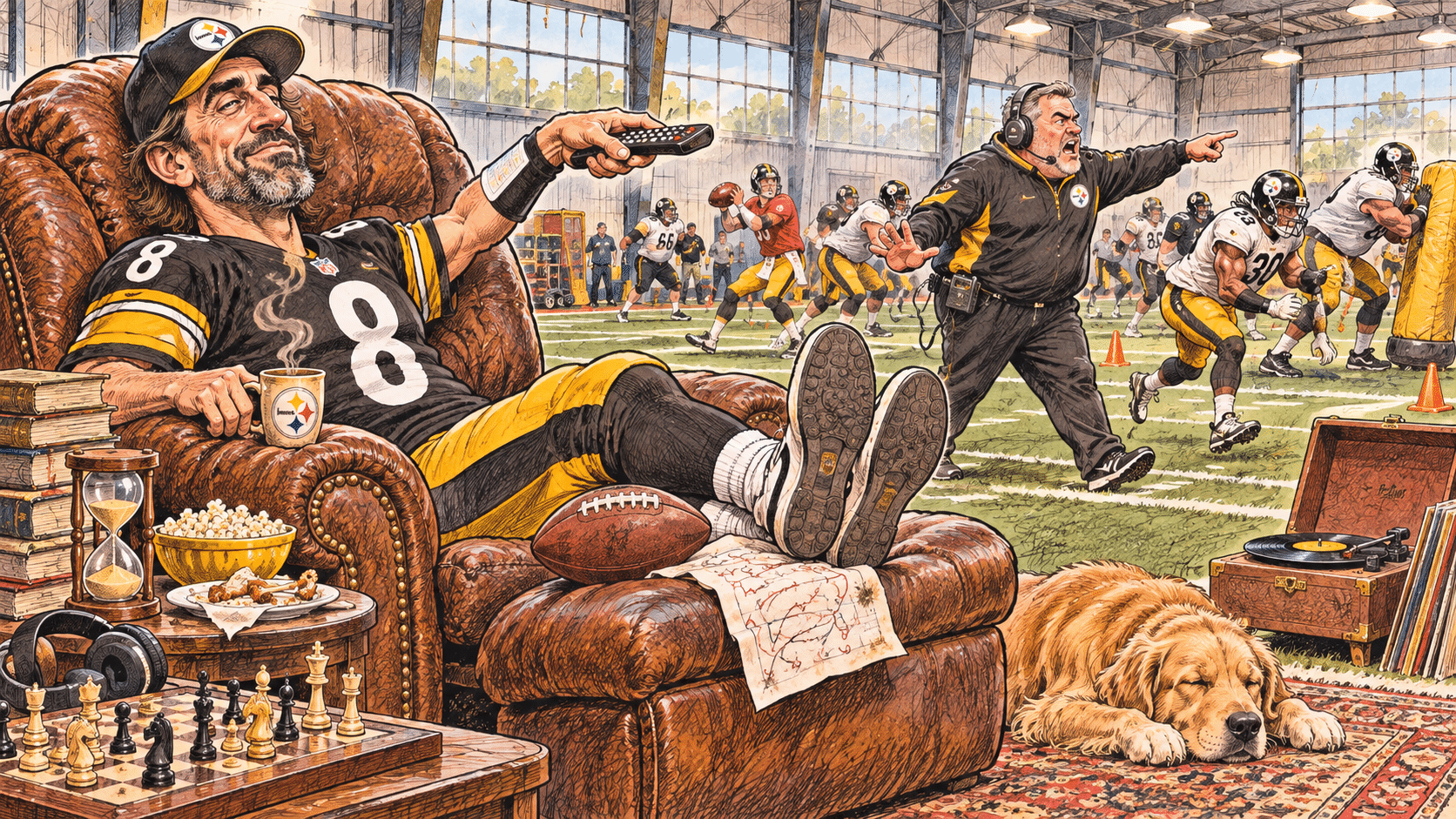
PITTSBURGH — Aaron Rodgers’ campaign for greater control of the Steelers offense has produced a sweeping expansion of his authority over lunch, television volume, and whether the afternoon requires pants.
The quarterback sought influence over the plays. Pittsburgh supplied something even more liberating: no plays, no meetings, and no pesky obligation to report to Pittsburgh. For the first time all season, every person in Rodgers’ huddle agrees with Aaron Rodgers.
Yahoo Sports’ account of the Rodgers–McCarthy dispute reports that McCarthy said an ultimatum prompted his decision to bench Rodgers. Reports described a demand for control of play-calling; McCarthy declined to detail it. Rodgers subsequently criticized his coach on Pat McAfee’s show, and the Steelers released him.
Aaron Rodgers Wins the Afternoon
This is the difficulty with telling your employer to do things your way or release you. Somewhere in the building is a person authorized to select the second option. You pictured a negotiation. Human resources pictured a remarkably efficient meeting.
Bohiney’s Department of Workplace Ultimatums defines the maneuver as handing somebody two buttons, then being furious that the ugly one works. Its senior fellow, Professor Clipboard, advises employees to practice at home by threatening a refrigerator. At least the refrigerator cannot revoke parking.
Rodgers can now install any offense he wants in his living room. Three receivers left, coffee table in motion, ottoman picking up the blitz. The remote has excellent pocket awareness. The couch has never questioned a protection adjustment, although it does occasionally swallow one.
Total Control Comes With Streaming Options
The autonomy is considerable. He can call a run on first down, a documentary on second, and a nap on third. There is no defensive coordinator alive who can stop a man from watching the same grievance twice with the subtitles on.
The refrigerator comparison does have limits. A refrigerator remains useful after you slam its door, and it rarely demands personnel authority. Nevertheless, workplace scholars at the Institute of Things We Could Have Seen Coming rank the ultimatum just below replying-all as a method of converting a manageable irritation into a permanent change of address.
In a Bohiney survey of the three cushions nearest the quarterback, all supported his leadership. One declined further comment after somebody sat on it. Researchers described the sample as small but unusually representative of the people currently required to follow his instructions.
McCarthy Makes the Call; Rodgers Audibles to McAfee
McCarthy said the benching was his decision. Rodgers answered through sports television, the modern employee suggestion box: climate-controlled, nationally distributed, and equipped with a host who looks delighted when the building catches fire.
The transition is tactically sound. Against an NFL defense, a quarterback must locate an open receiver before the pocket collapses. On McAfee, the receiver is already open, the pocket has studio lighting, and nobody can interrupt without becoming tomorrow’s segment.
Bohiney’s imaginary broadcast analyst, Chip Firstdown, calls it the grievance spread. You spread the blame across the screen and keep talking until a commercial supplies the only effective pass rush. Film study becomes a producer locating the exact clip everyone will argue about at dinner.
There is something touching about a sport built on concise communication producing this much explanation. A quarterback can communicate a complicated formation in seconds. Explaining why a former colleague is impossible apparently requires an entire broadcasting ecosystem and several men wearing headphones.
The Bench Cannot Stop the Mouth
On the field, the coach can remove your helmet radio. Off the field, somebody immediately hands you a better microphone. The NFL has successfully regulated where quarterbacks stand while leaving the crucial question of where they complain entirely to cable television.

Steelers Test Whether Divorce Works Better in Pennsylvania
The reunion’s underlying theory was familiar to anybody who has ever taken back an ex because the new apartment had better light. Rodgers and McCarthy had history in Green Bay. Pittsburgh offered a fresh start, different curtains, and thousands of witnesses.
Bohiney’s fictional couples counselor, Dr. Marital Waivers, reviewed the experiment and found that neither party had become a different person during the drive. She recommends asking returning partners three questions: What changed? Who decides? And why is your agent sitting between us at breakfast?
The remarriage analogy also explains the fascination. Nobody watches a reunion to discover whether two reasonable adults can agree on a calendar. They watch because somebody remembers exactly what was said in Wisconsin. The argument has accumulated compound interest. By the time it reaches Pennsylvania, even the silence has an agent.
The Steelers selected a football reunion with the emotional architecture of a second wedding where the first wedding’s arguments are printed on the invitations. Everybody admired the shared experience. Nobody appeared concerned that much of the experience involved experiencing each other.
A new uniform is a powerful psychological tool. It can make an old disagreement look like a personnel strategy. Unfortunately, underneath the black and gold remain the same two men, each carrying an extensive archive of occasions on which the other should have listened.
Same Argument, Better Sandwiches
Fans were promised continuity and received it. The familiar tension survived interstate travel beautifully. Pittsburgh has demonstrated that relationship baggage can arrive intact even when ordinary luggage cannot.
The Alleged Packers Speech Offers Unexpected Clarity
Rodgers also alleged that McCarthy ended a Steelers halftime huddle with “1-2-3, Packers!” Yahoo reports that McCarthy called the episode embarrassing, while describing a difference of opinion over the comments. The confusion immediately supplied this offense with something precious: an identifiable destination.
Bohiney’s imaginary huddle consultant recommends confirming the team’s identity before discussing its identity crisis. Colors help. So do helmets, stadium signage, and the large payroll maintained specifically to establish which organization everybody works for.
An accidental Packers cheer is awkward. Still, it has the advantage of being a complete instruction. Players can misunderstand a complex route tree. They know where Green Bay is. For one brief moment, the scheme had a city, a mascot, and a reasonably legible exit strategy.
The communications dispute adds another layer. Rodgers said a teammate told him about his benching; McCarthy described efforts to reach him and contact with his agent. Football can deliver a play through a helmet amid stadium noise. Employment news apparently needs a mutual friend.
Mason Rudolph Inherits Football
Meanwhile, Mason Rudolph inherits the radical assignment of playing quarterback. His immediate competitive advantage is that his workday still includes work. In an organization briefly operating as a televised separation agreement, availability has become a leadership philosophy.
Bohiney’s fan focus group found broad support for a simpler arrangement: one coach, one quarterback, and at least one conversation conducted without an audience. Participants were then shown the potential television ratings and withdrew the proposal. Peace, they conceded, offers terrible highlights.
There is practical wisdom here for any workplace: before issuing an ultimatum, make sure you can tolerate both outcomes. Before reuniting with an old colleague, identify one disagreement you have actually resolved. Before breaking a huddle, read the shirt.
Rodgers, at least, has solved the problem of someone else calling his afternoon. He can go deep, check down, or order takeout. McCarthy cannot bench him from the recliner. The only remaining threat to complete offensive control is somebody asking him to pass the remote.
Fifteen Observations From the Cheap Seats
- Rodgers demanded control of the offense and received control of the thermostat.
- A quarterback can change the play at the line; a coach can change who gets through the door.
- Pat McAfee is the receiver who never complains that Rodgers is taking too long to release.
- Reuniting Rodgers and McCarthy was remarriage with a different mailing address.
- The Steelers thought black and gold would hide the same old red flags.
- A late-night benching is a breakup text with a depth chart attached.
- Calling Pittsburgh the Packers gives everyone a direction, provided they own a compass.
- The most dangerous audible in football is ‘Get my agent.’
- An ultimatum is a multiple-choice test written by someone who believes only one answer counts.
- Mason Rudolph’s breakthrough play was remaining available while other people expressed themselves.
- A microphone offers excellent protection because nobody is permitted to sack the guest.
- Two men can agree that the team comes first while fighting over who gets to define the team.
- ‘Private conversations’ become public surprisingly fast when one participant has a standing television invitation.
- Fans buy tickets to watch adults settle differences through football, then discover football is delaying the argument.
- Changing cities can save a relationship, assuming the relationship’s problem was the airport.
Editorial Disclaimer
The Department of Excessive Huddling awards ceremonial credit for this entire human collaboration to two sentient beings: the world’s oldest tenured professor and a philosophy major turned dairy farmer. Their imaginary survey, consultants, and institutions carry the same legal authority as a couch calling an audible. Neither is authorized to select Pittsburgh’s quarterback.