
Banned Books Week Celebrates Free Expression by Carefully Selecting Which Free Expression You’re Allowed to Celebrate
Libraries Declare Every Viewpoint Welcome, Assuming It Has Already Been Approved for the Display Table
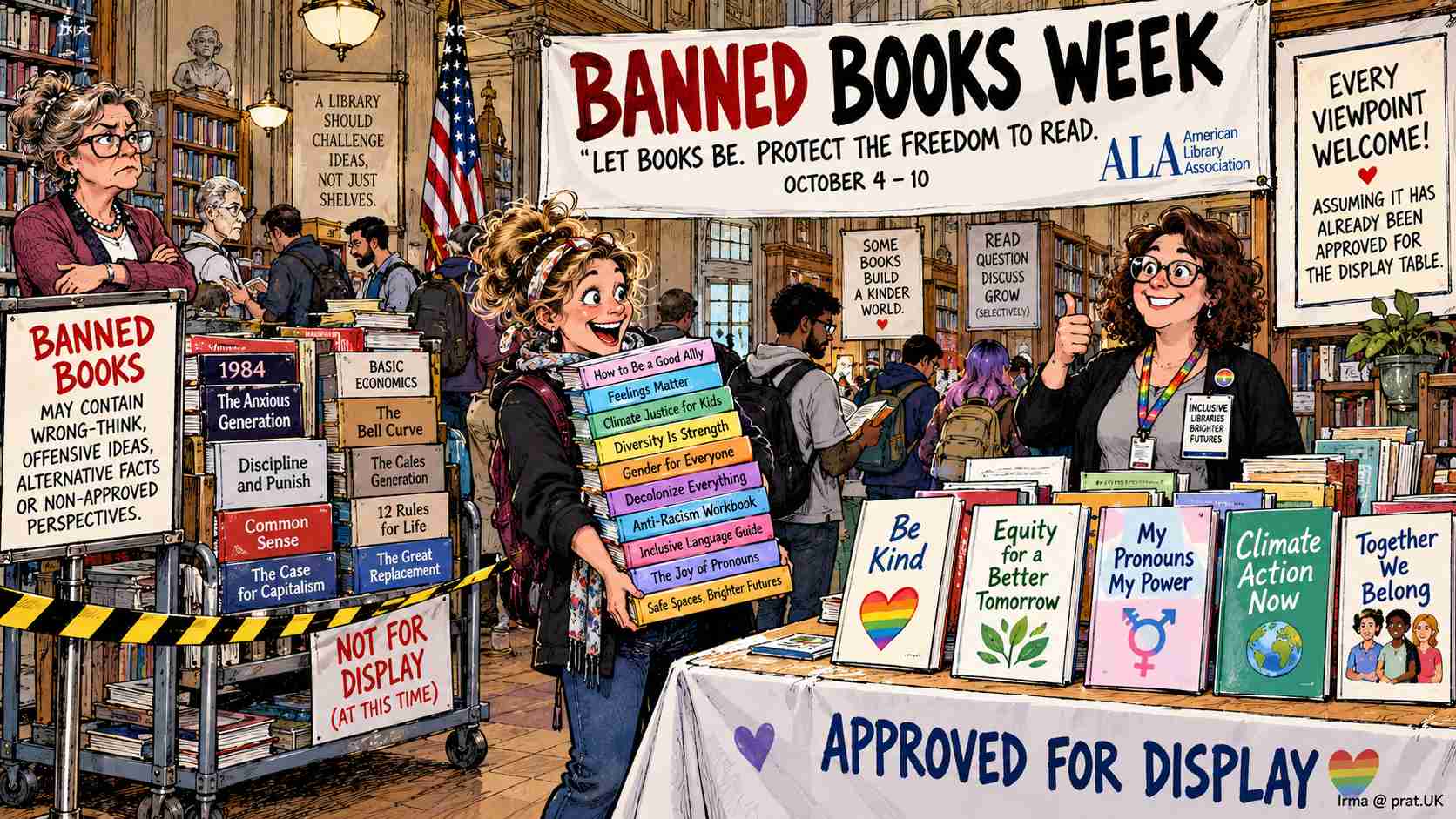
CHICAGO | Banned Books Week returns October 4 through 10 under the American Library Association’s wonderfully uncomplicated theme, “Let Books Be. Protect the Freedom to Read.” The festivities arrive amid a fresh argument over whether organizations dedicated to combating censorship sometimes practice a subtler form of ideological selection themselves, a criticism raised Friday by Daniel J. Flynn in National Review.
This is an important American debate because nothing demonstrates our national commitment to unrestricted intellectual inquiry quite like spending six months arguing over which books should occupy a folding table beside the photocopier.
The American Library Association says Banned Books Week exists to oppose attempts to remove or restrict books in libraries and schools. Its Office for Intellectual Freedom reported 4,235 unique titles challenged in 2025, the second-highest number it has recorded. ALA defines a challenge as an attempt to remove or restrict material and a ban as its removal. Those are real distinctions, and real disputes over access plainly exist.
But then comes the wonderfully uncomfortable question.
Who decides which controversies become the censorship controversy?
And suddenly everyone looks at the carpet.
Anti-Censorship Campaigners Demand End to Book Bans, Quietly Move Wrong-Think Books Beside Boiler Manual
Flynn’s criticism is not that Banned Books Week should disappear. His argument is that the movement presents what he describes as a politically “monolithic” public face while drawing attention to some forms of suppression far more energetically than others.
That is where satire enters carrying a library card and asking inconvenient questions.
Because apparently there are several levels of literary freedom.
Level One is BANNED, which is terrible.
Level Two is CHALLENGED, which is also terrible.
Level Three is AVAILABLE, which sounds pretty good.
Then there is Level Four:
Technically available, but located on the bottom shelf behind a 680-page county drainage report beneath a flickering fluorescent tube last replaced during the Reagan administration.
Nobody banned it.
Nobody censored it.
Nobody removed it.
Nobody can find it without a flashlight, a compass and three semesters of archival science.
This is known professionally as victory for intellectual freedom.
A satirical librarian interviewed for this report explained the distinction.
“We absolutely support every viewpoint,” she said, carefully lowering her voice. “Some viewpoints are supported on the front display with bookmarks, posters and an author webinar. Other viewpoints are supported geographically.”
Geographically?
“Yes. Basement. Northeast corner.”
That is the beautiful thing about modern censorship. We have become much too sophisticated to burn books.
Fire is vulgar.
We have metadata now.
Libraries Declare War on Censorship, Introduce Revolutionary Policy: Every Viewpoint Welcome Provided It Already Has a Display Table
ALA’s own Freedom to Read language, and its Banned Books Week proclamation, contains a line that deserves applause from virtually everybody involved in this debate. It says Americans favor a “free enterprise in ideas and expression” and can be trusted to exercise critical judgment.
Excellent.
That is practically Hayek with late fees.
Free enterprise in ideas means you do not need an Intellectual Department of Agriculture deciding which opinions receive fertilizer.
Put the books out there.
Let Milton Friedman fight Karl Marx near the drinking fountain.
Let Thomas Sowell share an aisle with Noam Chomsky.
Let Edmund Burke glare suspiciously across the stacks at Jean-Jacques Rousseau.
If civilization survives the encounter, congratulations. You have a library.
If it does not, at least the collapse will be properly footnoted.
The difficulty begins when “free enterprise in ideas” becomes suspiciously similar to a shopping mall where management insists every store is welcome but somehow certain tenants keep receiving parking spaces beside the loading dock.
A library obviously cannot put every book on its promotional tables. Selection is inevitable. There are only so many tables, so many posters and so many pieces of construction paper available before the children’s department starts asking questions.
That does not make selection censorship.
But it does make selection selection.
And once institutions begin presenting themselves as neutral defenders of the entire intellectual ecosystem, people are entitled to ask whether the landscaping crew keeps watering only one side of the garden.
That is not an argument for banning anybody’s books.
It is an argument for enlarging the garden.
Banned Books Activists Condemn Gatekeeping, Immediately Appoint Themselves Gatekeepers of Which Gatekeeping Counts
Modern politics has developed a marvelous linguistic trick.
When the other side refuses access to something, it is censorship.
When our side refuses access, it is moderation.
When they remove a speaker, it is silencing.
When we remove a speaker, it is community standards.
When they decide which ideas deserve prominence, they are gatekeepers.
When we do it, we are curators.
A curator is essentially a gatekeeper with better glasses.
The argument becomes even funnier because every faction now possesses its own customized First Amendment emergency siren.
Conservatives discover censorship whenever a university cancels a controversial speaker.
Progressives discover censorship whenever a school board removes a controversial book.
Libertarians discover censorship whenever anybody discovers censorship and immediately start yelling, “WHY IS THERE A BOARD INVOLVED?”
Meanwhile, ordinary Americans are standing outside the library wondering whether anybody remembers where the tax forms are.
America Discovers a Banned Book Can Be Both Suppressed and Available in Paperback, Hardcover, Kindle and Audiobook
The phrase “banned book” itself has enormous marketing power.
Publishers should be required to disclose this.
Nothing turbocharges adolescent curiosity faster than telling a 15-year-old, “Powerful adults desperately hope you never discover what is inside this book.”
You might as well attach fireworks to it.
Tell a teenager, “This is an important literary classic,” and he will develop instantaneous narcolepsy.
Tell him, “The school board held a six-hour emergency meeting because of page 147,” and that kid will have the audiobook downloaded before the superintendent reaches his Buick.
America may therefore have accidentally created the first censorship system that occasionally functions as an advertising campaign.
The genuinely serious issue is access. A book unavailable because government authorities removed it presents a different problem from a book that remains freely obtainable but was not selected for a promotional display. Collapsing those categories makes sensible discussion harder.
It is perfectly possible to oppose actual book removals while also questioning ideological conformity among organizations campaigning against them.
Human beings are capable of holding two thoughts simultaneously.
Scientists believe the phenomenon may someday reach Congress.
Bohiney Institute Poll Finds 93 Percent Support Intellectual Diversity Until Second Opinion Appears
In a completely unscientific survey conducted around our office coffee pot, 93 percent of respondents strongly supported intellectual diversity.
Support fell to 41 percent after we explained that intellectual diversity involved encountering ideas they disliked.
It fell to 12 percent after respondents learned they might have to read them.
It recovered to 97 percent when we clarified that merely purchasing the book and placing it impressively on a coffee table would qualify.
This tells us almost nothing, which means it is now ready for cable news.
But the joke contains a recognizable human tendency.
Most people adore freedom abstractly.
Freedom is majestic.
Freedom gets monuments.
Freedom receives orchestral music.
Then somebody actually uses it.
Suddenly there is a committee meeting Tuesday at 7.
The Proper Cure for Bad Books Remains More Books: Why Libraries Should Defend Free Speech and Intellectual Freedom
There is, fortunately, a revolutionary solution available. It is roughly what Milton’s Areopagitica argued in 1644, and it has aged better than most library display policies.
Put more competing ideas on the shelves.
When someone writes a bad argument, publish a better one.
When someone writes an offensive history, place another history beside it.
When somebody publishes ideological nonsense, resist the temptation to make it disappear.
Keep it available so future generations can study exactly how ideological nonsense works.
Libraries should be intellectual boxing gyms.
Every argument gets gloves.
Nobody gets to remove the other boxer before the bell.
And readers get to decide who landed the punch.
That philosophy also has the magnificent advantage of annoying everyone equally.
The right must tolerate books it considers radical.
The left must tolerate books it considers reactionary.
Religious readers encounter atheists.
Atheists encounter theologians.
Capitalists encounter Marxists.
Marxists discover the economics section and eventually ask why all the books about price controls keep ending badly.
Everybody goes home irritated.
That is pluralism working.
Banned Books Week Should Consider Its Most Dangerous Exhibition Yet: Books Its Organizers Disagree With
Banned Books Week’s 2026 slogan is “Let Books Be.”
Wonderful.
Perhaps next year the movement can conduct the ultimate stress test.
Fill one table with books challenged by conservatives.
Fill another with books disliked by progressives.
Add controversial religious books, atheist books, socialist books, capitalist books, radical books, traditionalist books and several books nobody understands but graduate students keep nodding at.
Then place one enormous sign above the entire collection:
YOU ARE AN ADULT. FIGURE IT OUT.
No trigger warning.
No ideological nutrition label.
No curator standing nearby whispering which author history has authorized you to admire.
Just books.
Some magnificent.
Some offensive.
Some brilliant.
Some ridiculous.
Some capable of changing your life.
Some capable only of making you wonder how the author found a publisher.
That is what freedom to read ultimately means.
Not freedom from terrible arguments.
Freedom to encounter them.
Because the great paradox of intellectual liberty is wonderfully inconvenient: defending expression becomes meaningful precisely when the expression is something you would rather throw behind the boiler manual.
15 Humorous Observations Behind the Banned Books Week Story
- Banned Books Week has reached the fascinating stage where freedom of expression apparently requires a merchandising department.
- A truly banned book is surprisingly difficult to buy, whereas many “banned books” arrive tomorrow with free shipping.
- The easiest way to make teenagers interested in a book is to announce that adults desperately do not want them reading it.
- Modern censorship debates often resemble two neighborhood associations fighting over who gets custody of the First Amendment.
- Libraries contain thousands of viewpoints, but the display table has room for twelve, which means somebody eventually becomes the nightclub bouncer of intellectual diversity.
- Nothing says “dangerously suppressed literature” quite like a commemorative poster, tote bag, webinar, national campaign, and prominently positioned display.
- Americans no longer burn troublesome books. We place them in administrative purgatory near Residential Boiler Maintenance, 1987 Edition.
- Every ideological faction believes censorship is terrible immediately after finishing its list of things nobody should say.
- “Freedom to read” is easy. “Freedom to read something I find idiotic” is where civilization starts charging overtime.
- A library can own 40,000 books and still create a political controversy over the fourteen sitting beside the checkout desk.
- The modern banned-book argument occasionally confuses “you cannot obtain this book” with “the librarian did not build it a little shrine.”
- Gatekeeping becomes much more respectable when the gatekeeper wears a conference lanyard.
- The most dangerous book in America may be the one nobody has placed on either side’s outrage list.
- If every controversial book received equal promotional treatment, libraries would need display tables the size of Nebraska.
- The purest test of free expression is not defending a book you love. It is defending somebody else’s dreadful book while resisting the urge to hide it behind the municipal plumbing codes.
Disclaimer
This is satire. Real book challenges, removals and disputes over access exist, and the American Library Association documents thousands of challenged titles annually. The comic argument here concerns consistency: a culture committed to intellectual freedom should scrutinize censorship, selective promotion, ideological conformity and gatekeeping wherever they appear, rather than assuming virtue automatically follows the person holding the “Free Speech” sign.
This story is entirely a human collaboration between two sentient beings: the world’s oldest tenured professor and a philosophy major turned dairy farmer. Any resemblance to an editorial committee is deeply unfortunate.