

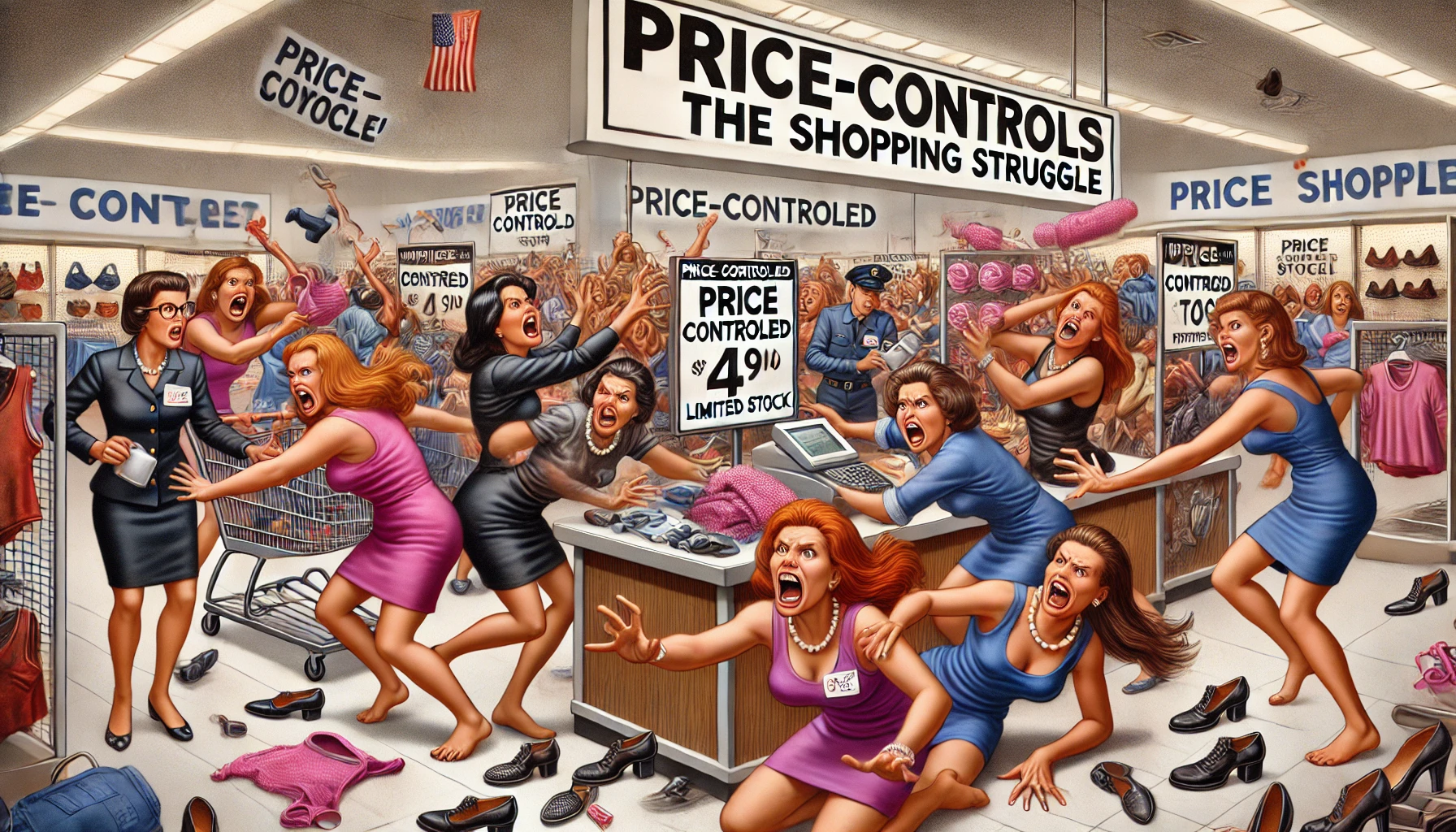
Price Controls vs. Women Shoppers: When the Battle of the Bargains Meets the War on Wallets
The Shopping Struggle: Price Controls and Female Shoppers
Somewhere Between the Mall and the Madness — When it comes to shopping, women have long been experts in the art of finding deals, navigating sales, and justifying that extra pair of shoes. But what happens when price controls get in the way of a good bargain? Chaos, that’s what.
Price controls, those government-imposed limits on how much you can charge for goods, might sound like a good idea in theory. After all, who doesn’t want to keep costs low? But when it comes to female shoppers, price controls are like a bad fitting room mirror—nothing good can come of it.
Shoes on Lockdown: The Price Control Crisis
One of the first casualties of price controls? Shoes. Imagine walking into your favorite store, only to find out that the price of every pair is fixed at a higher rate than the sales you used to enjoy. Suddenly, those cute heels aren’t so appealing, and the hunt for the perfect bargain turns into a bitter battle.
One frustrated shopper, who preferred to remain anonymous (likely to protect her shoe collection), said, “I used to love finding deals on shoes, but now with price controls, it’s like the thrill is gone. It’s a tragedy, really.”
Experts agree that price controls on shoes are a recipe for disaster. “Women shop for shoes not just because they need them, but because it’s an experience,” one fashion psychologist explained. “When you take away the ability to find a good deal, you’re taking away the joy of the hunt.”

Handbags: The New Contraband
Next up on the price control hit list: handbags. With luxury bags suddenly subject to price ceilings, the underground market has exploded. Women who once proudly flaunted their designer purses are now discreetly swapping them like contraband.
“I never thought I’d be involved in a black-market handbag trade,” admitted one shopper, “but desperate times call for desperate measures.”
Public opinion is split on this one. Some believe that price controls on handbags are necessary to curb excessive spending, while others argue that it’s an infringement on personal freedom. “If I want to spend my hard-earned money on a purse, that’s my business,” one woman declared. “Now I’m just doing it under the radar.”

Skincare Shortages: The Wrinkle in Price Controls
When price controls hit the skincare aisle, things really got ugly. Suddenly, women were faced with a shortage of their favorite lotions and serums. What was once a leisurely trip to the beauty store turned into a frantic search for supplies.
“I went to three different stores looking for my moisturizer, and it was sold out everywhere,” one shopper lamented. “I ended up buying it from a friend who had stockpiled it. She charged me double, but what choice did I have?”
The situation has become so dire that some women are resorting to DIY skincare remedies. “I never thought I’d be making my own face masks out of kitchen ingredients,” said one woman, “but here we are. Thanks, price controls.”
Price ceilings, which set a maximum price that can be charged for a good, always lead to shortages.

The Chocolate Catastrophe
Perhaps the most shocking development in the world of price controls has been the impact on chocolate. Yes, chocolate. With prices capped and supply dwindling, the once-abundant sweet treat has become a rare commodity.
“I walked into the store, and the chocolate shelf was empty,” one shopper recounted with horror. “Empty! Do you know what that does to a woman who’s just had a rough day?”
The public outcry has been swift. Chocolate lovers across the nation are demanding that the government lift the price controls, arguing that chocolate is a necessity, not a luxury. “If they don’t fix this soon, there’s going to be a revolt,” warned one woman as she clutched her last remaining bar of dark chocolate.
Makeup Mayhem: Lipstick Limits
In another blow to female shoppers, price controls have hit the makeup industry. Suddenly, women are finding it harder to score deals on their favorite lipstick shades, and the black market for cosmetics is booming.
“I had to pay twice the retail price for my favorite lipstick,” one woman confessed. “But what can you do? A girl’s gotta look good.”
Experts have weighed in on the situation, noting that price controls on makeup could have unintended consequences. “When women can’t access affordable beauty products, it affects their self-esteem and confidence,” one beauty industry insider explained. “It’s not just about looking good; it’s about feeling good.”
Bad Hair Days Ahead: The Price Control Effect
Hair products have not been spared from the wrath of price controls, and the result has been a wave of bad hair days across the country. With the cost of shampoos, conditioners, and styling products skyrocketing, women are being forced to make do with less.
“My hair has never looked worse,” one woman grumbled. “I used to buy salon-quality products, but now I’m stuck with whatever’s cheapest. It’s a nightmare.”
Public opinion on this issue is divided. Some argue that price controls on hair products are necessary to prevent price gouging, while others believe that women should be able to splurge on their hair care if they want to. “It’s my hair, my choice,” one woman declared.
Yoga Pants Crisis: The Stretch of Price Controls
Price controls have even made their way into the world of fitness gear, with yoga pants now subject to strict pricing regulations. For women who live in their yoga pants—whether at the gym or the grocery store—this has been a major blow.
“I used to buy a new pair of yoga pants every month,” said one fitness enthusiast. “But now, with these price controls, I’m stuck wearing the same pair over and over. It’s just not right.”
Fitness experts are concerned that the price controls on workout gear could lead to a decline in physical activity. “When women don’t feel comfortable in their workout clothes, they’re less likely to exercise,” one trainer explained. “It’s a slippery slope.”
The Jewelry Debacle: No Sparkle for You
Jewelry, once a go-to splurge for many women, has also fallen victim to price controls. With the cost of gold and diamonds now tightly regulated, finding a good deal on a piece of jewelry has become nearly impossible.
“I used to treat myself to a little bling every now and then,” said one woman. “But now, with these price controls, it’s like the sparkle has been taken out of my life.”
Jewelry retailers are feeling the pinch as well. Many have reported a decline in sales, with customers opting to hold off on purchases until the price controls are lifted. “It’s a tough time for the industry,” one jeweler admitted. “But we’re hopeful that things will bounce back once the regulations are eased.”
Candle Crisis: Romance on a Budget
Price controls on candles may not seem like a big deal, but for women who love to create a cozy, romantic atmosphere at home, it’s been a major disappointment. With prices capped and supplies limited, finding the perfect candle has become a challenge.
“I used to stock up on candles whenever there was a sale,” said one woman. “But now, with these price controls, I can barely find any, and when I do, they’re way more expensive than they used to be.”
Candle enthusiasts are calling for an end to the price controls, arguing that candles are essential for setting the mood and creating a relaxing environment. “A home without candles is like a date without romance,” one woman quipped.
Coffee Shop Chaos: Caffeine Control
Perhaps the most controversial aspect of price controls has been their impact on coffee shops. With the cost of a latte now tightly regulated, women who rely on their daily caffeine fix are feeling the effects.
“I used to stop by my favorite coffee shop every morning,” said one woman. “But now, with these price controls, I’m making my coffee at home, and it’s just not the same.”
Public opinion is divided on this issue as well. Some argue that price controls on coffee are necessary to prevent price gouging, while others believe that coffee should be exempt from regulation altogether. “Coffee is life,” one woman declared. “Don’t mess with my coffee.”
The Accessory Problem: No More Fun?
Accessories, long considered a fun and affordable way to update a wardrobe, have also been affected by price controls. With prices now fixed, finding a good deal on a scarf or a pair of earrings has become a rare occurrence.
“I used to love shopping for accessories,” said one woman. “But now, with these price controls, it feels like all the fun has been taken out of it.”
Fashion experts are concerned that the price controls could lead to a decline in accessory sales, as women opt to hold off on purchases until prices return to normal. “Accessories are the icing on the cake,” one stylist explained. “Without them, fashion just isn’t as fun.”
Fitness Gear Fiasco: Price Controls at the Gym
Fitness gear, from yoga mats to dumbbells, has also been hit by price controls. For women who take their workouts seriously, this has been a major inconvenience.
“I used to buy new workout gear all the time,” said one fitness enthusiast. “But now, with these price controls, it’s like the gym has lost its sparkle.”
Fitness experts are concerned that the price controls could lead to a decline in physical activity, as women are less likely to invest in new gear. “When you feel good in your workout clothes, you’re more likely to exercise,” one trainer explained. “Price controls are taking away that motivation.”
Perfume Problems: The Scent of Rebellion
Perfume, once a go-to splurge for many women, has also fallen victim to price controls. With the cost of luxury fragrances now tightly regulated, finding a good deal on a bottle of perfume has become nearly impossible.
“I used to treat myself to a new perfume every few months,” said one woman. “But now, with these price controls, it’s like I’m stuck wearing the same scent all the time.”
Perfume retailers are feeling the pinch as well. Many have reported a decline in sales, with customers opting to hold off on purchases until the price controls are lifted. “It’s a tough time for the industry,” one perfumer admitted. “But we’re hopeful that things will bounce back once the regulations are eased.”
Dress Dilemmas: The Price Control Effect
Finally, dresses—long considered a wardrobe staple—have also been affected by price controls. With prices now fixed, finding a good deal on a new dress has become nearly impossible.
“I used to love shopping for dresses,” said one woman. “But now, with these price controls, it feels like all the fun has been taken out of it.”
Fashion experts are concerned that the price controls could lead to a decline in dress sales, as women opt to hold off on purchases until prices return to normal. “Dresses are the ultimate expression of femininity,” one stylist explained. “Without them, fashion just isn’t as fun.”
Step-by-Step Guides for Navigating Price Controls
For women struggling to cope with the effects of price controls, here are some practical tips:
- Pro tips: Look for sales and discounts whenever possible—just because prices are controlled doesn’t mean you can’t find a deal.
- Insider knowledge: Shop at off-peak times to avoid crowds and score the best selection.
- Expert insights: Don’t be afraid to shop online—sometimes you can find better deals than in stores.
- Best practices: Stay flexible with your shopping list—if your favorite item is out of stock, try something new.
- Comprehensive coverage: Keep an eye on the news for updates on price controls—they might not last forever.
Price Controls—The Real Cost of Shopping?
As price controls continue to impact female shoppers, the question remains: are they really helping, or are they just making things more difficult? Only time will tell, but for now, it’s clear that the effects are being felt across the board. From shoes to skincare, women are finding it harder than ever to get the deals they once took for granted. And while some are finding ways to cope, others are simply hoping that the price controls will be lifted sooner rather than later.
Disclaimer
This article is a blend of satire and reality. Any resemblance to actual shopping experiences is purely coincidental—except for the part about shoes. We all know that’s true. This is a human collaboration between two beings—one who loves to shop and one who prefers to write.
Price Controls – Economics 101 (Basics)
Price ceilings, which are government-imposed limits on the prices that can be charged for goods and services, can have several harmful effects on an economy. While they may be implemented with the intention of protecting consumers from high prices or ensuring affordability of essential goods, price controls often lead to unintended negative consequences. Here are some of the key harmful effects:
1. Shortages
- Price ceilings, which set a maximum price that can be charged for a good, always lead to shortages. When the price is kept artificially low, demand increases, but suppliers may find it unprofitable to produce and sell the good at that price. This mismatch between supply and demand leads to shortages, as seen in cases like rent control, where housing becomes scarce.
2. Reduced Quality
- To compensate for the lower prices imposed by price ceilings, producers might reduce the quality of their products. For instance, in the case of rent controls, landlords may cut back on maintenance and repairs to save costs, leading to deteriorated housing conditions.
3. Black Markets
- Price ceilings often lead to the emergence of black markets, where goods are sold at higher prices outside of the regulated system. This is because the artificially low prices create a gap between supply and demand, incentivizing illegal transactions at market-determined prices. A historical example includes the rationing and black markets for food and other essentials during wartime.
4. Misallocation of Resources
- Price ceilings can distort market signals, leading to inefficient allocation of resources. For example, if the price of gasoline is capped, consumers may overuse it, leading to waste and a lack of incentives for producers to invest in more production. This misallocation can hinder economic growth and innovation.
5. Reduced Investment
- Price ceilings can deter investment in industries where profits are artificially limited. When businesses cannot charge prices that reflect the cost of production and provide a return on investment, they may reduce or cease investment in that sector, leading to reduced growth and innovation over time.
6. Surpluses (in the case of price floors)
- Price floors, which set a minimum price that can be charged, can lead to surpluses. For example, agricultural price supports may lead to overproduction of certain crops, resulting in wasted resources and excess supply that cannot be sold at the controlled price.
7. Increased Government Spending
- To manage the consequences of price controls, governments often need to spend more on enforcement, subsidies, and other interventions. This can strain public finances and lead to inefficiencies in government spending.
8. Harm to Small Businesses
- Price controls can disproportionately affect small businesses that lack the financial flexibility to absorb the reduced profits. Larger corporations may be able to withstand price controls by cutting costs elsewhere or through economies of scale, but smaller businesses may struggle to survive, leading to reduced competition in the market.
9. Long-Term Economic Distortions
- Over time, the persistent use of price controls can lead to more significant economic distortions, such as reduced innovation, lower productivity, and slower economic growth. The economy becomes less dynamic, and the market loses its ability to efficiently allocate resources based on supply and demand.
10. Unintended Consequences
- Price controls can have a range of unintended consequences that policymakers may not foresee. For example, during the 1970s, the U.S. government imposed price controls on oil, which led to long lines at gas stations, gasoline shortages, and a decline in domestic oil production.
From Shoes to Shampoos: How Price Controls Are Turning Shopping Sprees into Shopping Snafus
15 Educational Observations About Price Controls and Female Shoppers
- Price ceilings on shoes? That’s like telling a woman she can only buy one pair in her favorite color—disaster in the making.
- When price ceilings hit handbags, expect a black-market boom in designer knock-offs.
- Price ceilings on skincare products? Prepare for an underground lotion exchange.
- Imagine trying to limit the price of chocolate—now you’ve got a national crisis on your hands.
- Price ceilings on makeup? Suddenly, eyeliner smuggling is a thing.
- “Sorry, ladies, no more sales on lipstick”—words that could start a revolution.
- When price ceilings hit hair products, prepare for some seriously bad hair days.
- Price ceilings on yoga pants? Now we’re just stretching the limits of sanity.
- Tell a woman she can’t get a discount on jewelry, and she’ll find a way to sparkle anyway.
- Price ceilings on candles? Well, now romance will officially cost you.
- When price ceilings hit coffee shops, expect an uprising fueled by caffeine withdrawal.
- Limiting prices on accessories? You might as well ban fun altogether.
- Price ceilings on fitness gear—because apparently, the government wants us to be out of shape, too.
- Trying to cap the price of perfume? Get ready for a whiff of rebellion.
- Price ceilings on dresses? Welcome to a world where even window shopping feels like a crime.
Originally posted 2024-08-16 14:10:02.