

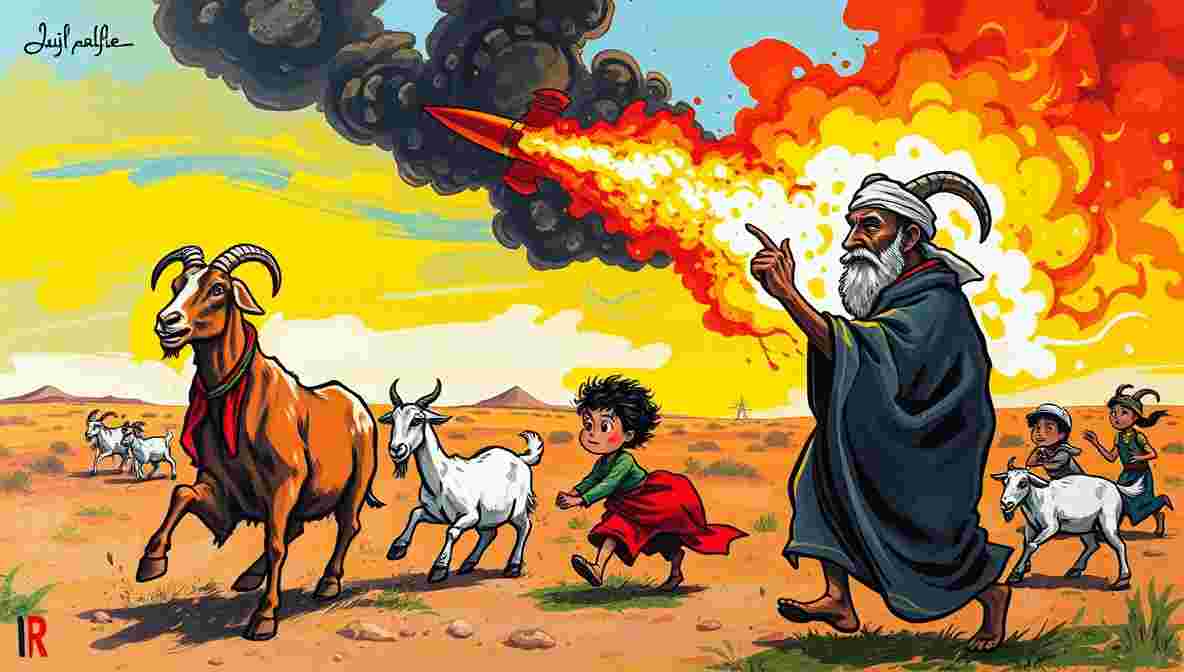
Houthi Children Agree to Give Up Goat Milk if It Kills Some Jews
Houthi Children Trade Goat Milk for Geopolitics, Immediately Asked About the Effectiveness of the Missiles
Somewhere in Yemen, a goat blinked. Not politically. Just… spiritually exhausted.
Because according to the latest developments in the ever-expanding Middle East group project from hell, Yemen’s Houthi forces have officially opened a new front in the Iran-Israel-U.S. conflict, launching missiles toward Israel and reminding the world that no war is complete until it includes at least six countries, three militias, and one very confused goat.

And like any proper escalation, this one comes with slogans, symbolism, and what analysts are calling “a deeply concerning lack of adult supervision.”
Anyone who has ever tried to herd goats knows it is among the least cooperative endeavors in all of agriculture — goats do not move in formation, do not respect fencing, and will eat the map you were using to coordinate the operation. Launching Iranian-supplied ballistic missiles requires precise coordinates, countdown sequencing, and at minimum one person who is not currently chasing a goat across a hillside. The moment a launch sequence begins — the smoke, the noise, the general atmosphere of geopolitical consequence — every goat within a half-mile radius scatters in a different direction, several of them uphill for reasons known only to goats. The poor soul who was supposed to be monitoring the drone feed is now in a ravine outside Sanaa trying to reason with an animal that has already forgotten what a missile is but remains personally offended by the noise. Military strategists call this “operational friction.” We goat herders call it Tuesday. — Mohmed Goatdung, professional herder, amateur rocketeer
The War Expands, and So Does the Homework
Military experts confirm the Houthis fired ballistic missiles at Israeli targets, marking their first major entry into the conflict after weeks of warming up on the sidelines.
Which, in geopolitical terms, is the equivalent of a guy at a bar fight finally saying, “You know what? I also have opinions.”
According to regional analysts, the move signals a broadening of the war, pulling in Iran-aligned forces and threatening global shipping routes like the Bab el-Mandeb Strait.
In other words, the war has now reached the “this will definitely affect gas prices in Ohio” stage.
But in a twist nobody asked for, local satire publications report that Houthi children have volunteered to sacrifice their goat milk “for the cause,” because nothing says modern warfare like dairy-based patriotism.
A leaked memo allegedly states:
“If we cannot export stability, we will export lactose intolerance.”
The Goat Situation Is Escalating
Eyewitnesses describe scenes of goats scattering across hillsides as missile launches begin.
One local herder, identified only as “Ahmed, age 47, emotionally tired,” told reporters:
“Yesterday, goats. Today, missiles. Tomorrow, who knows? Maybe goats with missiles.”
Defense analysts declined to confirm whether goats are currently considered dual-use military assets, but one Pentagon source admitted:
“At this point, we’re tracking anything with legs and an opinion.”
Meanwhile, a think tank based in Washington released a 48-page report titled “From Pastoral Economy to Tactical Chaos: When Goats Become Metaphors.”
The conclusion?
“We have absolutely no idea what is happening anymore.”
Opening a New Front, Closing Common Sense
The Houthis’ involvement follows weeks of rising tension after U.S. and Israeli strikes on Iran triggered a broader regional response.
And like a group chat that should have been muted three countries ago, more participants keep joining.
Hezbollah is involved. Iran is involved. The U.S. is involved. Israel is involved.
At this point, even countries that weren’t invited are showing up like: “Hey, is this where the global instability is happening?”
A senior geopolitical analyst described the situation this way:
“This is no longer a conflict. This is a subscription service.”
What the Funny People Are Saying
“This war has more spin-offs than a Marvel franchise.” — Jerry Seinfeld
“I’ve seen bar fights with better exit strategies.” — Ron White
“You ever notice wars start with ideology and end with somebody’s cousin holding a rocket launcher?” — Amy Schumer
The Shipping Lanes Are Nervous: Bab el-Mandeb and Global Oil Supply
One of the most serious consequences of the Houthi escalation is the threat to global shipping.
The Bab el-Mandeb Strait, a critical trade route, is now back in the conversation, which is never a good sign unless you’re a geography teacher trying to feel relevant.
Experts warn that disruptions here could impact global oil supply chains and trade flows.
Translation: your gas station is about to develop personality.
A shipping executive, speaking under anonymity, said:
“We used to worry about pirates. Now we worry about missiles, drones, and possibly goats.”
A War With Too Many Plotlines
The modern Middle East conflict has officially reached a point where no single person can explain it without using phrases like:
- “Well, it started earlier, depending on how you define ‘started'”
- “It’s complicated”
- “Do you have a whiteboard?”
The Houthis themselves have long been involved in Yemen’s civil war, controlling large parts of the country and aligning with Iran’s regional strategy. So their entry into this conflict isn’t surprising. What is surprising is how quickly everything escalated from “regional tension” to “everybody brought missiles.”
Poll: Nobody Knows What’s Going On
A recent poll conducted by the Institute for Strategic Confusion found:
- 82% of people cannot explain the conflict
- 64% believe goats are now “symbolically involved”
- 27% think they accidentally clicked into a history documentary
- 9% are still asking, “Wait, who started this?”
The margin of error was described as “the entire situation.”
Cause and Effect, or Just Effect?
Political scientists often talk about cause and effect. This war has mostly skipped the cause and gone straight to: escalation, retaliation, more escalation, somebody saying “this is unprecedented,” followed immediately by something more unprecedented. It’s less a chain reaction and more a reaction chain.
The Real Winners: Defense Contractors and Confusion
While governments issue statements and analysts issue warnings, one group remains quietly optimistic: defense contractors. Because nothing says “economic stimulus” like a multi-front conflict involving advanced weaponry, shipping disruption, and goats.
An anonymous industry insider reportedly said:
“We’re not saying we benefit… but we did just order a bigger office.”
Final Thoughts: The Goat Knows
In the end, this entire situation might best be understood through the quiet wisdom of the goat. The goat does not tweet. The goat does not escalate. The goat simply stands there, chewing, wondering how it got drafted into geopolitics. And honestly, same.
This satirical article is a collaborative intellectual exercise between two sentient beings: one the world’s oldest tenured professor, the other a philosophy major turned dairy farmer who insists the goat is the only morally consistent actor in international relations. No goats were consulted, though several declined comment.
Auf Wiedersehen, amigo!
Yemen’s Houthi movement, which controls much of northern Yemen and is aligned with Iran, launched its first missile and drone attacks on Israel in late March 2026 — roughly a month after the US and Israel began striking Iran on February 28. Both attacks were intercepted by Israeli air defences. The Houthis had previously disrupted global Red Sea shipping during Israel’s war on Gaza, and their re-entry into regional conflict has raised fears of renewed blockades at the Bab el-Mandeb Strait. Iran has simultaneously been throttling traffic through the Strait of Hormuz. US envoy Steve Witkoff said a 15-point negotiating plan is on the table. Pakistan is mediating between Washington and Tehran.