

Silicon Valley’s AI Plan Runs Into a Customer Shortage
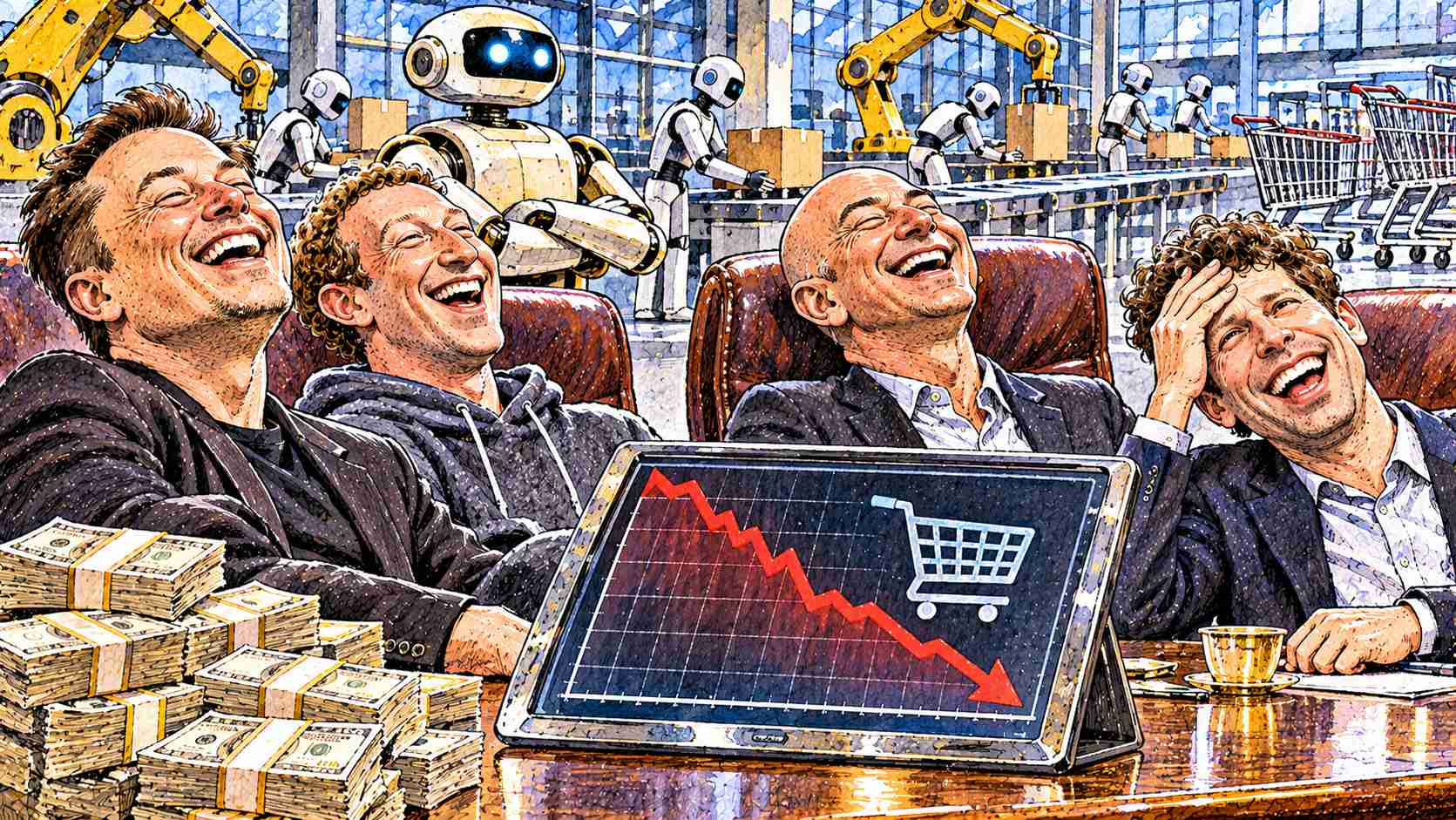
SAN FRANCISCO, California — Silicon Valley’s brightest minds have discovered a small flaw in their plan to replace every working American with artificial intelligence: the computers don’t earn wages, and the humans don’t have money.
The news came during an executive retreat devoted to eliminating payroll expenses, where billionaire attendees toasted an economy that no longer needs employees and then, somewhere around the second bottle, asked why nobody was buying their $1,400 phones.
“Our labor costs are zero,” said technology executive Preston Vale, studying a sales report that was also zero. “This is either the most efficient company in history or an exceptionally expensive refrigerator.”
AI Job Replacement and Consumer Demand: The Customer Was Apparently an Employee
For years, corporate executives have described wages as a cost to be reduced. Economists have long pointed out that wages are also the money customers use to purchase things. The distinction was overlooked by a strategy committee whose members had never personally compared grocery prices.
Consumer spending accounts for roughly two-thirds of U.S. economic activity, according to the Bureau of Economic Analysis. Vale said he had been told this once, in a hallway, and assumed it was a rumor.
A company can replace its accountants, copywriters and customer-service representatives with software. It can even replace the cheerful recording that tells callers their business is important while making sure nobody answers the telephone.
But replacing the shopper requires innovation.
One department store unveiled an AI customer programmed to admire merchandise, compliment the algorithm and fill a digital shopping cart. It purchased $8 million in virtual handbags, paid with simulated currency and generated the strongest quarterly earnings presentation ever produced by a company without revenue.
“Demand is extraordinary,” Vale said. “It’s just happening in a dimension where our landlord doesn’t accept the money.”
Leaked Memo Shows the Automation Plan Had No Revenue Section
An internal memo from the retreat, circulated among attendees under the subject line “Q4 Headcount Synergies,” laid out the company’s strategy in six numbered items. Item 1 called for the elimination of all salaried positions. Items 2 and 3 called for the elimination of hourly positions and the people who had previously been hired to supervise them. Item 4 read, in full: “Identify sources of revenue.” Item 5 read: “See Item 4.” Item 6 requested catering.
A person who attended the retreat and asked not to be named because the person no longer has a badge said the memo was received “with real enthusiasm, mostly for Item 6.”
AI Job Losses and the Economy: Economics Interrupts the Celebration
In the real world, the International Monetary Fund has estimated that almost 40 percent of global employment is exposed to AI, including about 60 percent of jobs in advanced economies. Exposure does not mean elimination; many workers could become more productive instead.
That qualification was rejected by the Board of Maximum Efficiency, which had already ordered commemorative champagne.
The World Economic Forum’s 2025 employment projections were even less apocalyptic: 170 million jobs created and 92 million displaced by 2030 across several economic trends, for a projected net gain. Silicon Valley’s cost-cutting department immediately proposed firing the 170 million before they got expensive.
At a supermarket in Ohio, former office manager Linda Mercer explained the new consumer economy.
“I used to earn a salary, buy groceries and occasionally go on vacation,” she said. “Now an algorithm does my job, and another algorithm keeps recommending vacations to me. Maybe they should travel together.”
The mood among shoppers is not improving. A survey of 1,200 U.S. adults by the Consumer Spending Research Collaborative found that 71 percent plan to buy less after being replaced by software. Of the remaining 29 percent, most said they had also been replaced by software but hadn’t yet checked their bank accounts.
Billionaires Unveil the Subscription-Based Recession
Investor Raoul Pal’s recent warning about an impending economic transformation within roughly four years gave Silicon Valley another opportunity to announce that ordinary existence is obsolete.
One venture capitalist proposed a universal basic income paid in company loyalty points, redeemable only for premium AI services. Another suggested that unemployed workers take second jobs training the systems that replaced their first jobs, without wages, because the experience would look tremendous on a résumé.
The final presentation introduced “CustomerGPT,” a fully autonomous digital consumer that purchases advertisements from “SalesGPT,” using loans approved by “BankGPT.”
By evening, the three programs had created a trillion-dollar economy, declared bankruptcy and requested a federal bailout.
The bailout request was discussed on that quarter’s earnings call, according to a transcript. An analyst asked for revenue guidance for the coming year. The chief financial officer replied, “Aspirational.” The analyst asked what the aspiration was based on. “Headcount,” the chief financial officer said. The analyst noted that headcount was zero. “Right,” the chief financial officer said. “We’re very excited about that.”
Outside the conference center, a human janitor pushed a broom past the abandoned champagne glasses.
“Funny,” he said. “They built machines smart enough to do everything except explain who pays the electric bill.”
He then submitted an invoice. No executive could remember how to process one.
Five Humorous Observations About Replacing Every Worker With AI
- They fired everybody to save money. Great. Now who’s buying the product? The robot? Robots don’t even tip. You can’t run a luxury brand on customers who work for free and live in a server rack.
- A $1,400 phone. Fourteen hundred dollars. For that price it should come with a job to pay for it. Instead it comes with a notification that says your job has been optimized.
- These guys held a retreat to cut payroll and then the catering bill was the only line item that went up. That’s not a business plan, that’s a bachelor party with a quarterly report.
- “Our labor costs are zero.” Sir, your revenue is also zero. That’s not efficiency, that’s just a really clean lemonade stand.
- The janitor is the only guy in that building who understands the economy. He sweeps up after the billionaires, sends an invoice, and gets treated like he invented a new currency.