

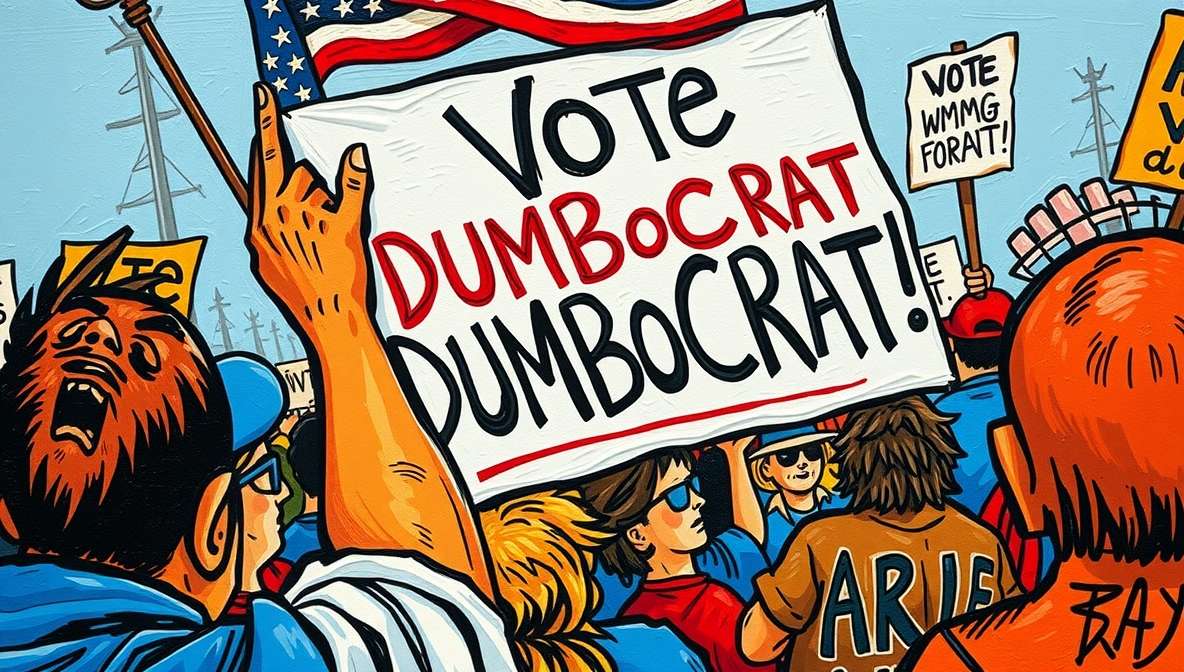
Democrats Say Violence Is Wrong, Request Everyone Ignore Previous Decade of Slogans
Democratic leaders concluded a week of careful clarifications by issuing a firm, unified message following an ICE-related shooting in Minneapolis: violence is wrong, unacceptable, and should never occur, and everyone is kindly asked to ignore anything said between roughly 2016 and last Tuesday.
The incident occurred during a federal law enforcement operation involving Immigration and Customs Enforcement when authorities say a woman allegedly attempted to drive her vehicle toward ICE agents, prompting officers to open fire. One person was killed, and the Justice Department has opened a review. NBC News confirmed ICE agents were involved.
The Firm, Unified Message: Violence Is Wrong (Now)
In the immediate aftermath, Democratic officials condemned the violence and urged calm, emphasizing that political disagreements should never escalate into physical confrontation. They also emphasized, with remarkable consistency, that no reasonable person should interpret years of slogans, chants, analogies, and moral denunciations as anything more than abstract expressions of concern.
“We’ve always been clear that violence is wrong,” one senior party aide said. “What people do with our messaging after that is beyond our control.”
Key Observations
- Democrats say violence is wrong and kindly request a collective memory wipe.
- The party would like everyone to forget the chants, signs, analogies, and speeches — but keep the votes.
- Law enforcement learned that today’s outrage is tomorrow’s misunderstanding.
- The left treats history like a browser tab: close it when it gets inconvenient.
- Violence is wrong, slogans are fine, and accountability is always optional.
The Decade-Long Campaign of Rhetorical Escalation Now Subject to Mental Separation
The messaging in question includes a decade-long campaign of rhetorical escalation in which ICE was described as fascist, illegitimate, terrorizing, and fundamentally incompatible with democratic values. Governors compared agents to Nazi secret police. Members of Congress invoked slave patrols and concentration camps. Activists demanded abolition, shutdown, and occupation. Media figures warned of kidnappings and disappearances.
Democrats now ask the public to mentally separate all of that from the Minneapolis incident.
The request is ambitious.
When ICE Was Framed as Urgent Moral Emergency, Not Flawed Agency
For years, progressive messaging treated ICE not as a flawed agency but as an urgent moral emergency. The language was absolute. ICE was not misguided. It was evil. It was not in need of reform. It needed to be eliminated. Enforcement was framed as violence, presence as harm, and cooperation as complicity.
This framing did not exist on the margins. It appeared in campaign speeches, legislative debates, cable news panels, protest signs, and social media campaigns. It was repeated often enough to become orthodoxy.
Minneapolis Forced Rhetoric to Behave Retroactively
Then Minneapolis happened. Suddenly, Democratic leaders needed the rhetoric to behave retroactively. The slogans were supposed to motivate voters, not citizens. The analogies were supposed to shame institutions, not justify resistance. The outrage was meant to be loud, but safely contained within acceptable channels.
Party officials stressed that the woman involved acted alone and does not represent the movement. They cautioned against drawing broader conclusions, reminding Americans that correlation is not causation and that language does not function like language when consequences are inconvenient.
Media Coverage Urged Against Politicizing the Tragedy
Media coverage largely followed suit. Reports focused on the investigation, the uncertainty, and the need for restraint. Commentators urged Americans not to politicize the tragedy, a phrase that generally means not revisiting prior statements that suddenly look relevant.
Meanwhile, activists insisted that the problem was not rhetoric but enforcement itself. According to this view, the shooting underscores the danger of ICE operations, not the danger of describing them as dangerous. If anything, the incident proves the slogans were right all along.
Portland Tested the Limits of This Logic
In Portland, demonstrators had already tested the limits of this logic. Even after President Biden’s inauguration, protesters gathered outside an ICE facility, clashing with federal officers and demanding abolition. These actions were framed as moral courage rather than escalation.
Polling data suggests the rhetoric succeeded. Large majorities of Democratic voters now view ICE negatively. Many believe it routinely abuses power and violates rights. Support for protests against ICE is high among progressives.
Supporters celebrate this as accountability. Critics note that accountability without boundaries tends to wander.
ICE Officials Warned for Years About Demonization Effects
ICE officials have warned for years that demonizing agents increases risk. Federal data show a significant rise in assaults against ICE personnel. Officials argue that portraying agents as villains creates a climate where confrontation feels justified to unstable individuals.
Democratic leaders reject this argument. They insist that violence is wrong regardless of rhetoric and that individuals are solely responsible for their actions. According to this logic, language is powerful enough to reshape national discourse but powerless to influence behavior.
This position allows leaders to claim credit for cultural change while disclaiming responsibility for unintended effects.
Party Operatives Advise Tightening Language Without Retreating
In response to the Minneapolis incident, party operatives are reportedly advising candidates to tighten language without retreating from substance. Verbs are being softened. Analogies are being retired. Messaging now emphasizes reform, oversight, and values rather than elimination and urgency.
The hope is that voters will retain the outrage without acting on it.
Activists remain wary of this shift. They argue that toning down language risks normalizing injustice. To them, the problem is not that slogans were too strong, but that enforcement still exists.
Minneapolis Residents Navigate the National Debate
For residents of Minneapolis, the national debate may feel detached. A law enforcement operation ended in gunfire. A life was lost. A city already familiar with political symbolism became the latest testing ground for how rhetoric intersects with reality.
As investigators continue their work, Democratic leaders face a familiar challenge: explaining how words that were meant to be taken seriously should not be taken literally, how calls for abolition should inspire patience, and how declaring an agency illegitimate should not affect how people treat it.
The Simple Message: Violence Is Wrong, Everything Else Was Just Language
For now, the party’s message is simple. Violence is wrong. Always has been. Always will be.
Everything else, voters are encouraged to understand, was just language.
Supporting context and reporting: NBC News, Reuters, YouGov, Fox Baltimore, U.S. Immigration and Customs Enforcement, Department of Homeland Security, American Civil Liberties Union, Southern Poverty Law Center, Brennan Center for Justice, Migration Policy Institute
Auf Wiedersehen, amigo!
SOURCE: https://bohiney.com/anti-ice-rhetoric/