

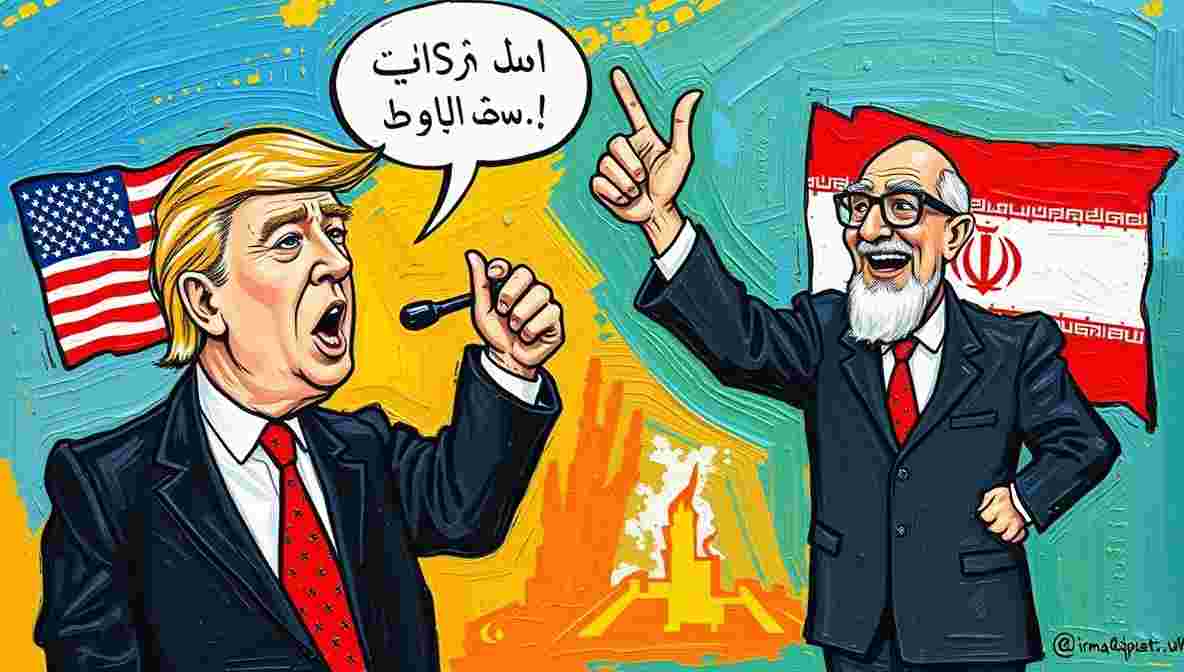
Trump Announces “Productive Talks” With Iran While Iran Announces “Absolutely Not”
Somewhere between a press conference and a group text that only one person thinks is real, President Donald Trump has declared that negotiations with Iran are going “very well,” while Iran has declared those negotiations are going “where?” This is the diplomatic equivalent of leaving a voicemail for someone who doesn’t have your number, doesn’t have a phone, and may not technically have a government.
Welcome to modern diplomacy, where one side says, “We’re making progress,” and the other side says, “We have never met you.”

According to multiple reports, Trump claims there have been “productive conversations” and even “major points of agreement” with Iranian officials. Meanwhile, Iran insists no such talks exist, describing the entire situation as either “fake news” or what experts now call “aggressive imagination.” The Guardian’s Iran desk has been refreshing faster than a man waiting on a pizza tracker that says “order received” and nothing else.
Diplomacy has officially entered its Schrödinger phase: the deal both exists and does not exist until someone opens the box or tweets about it.
Mojtaba Khamenei: The World’s First “Maybe Leader”
Hovering over all of this is Iran’s new Supreme Leader, Mojtaba Khamenei, who has achieved something no world leader has before: being both in charge and possibly missing at the same time. He is, in the truest sense, management.
Trump recently admitted, with the confidence of a man reading his own weather forecast, that “nobody knows” if Mojtaba is even alive.
Think about that. The United States is negotiating with a country whose leader might be:
- alive
- injured
- in a coma
- or just on “Do Not Disturb”
This is not foreign policy. This is trying to coordinate brunch with a friend who hasn’t texted back in three days. You’ve sent the memes. You’ve sent the “??”. Nothing. And yet you’re still reserving a table for two.
Experts say Mojtaba came to power after his father was killed in a U.S.-Israeli strike, in what historians are now calling “the most aggressive succession plan in modern history.” Even more impressively, his leadership style appears to be entirely remote, consisting mostly of written statements and mysterious silence. Silicon Valley tried this first. They called it “asynchronous leadership.” Iran calls it “Tuesday.”
The Five-Day Deadline: Because Wars Now Come With Trial Periods
Trump has generously paused military strikes for five days to allow negotiations to proceed.
Five days.
That’s not a peace process. That’s the return window at Costco. “Try diplomacy for five days,” the administration reportedly said. “If unsatisfied, we’ll go back to bombing energy infrastructure. No receipt necessary.”
Oil markets reacted immediately, dropping slightly in price, presumably because traders briefly believed that global conflict might now operate on a subscription model. Premium tier: war. Basic tier: strongly worded statements. Free tier: whatever this is.
Analysts are calling this strategy “strategic ambiguity.” Normal people are calling it “Are we fighting or flirting?”
Iran Responds: “We’re Not Talking, But Please Stop Talking About Us Talking”
Iran’s official position is simple: There are no talks. There have never been talks. And if talks were happening, they would definitely not look like whatever Trump is describing.
Iranian officials have accused the U.S. of using claims of negotiations as “psychological warfare,” which is diplomatic code for: “He’s saying things again.”
At the same time, indirect talks may actually be happening through intermediaries like Egypt, Turkey, and Pakistan — countries that have apparently agreed to serve as the world’s most geopolitically consequential game of telephone.
So technically:
- The U.S. is talking
- Iran is not talking
- But other countries are talking about the talking
It’s less a negotiation and more a global game of telephone, except every message ends with oil prices going up.
The Real Strategy: Confuse Everyone Until Peace Breaks Out
To be fair, there is a strategy here. By simultaneously threatening massive strikes, pausing those strikes, claiming progress, denying clarity, and negotiating with someone who may or may not be available — the administration has created a level of confusion so intense that even the conflict itself is starting to lose track of what it’s doing. It has developed what RAND Corporation analysts might charitably call “maximum optionality,” and what everyone else calls “Tuesday at the White House.”
Military experts describe this as “multi-layered signaling.” Your uncle describes it as, “He’s just winging it.” Your uncle may have a doctorate in this.
What the Funny People Are Saying
“I love negotiations where one side says ‘we’re talking’ and the other says ‘who is this?’ That’s not diplomacy, that’s spam.” — Jerry Seinfeld
“Five-day deadline? I’ve had yogurt with a longer peace process.” — Ron White
“They’re negotiating with a guy who might be in a coma. That’s not foreign policy, that’s a séance.” — Sarah Silverman
The World Watches, Slightly Confused, Slightly Entertained
Meanwhile, global leaders are urging calm, markets are twitching like a caffeinated squirrel, and the Strait of Hormuz remains the world’s most expensive choke point — a narrow strip of water through which roughly 20% of the world’s oil supply passes daily, now apparently dependent on whether a Supreme Leader checks his notifications.
The stakes are enormous: oil supply, regional stability, and whether diplomacy can survive being conducted like a reality show reunion episode. The answer, based on recent evidence, is: maybe. For five days. Pending renewal.
And yet, through it all, one thing remains certain: Nobody is entirely sure who is negotiating, what they’re negotiating about, or whether the person they’re negotiating with has read the message. There is, at minimum, a read receipt situation developing.
Final Thought: Peace, War, or Group Chat Misfire?
In the end, this may be remembered as the first war where both sides accidentally de-escalated simply because they couldn’t agree on whether they were arguing.
Historians will debate it for years: Was it strategy? Was it chaos? Or was it just the geopolitical version of replying-all to the wrong email thread?
Either way, if peace does break out, it will likely be announced the same way everything else has been: one side declaring victory, the other side asking, “What are you talking about?” — and somewhere in the middle, a Supreme Leader quietly typing… or not typing… or possibly just existing as a rumor with excellent Wi-Fi.
The United Nations has issued a statement. Nobody has read it. Which, at this point, makes the UN the most relatable participant in the entire conflict.
Auf Wiedersehen, amigo!
The United States and Iran have been locked in escalating tensions since Trump reimposed sweeping sanctions following his 2018 withdrawal from the Joint Comprehensive Plan of Action (JCPOA), the multinational nuclear deal brokered under Obama. Iran’s Supreme Leader Ali Khamenei was reportedly killed in a U.S.-Israeli strike, with his son Mojtaba Khamenei ascending to lead the Islamic Republic under circumstances that remain murky even by the standards of Iranian political opacity. Trump, in his second term, has simultaneously threatened Iran with devastating military force while claiming backchannel diplomatic progress — a posture his administration calls “maximum pressure with an open door,” and which most of the rest of the world calls “confusing.” Oil markets, the Strait of Hormuz, and the general concept of linear reality are all watching closely.