

America Accidentally Wins the Iran War Economy While Everyone Else Pays the Gas Bill
The world woke up this week to discover a fascinating new theory of modern economics: if there is a global crisis, the United States might somehow end up selling everybody the solution. Economists now whisper that America could emerge as the “unexpected economic winner” of the Iran war thanks largely to energy exports and global demand for U.S. liquefied natural gas.
This is the geopolitical equivalent of hosting a house fire and then selling your neighbors the water.
According to analysts, Europe’s decision to break away from Russian energy created a giant opening for American energy companies. The United States is now the largest supplier of LNG to the EU, accounting for nearly 58% of total European LNG imports — a figure that has tripled since 2021. With Middle East oil supplies now disrupted and prices climbing, countries scrambling for fuel may end up buying even more American LNG and petroleum products.
In other words, the global energy market has become a yard sale where America owns the folding table.
Observations on the Iran war economy…
America accidentally winning while everyone else pays the gas bill:
-

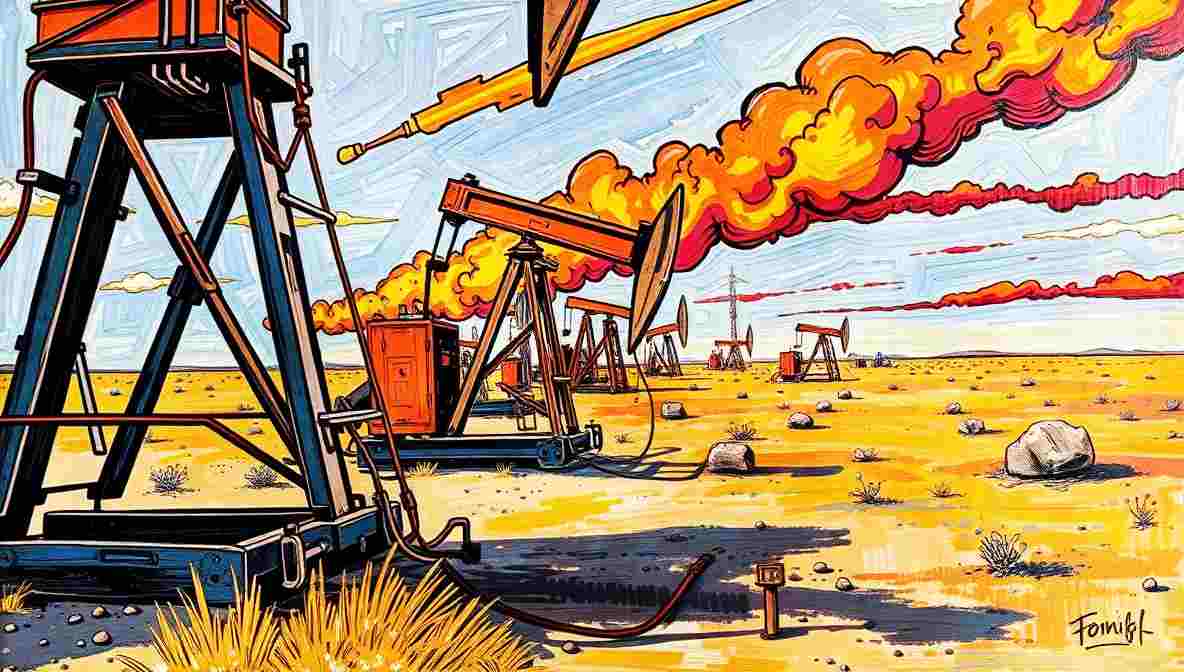
West Texas crude producers benefit as Iran conflict disrupts Strait of Hormuz shipping and drives global oil prices above $100 per barrel. America’s foreign policy strategy has evolved from “speak softly and carry a big stick” to “say nothing, sit on a continent full of oil, and wait.”
- Europe spent thirty years building a pipeline relationship with Russia, then broke up via sanctions — and immediately started dating Texas. It’s the most expensive rebound in history.
- The Strait of Hormuz is twenty-one miles wide. The entire global economy is being held hostage by something narrower than Los Angeles rush hour traffic.
- Oil traders have discovered that “panic” is not just an emotion — it’s a monetizable asset class with excellent quarterly returns.
- 150 tanker ships sitting outside the strait, engines idling, each burning fuel while waiting to deliver fuel. The irony has its own carbon footprint.
- The Pentagon using AI to run a war is Silicon Valley’s ultimate pivot — from “disrupting the taxi industry” to “disrupting geopolitical stability.”
- Stagflation means high prices AND slow growth simultaneously. Economists invented a special word for it because “everything is terrible in two directions at once” wouldn’t fit on a PowerPoint slide.
- An oil executive calling a war “surprisingly profitable” is the corporate version of a umbrella salesman doing a rain dance.
- Europe’s sophisticated energy diversification plan essentially required calling the one country that wears cowboy hats to international summits.
- The invisible hand of the free market has been located. It is, in fact, in Houston. It is wearing a Rolex.
Economists Discover War Is Great for Business (If You Sell the Gas)
Experts say the conflict in the Middle East is already rattling global markets. The Strait of Hormuz, the narrow waterway through which roughly 20% of the world’s oil flows, has become the economic equivalent of a clogged artery in the global economy. When tankers stop moving there, the entire planet starts hyperventilating.
Oil prices have surged above $100 a barrel amid fears of supply disruptions, sending governments into emergency meetings and drivers into therapy. Meanwhile, American oil executives are quietly checking their stock portfolios and whispering things like:
“Wow… this terrible tragedy has been surprisingly profitable.”
Energy traders across the world have developed a new trading strategy known as “yelling while refreshing oil charts.”
The American Economy’s Secret Weapon: Geography and a Guy Named Randy
Economists have long known that geography matters in global economics. Switzerland has mountains. Singapore has ports. America has an entire continent full of oil, natural gas, pipelines, refineries, railroads, truck stops, and a guy named Randy who runs a diesel pump outside Tulsa.
When global energy supply gets disrupted, the United States suddenly becomes the only convenience store open at 3 a.m.
One analyst described the situation like this:
“If Middle Eastern oil shipments slow down, the rest of the world still needs energy. And the United States just happens to be sitting on massive supplies.”
Indeed, the U.S. set a new benchmark in 2025, exporting a record 111 million metric tons of liquefied natural gas — the first country ever to surpass the 100-million-ton threshold in a single year, leaving Qatar in the dust like a sedan at a drag race.
The global economy has essentially wandered into America’s gas station holding an empty tank and a panicked look.
Europe’s Energy Strategy: Panic First, Policy Later, Call Texas
Europe’s energy planners are currently experiencing what economists call “strategic regret.”
For decades, European nations relied heavily on Russian pipeline gas. That arrangement collapsed after geopolitical tensions and sanctions cut off much of that supply. Russia’s share of EU pipeline gas imports dropped from around 40% in 2021 to around 6% in 2025. Europe then attempted to solve the problem by importing liquefied natural gas from the United States, which was an excellent plan right up until the Middle East also caught fire.
Now that the Middle East is unstable again, the European energy strategy has evolved into a sophisticated two-step plan:
- Panic
- Call Texas
Several European leaders have reportedly begun practicing phrases like:
“Hello America, yes, we’ll take all the gas you have.”
The Europeans, to their credit, have been building new LNG import terminals at a frantic pace. EU countries spent approximately €117 billion on U.S. LNG imports between 2022 and mid-2025. That’s a lot of euros for a resource that used to arrive by pipeline from a country they no longer speak to at dinner parties.
Wall Street Reacts Calmly by Panicking Professionally
Markets responded to the Iran war the way markets respond to everything: by briefly losing their minds.
Investors rushed into safe-haven assets while currencies shifted dramatically. The U.S. dollar climbed against the euro as traders sought stability. Nothing says “economic stability” like a war in the world’s most important oil shipping lane.
Meanwhile, stock traders on Wall Street developed a new professional posture known as the “aggressive shrug.”
Oil Tankers Form the World’s Most Expensive Traffic Jam
With shipping through the Strait of Hormuz disrupted, hundreds of oil tankers have reportedly gathered outside the region waiting for someone to explain whether they are supposed to move or simply float nervously. Tanker traffic dropped approximately 70% almost immediately, with over 150 ships anchoring outside the strait, before traffic fell to essentially zero.
Satellite images now show the world’s most expensive traffic jam. Some tanker captains are said to be spending the delay productively by playing cards and calculating how much oil prices are rising while they wait.
One anonymous shipping executive reportedly sighed:
“Every hour those ships sit there, oil gets more expensive.”
He paused.
“And frankly, some people seem pretty happy about that.”
Per S&P Global’s head of crude oil research: “If the reduction in tanker traffic continues for a week or so, it will be historic. Beyond that, it would be epochal for the oil market.” He was quoted from what appeared to be a very comfortable leather chair in a very expensive office.
The Global Economy’s Favorite Hobby: Worrying About Stagflation
While some analysts say the United States could benefit economically, others warn the war could trigger a broader global slowdown. Higher oil prices could push inflation upward while slowing growth, a toxic combination economists refer to as “stagflation.” The last time that happened, disco music and polyester suits ruled the earth. Nobody wants that again.
If oil prices continue rising, gasoline could climb toward $4 per gallon in the United States — or higher — squeezing household budgets and rattling central banks. Which means economists will soon be appearing on television saying:
“Technically this is fine.”
America’s Two Booming Exports: Energy and Anxiety
In practical terms, the U.S. economy now benefits from two powerful exports:
- Liquefied natural gas
- Global anxiety
Whenever the world worries about oil supplies, American producers sell more fuel and investors buy more dollars. It’s a strange system, but it has a certain elegance. The global economy panics. America sells the solution.
The EIA has predicted that U.S. LNG export capacity will more than double by 2029, which means America is essentially installing a larger hose on the same fire truck it rents to everyone else.
Pentagon Discovers War Also Doubles as a Software Demo
The war has also turned into a real-world demonstration of artificial intelligence in military operations. The U.S. military is reportedly using AI tools to help identify targets and plan operations more efficiently. Which means Silicon Valley has finally achieved its ultimate dream:
Turning war into a software update.
Defense contractors are now pitching their latest product line as “cloud-based conflict management.” Coming soon: a subscription tier. Premium users get fewer explosions. The free plan comes with ads.
The Final Economic Lesson: Somebody Always Profits
The great irony of the Iran war economy is that everyone loses something except the people selling the most valuable commodity in modern civilization: energy.
- Consumers pay more at the pump.
- Governments scramble to stabilize markets.
- Central banks panic about inflation.
But somewhere in Houston, an oil executive pours himself a quiet glass of bourbon and murmurs:
“Well… this escalated profitably.”
And that, economists say, is the invisible hand of the market.
Unfortunately, the invisible hand appears to be holding a gas nozzle. ⛽📈
Auf Wiedersehen, amigo!