

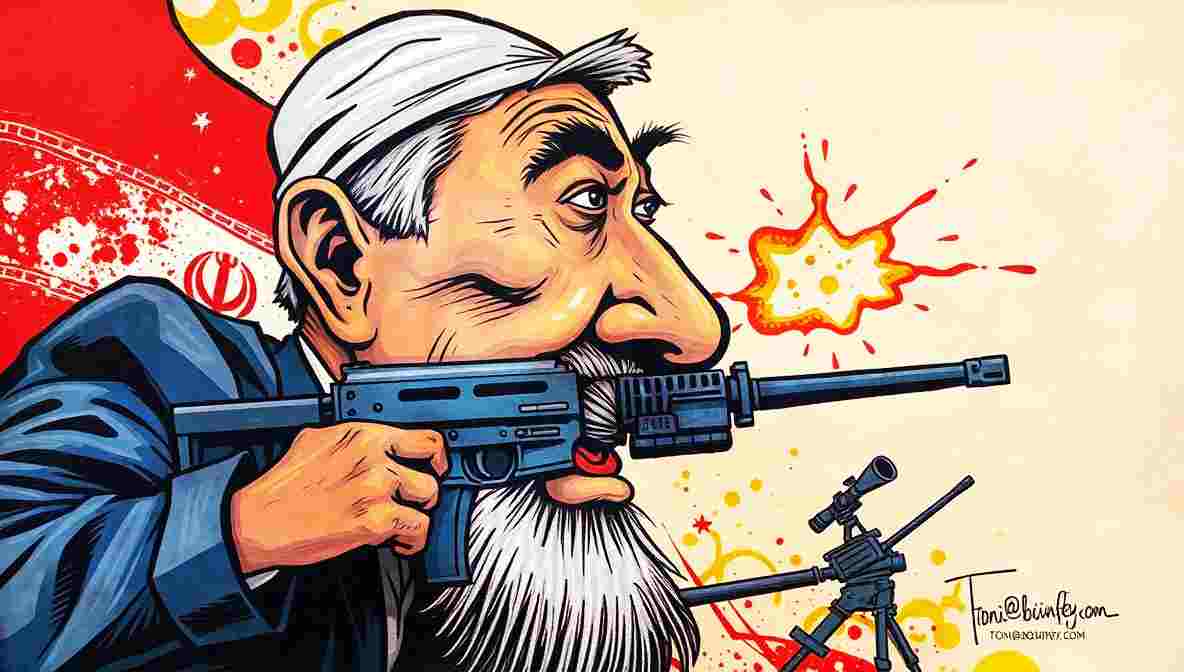
First Principles Guide to the Iran War: A Completely Scientific Reconstruction of the Problem
Let us rebuild the current Iran war from first principles. That means stripping the situation down to the most fundamental truths and then stacking them back together like geopolitical Lego bricks.
But instead of Pentagon briefings, imagine a bunch of world leaders arguing in a gas station parking lot.
Because honestly… that is not far off.
As of Day 11, the United States and Israel have struck more than 5,000 targets inside Iran. Defense Secretary Pete Hegseth announced Tuesday morning that today will be, quote, “our most intense day of strikes inside Iran yet.” Trump, meanwhile, told Republican lawmakers the U.S. still needs “ultimate victory”—one day after saying the war was “very complete.” Oil prices are up 27 percent in a single week. Seven American soldiers are dead. And somewhere in Tehran, a new Supreme Leader is being installed because the old one was killed in the opening salvo on February 28th.
So: from first principles. Let’s figure out how we got here.
Fundamental Truth #1: Humans Like Power, Territory, and Being Right

At the most primitive level, international politics is basically:
“This is mine.”
“No it isn’t.”
“Yes it is.”
“Fine, let’s buy missiles.”
From cavemen throwing rocks to modern states throwing $2 million cruise missiles, the underlying logic is exactly the same.
- Iran wants influence in the Middle East.
- The United States wants stability and allies in the Middle East.
- Israel wants security.
- Oil markets want therapy.
Eventually someone says: “What if diplomacy fails?”
“Then we use the world’s most expensive argument.”
And thus a war is born.
Worth noting: as recently as February 25th, Iranian Foreign Minister Abbas Araghchi declared that a “historic” agreement was “within reach” in Geneva. Three days later, the bombs started falling. So the window from “historic opportunity” to “historic rubble” is apparently 72 hours.
Fundamental Truth #2: Oil Is the World’s Emotional Support Liquid
Now introduce oil.
A huge portion of the world’s oil flows through the Strait of Hormuz, a narrow shipping lane next to Iran that carries roughly 20% of global oil supply. Iran’s military has confirmed the strait technically remains “open”—while simultaneously threatening to target any U.S. or Israeli ships that attempt to use it. That is the geopolitical equivalent of a restaurant saying they’re open for business but the chef will stab you if you order the fish.
The first-principles economic model looks like this:
Step 1: Country A bombs Country B
Step 2: Oil stops moving
Step 3: Gas becomes $8 a gallon
Step 4: Americans blame whoever is president
Step 5: Economists write 900-page reports explaining Step 4
In one week of war, Brent crude climbed 27 percent—the largest weekly gain since the COVID-19 pandemic. The Strait of Hormuz is effectively shut. Shipping lanes are being rerouted. And somewhere, an oil trader is quietly buying a yacht and naming it “Escalation Dynamics.”
Fundamental Truth #3: War Is Just Physics With Flags
At its core, war is surprisingly simple. It is basically Newtonian physics applied to explosives.
Force = Mass × Acceleration
Missile = Metal × Anger
On February 28, 2026, the U.S. and Israel launched nearly 900 strikes in 12 hours, targeting Iranian missile sites, air defenses, military infrastructure, and leadership. Supreme Leader Ali Khamenei was killed in the opening wave. Iran responded with missiles and drones against U.S. allies across the region, including Azerbaijan, Bahrain, Iraq, Jordan, Kuwait, Oman, Qatar, Saudi Arabia, Turkey, and the UAE.
Which leads to the simplified geopolitical equation:
Missiles + Retaliation = More Missiles
Military strategists call this “escalation dynamics.”
Everyone else calls it “things getting out of hand.”
Fundamental Truth #4: Every War Has a Spreadsheet
War is not just bombs. It is also PowerPoint.
Somewhere in Washington, Tehran, and Tel Aviv are rooms full of analysts staring at graphs. Here is what those graphs track:
| Chart | What It Means |
|---|---|
| Missile inventory | How many things we can still explode |
| Oil price curve | How mad consumers will be at the pump |
| Political approval rating | Whether anyone keeps their job |
| Drone losses | Eleven MQ-9 Reapers and counting |
Speaking of the drone column: the U.S. military has now lost 11 MQ-9 Reaper drones during “Operation Epic Fury.” These drones were designed for counter-terrorism environments with minimal air defenses—not for countries with modern missile systems. Sending Reaper drones into Iran is roughly equivalent to showing up to a knife fight in a golf cart.
Trump, for his part, announced the war is running “very far ahead of schedule.”
Nothing calms people down like hearing a war is running efficiently.
Fundamental Truth #5: Every Side Thinks It Is the Adult in the Room
A fascinating rule of geopolitics: every country believes the other guy started it.
Nation A logic: We acted in self-defense.
Nation B logic: They attacked us first.
Nation C logic: Can someone please stop the oil prices.
Every government also believes it has a clever strategy nobody else understands. Examples include:
- “Decapitation strike”
- “Strategic deterrence”
- “Escalation dominance”
- “Ultimate victory” (Trump, Monday)
- “The war is very complete” (also Trump, Monday)
These are technical terms meaning: “We hope this works.”
Meanwhile, a U.S. National Intelligence Council report found that a large-scale assault on Iran was unlikely to topple the government, and that Iran’s fragmented opposition taking control of the country was also “unlikely.” The Trump administration called the report “political.” History will call it “Tuesday.”
Fundamental Truth #6: Wars Spread Like Group Chats
Once fighting begins, other countries start joining the conversation.
Regional allies get nervous. Markets panic. Energy traders start sweating through their suits.
In the current conflict, Iran has launched strikes against U.S. positions in Bahrain, Kuwait, Qatar, Saudi Arabia, and the UAE. Turkey’s presidential spokesman confirmed that NATO air defenses intercepted an Iranian ballistic missile over the Gaziantep region. France authorized the U.S. to use French military bases. Spain refused and got threatened with tariffs. Iraq told Secretary of State Rubio its territory cannot be used for military action against neighbors. Three Amazon Web Services data centers in the UAE were struck and damaged.
The situation resembles a family argument at Thanksgiving:
- One cousin flips the table
- Another cousin throws mashed potatoes
- The grandmother is yelling
- Someone just blew up the cloud
- Oil traders are quietly buying yachts
Fundamental Truth #7: Everyone Wants Victory Without Consequences
Every government hopes for the same magical outcome:
We win quickly.
They surrender.
The oil keeps flowing.
Nobody writes a documentary about our mistakes.
Which explains why leaders say things like: “The war will end on our timeline.”
Trump has now said the war will be over “very soon,” “pretty quickly,” “not this week,” and that the U.S. still needs “ultimate victory”—all in a 24-hour period. That is four distinct timelines before lunch.
Unfortunately, wars tend to run on their own schedule, which historians later describe as “a mistake.”
Fundamental Truth #8: The Global Economy Is Basically a Nervous Cat
Financial markets hate uncertainty. When a major oil route is threatened, markets react like this:
- Investors panic
- Oil spikes
- Economists appear on television
- Nobody understands the economists
- The economists don’t understand each other either
Beyond oil prices, the war has disrupted global travel, halted flights in and out of the Middle East, and forced shipping reroutes away from both the Strait of Hormuz and the Red Sea. The humanitarian toll inside Iran has now reached more than 1,255 dead and approximately 10,000 injured. A missile struck a girls’ school adjacent to a naval base, killing at least 160 people—many of them children—and Human Rights Watch has called for a war crimes investigation.
Which proves another fundamental truth:
Wars may start with missiles, but they end with accountants.
And sometimes, prosecutors.
The Ultimate First-Principles Explanation
If we compress the entire conflict into its simplest form, the Iran war becomes:
Human nature
+ oil
+ pride
+ military technology
= geopolitics
Or, in plain English: people with powerful weapons disagree about things.
The Satirical Strategic Model: A Pentagon-Ready Chart
| Step | Description |
|---|---|
| 1 | Leaders say war will be quick |
| 2 | Intelligence analysts say war will be complicated |
| 3 | Gas prices go insane |
| 4 | Everyone becomes a Middle East expert |
| 5 | History professors sigh deeply |
| 6 | Pentagon announces “most intense day of strikes yet” (repeat step 6) |
Final First-Principles Insight
After breaking the problem down completely, the deepest truth of the Iran war is this:
Civilizations invented satellites, artificial intelligence, nuclear physics, and the internet.
And yet global diplomacy still occasionally comes down to:
“Stop hitting me.”
“You stop hitting me.”
With oil tankers floating nearby like nervous Uber drivers—and eleven drones already in the scrap heap.
Geopolitics right now looks like three guys arguing over a gas pump while holding nuclear physics degrees and matching “Operation Epic Fury” hoodies.
Auf Wiedersehen, amigo!
Background: On February 28, 2026, the United States and Israel launched a coordinated military campaign against Iran, killing Supreme Leader Ali Khamenei and triggering a wider regional conflict now in its eleventh day. The strikes, described by Washington as targeting Iran’s nuclear and ballistic missile programs, have resulted in more than 1,255 Iranian deaths, seven American soldiers killed, and oil prices surging 27 percent in a single week. Iran has retaliated with drone and missile attacks across the Gulf region, striking targets in Saudi Arabia, Kuwait, the UAE, Bahrain, and Iraq, while the Strait of Hormuz—through which roughly 20 percent of global oil supply flows—has been effectively closed to commercial shipping. A new Supreme Leader, Mojtaba Khamenei, son of the slain cleric, has been named. Defense Secretary Pete Hegseth has called Tuesday the most intense day of U.S. strikes since the war began.