

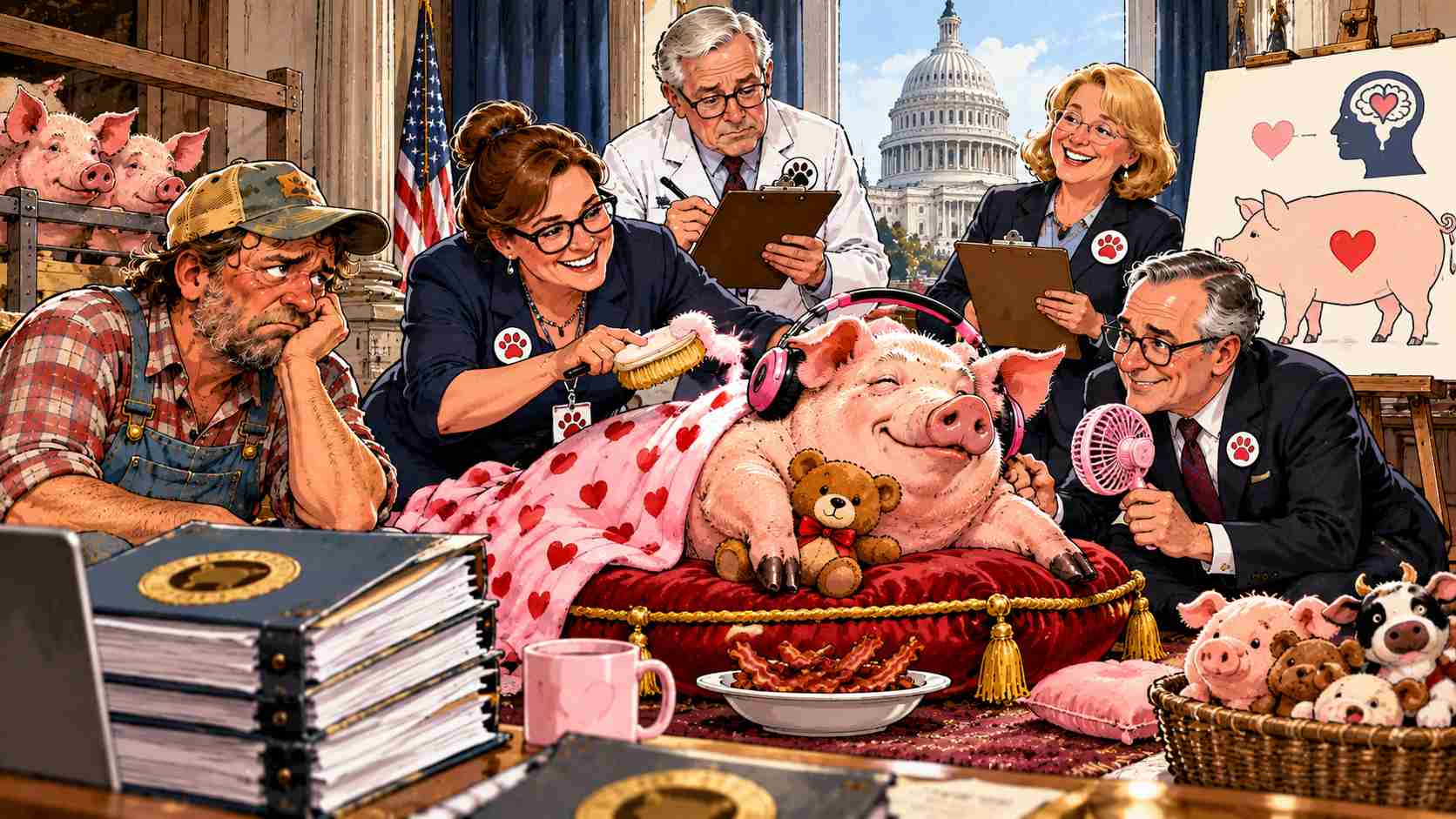
Congress Weighs Pig Therapy After Britain Moves on CO2 Stunning
WASHINGTON, D.C. — Britain is considering phasing out carbon dioxide stunning for pigs, prompting American officials to investigate whether the nation’s breakfast meats have been suffering from emotional neglect.
Under the British proposal announced October 26, slaughterhouses would replace CO₂ stunning, currently used for approximately 90 percent of British pigs, with alternatives such as argon gas or electrical stunning. The transition could take two or three years, assuming the government can complete its consultations before the pigs develop opposable thumbs. The consultation closes December 21.
Washington immediately recognized an opportunity.
America has spent decades trying to make slaughter more humane. Congress has spent decades trying to make legislation less humane.
Finally, the two industries have something to discuss.
The Humane Methods of Slaughter Act has governed American slaughterhouses since 1958, and the statute itself lists carbon dioxide among the accepted methods. That fact did not come up in committee.
The Department of Pork Feelings and the Swine Emotional Wellness Initiative
A congressional subcommittee promptly proposed a National Swine Emotional Wellness Initiative, complete with diversity training, government-certified counselors and a $400 million grant to determine whether pigs prefer classical music or podcasts.
One congressman reportedly suggested that every pig receive a government-funded therapist.
Another demanded a federal investigation into why pigs have never been represented in the Senate.
A third wanted to know whether the animals had considered moving to California, where practically everything already requires a psychological evaluation.
The committee’s most controversial proposal involved informing pigs about their approaching slaughter.
Apparently, nobody in Congress had considered that the biggest psychological problem facing a pig might be the actual slaughter.
Instead, legislators concentrated on the atmosphere.
Minutes from Wednesday’s subcommittee session, obtained by this publication, record 41 minutes spent on the name of the initiative, nine minutes spent on whether pigs could be reached for comment, and 90 seconds on stunning methods. The session adjourned for lunch. Ham was served.
A USDA official explained the distinction.
“We cannot guarantee a pig’s future, but we can certainly improve the paperwork surrounding its departure.”
The official then requested another $12 million.
Argon Gas Costs 87 Pence Per Pig; Congress Prices It at $6.4 Billion
Britain’s own government estimates that switching to argon could add approximately 87 pence per pig, equivalent to about one-tenth of a penny per sausage if the additional cost is distributed across pork products. The British pork industry’s research body, AHDB, puts the figure closer to £1.07 per pig.
American politicians found the arithmetic fascinating.
Eighty-seven pence? Or £1.07? A gap of twenty pence, in Washington, is what’s known as a bipartisan agreement.
It also isn’t enough money to investigate why the government spent $14 million investigating something else.
Nevertheless, congressional economists predicted that America’s version would cost $6.4 billion, require 3,000 administrators and produce a final report entitled Exploring the Intersectionality of Bacon and Atmospheric Justice.
The study would conclude that pigs are mammals.
Congress would demand further research.
Pork Imports, Tariffs and the International Bacon Crisis
Trade negotiators then discovered a potentially embarrassing problem.
British pork produced under stricter welfare rules could compete with cheaper imported pork processed under different standards.
Washington proposed solving the discrepancy through a tariff.
The tariff would protect American jobs, British pigs, international diplomacy and, most importantly, the government’s ability to collect revenue from all three.
A poll of 1,214 registered voters, released Tuesday by a Midwest pork-industry group, found that 71 percent could not locate Britain on a map, 64 percent believed argon was a character on a streaming series, and 88 percent wanted bacon to cost less. Four percent said they would pay extra for bacon with a good attitude.
A pork importer attempted to explain that American consumers primarily want affordable bacon.
A federal consultant disagreed.
“Consumers want transparency.”
“Fine,” said the importer. “The package is transparent. You can see the bacon.”
The consultant recommended a seven-year study.
Congressional Hot Air Versus CO₂ Stunning
Researchers acknowledged that concentrated CO₂ causes considerable distress to pigs before unconsciousness, which is the genuine animal-welfare issue driving Britain’s proposal. The RSPCA and the government’s Animal Welfare Committee have been raising it for the better part of two decades.
Congress briefly considered this evidence before returning to an argument over whether bacon should identify as breakfast or lunch.
A British observer pointed out that Westminster had already decided the best way to protect animals from distress was to subject meat processors to considerably more of it. Congress took notes.
One exhausted agricultural economist proposed an alternative.
“Why don’t we use the carbon dioxide produced by congressional speeches?”
Scientists rejected the idea.
The concentration was too unpredictable, the volume was impossible to regulate, and some representatives had been emitting hot air continuously since 1978.
Congress nevertheless introduced the Bipartisan Humane Bacon Awareness Act.
The legislation contained 847 pages.
Only three concerned pigs.
The remaining 844 addressed congressional travel expenses.
America had finally achieved something remarkable. The pigs were getting a more humane stunning process, while American taxpayers continued receiving the traditional method.
Five Humorous Observations
- Britain looked at a pig and said, “Maybe he shouldn’t panic on the way out.” America looked at the same pig and said, “Can we get a subcommittee on that?” One country has a conscience. The other has a calendar.
- Eighty-seven pence. You know what eighty-seven pence buys in Washington? Half a stapler. A government stapler. With a cost overrun.
- They want to give every pig a therapist. So the pig walks in, sits on the couch, and the therapist goes, “Tell me about your childhood.” And the pig says, “It was great until Thursday.”
- Nobody wants bacon to have feelings. That’s the whole deal with bacon. It’s the one thing in your life that never texts you “we need to talk.”
- Eight hundred forty-seven pages and three of them are about pigs. That’s the entire pig lobby. Honestly, that’s more representation than my state’s got.