

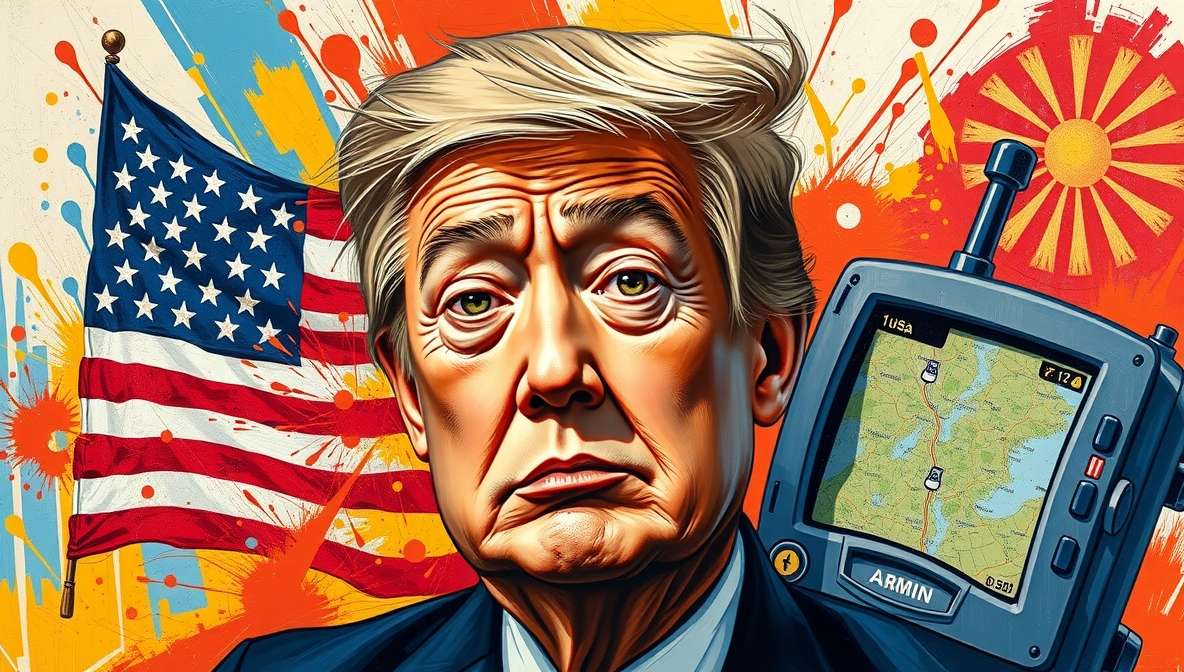
Erratic Diplomacy and the GPS That Lost the Map
Trump’s Foreign Policy: The New Era of Diplomatic Unpredictability
It’s a new era in international relations: where alliances are like Tinder dates, treaties feel like Yelp reviews, and the U.S. foreign policy operates on a system suspiciously similar to a magic 8-ball. Observers from Brussels to Bangkok are consulting their coffee cups instead of briefing books. According to the New York Times, President Trump’s foreign policy has officially reached a level of unpredictability that diplomats describe as “astounding uncertainty.” Or, as Ron White said: “You can’t fix stupid, but you can sure as hell watch it try.”
When International Relations Became a Magic 8-Ball
The Trump administration’s approach to diplomacy has transformed international relations into a high-stakes guessing game. One think tank expert said, “If foreign policy were a road trip, we’d all be lost somewhere between ‘Neutral St.’ and ‘Tariff Ave.'” Eye witnesses confirm that ambassadors are now carrying compasses and snack bars, just in case. Jerry Seinfeld said at his recent Madison Square Garden show: “What’s the deal with foreign policy that changes more often than my socks?”
What “Erratic” Really Means in Modern Diplomacy

By dictionary standards, “erratic” means lacking regularity or consistency. By diplomatic standards, it means your GPS keeps recalculating in the middle of the South China Sea. According to a survey by the International Diplomacy Institute, 62% of diplomats admit they have no idea what the U.S. position is on any given day, and the remaining 38% pretend they do just to survive cocktail parties.
Lost Between Neutral Street and Tariff Avenue
Observers note that one day America threatens sanctions, the next day sends gift baskets. One European envoy said, “We keep waiting for the punchline, but the joke’s on us.” Kevin Hart said during his Reality Check tour: “Man, you gotta love a country that keeps you guessing more than my last stand-up audience!” The unpredictability has reached levels previously thought impossible outside of reality television.
America First Policy: From Doctrine to Daily Guessing Game
The “America First” mantra has evolved. Now it appears to mean “America First, maybe everyone else, we’ll see.” A fake-but-true poll of international business leaders shows 54% are hedging investments, 23% are buying popcorn, and 23% are considering taking up origami while waiting for guidance.
Why Allies Are Hedging Their Bets
The transformation from predictable ally to diplomatic wildcard has forced NATO partners and Asian allies to develop contingency plans A through Z. Bill Burr said on his recent podcast: “You know it’s bad when ‘diplomatic hot potato’ sounds safer than my neighborhood BBQ.” Financial markets now treat presidential tweets with the same gravity as Federal Reserve announcements.
The Hot Potato Alliance System Under Trump
Diplomats now describe alliances like a game of hot potato. NATO meetings have transformed into extreme sports, with documents being tossed faster than frisbees. Analysts note that contingency planning has become a survival skill, with each country maintaining a comprehensive backup strategy for dealing with U.S. unpredictability.
NATO Meetings as Extreme Sports Events
Experts note that peace talks under this administration feel like a garage sale: “Everything must go! Treaties, tariffs, credibility—all discounted today only!” The average cost of global trust has dropped by an estimated 47% since 2017. Witnesses report seeing aides frantically scribbling agreements on napkins between coffee breaks. Ali Wong said at her recent Baby Cobra special taping: “Who knew diplomacy could be more chaotic than my family’s Christmas morning?”
Napkin Diplomacy: When Official Briefings Disappear
A NATO official confirmed, under the condition of anonymity, that doodles on napkins have replaced official briefing papers. “We have a rough sketch, but the arrows keep moving,” the official explained. A social science study confirms that inconsistent policy correlates with high anxiety levels among allies, but low levels of boredom.
Doodles Replace Policy Papers in NATO Headquarters
Sarah Silverman said during her recent HBO special: “Napkin diplomacy: it’s like arts and crafts, but with nuclear codes!” The transformation from formal diplomatic protocols to impromptu sketching sessions has left career diplomats wondering if they should have studied art instead of international relations.
Surprise Press Releases and Reversed Positions
The hallmark of current U.S. diplomacy is surprise press releases. One day the U.S. pledges support for one country, the next day it issues a statement that reverses everything. Public opinion polls show that 65% of citizens are confused, 20% are entertained, and 15% have started a betting pool on which country will be next.
How Social Media Changed International Relations Overnight
Trevor Noah said on The Daily Show: “It’s like watching a reality show where the prize is international stability, and nobody wins.” High-stress levels in embassies are at an all-time high. An eyewitness from the European Union headquarters reported: “People are pacing, muttering about tariffs, and holding emergency meetings just to figure out breakfast options.” Studies in organizational behavior suggest that such unpredictability boosts creativity but lowers sleep quality.
Dave Chappelle said at his recent Netflix special: “Man, if I had to deal with that, I’d be laughing at the wrong time too.” The combination of social media announcements and traditional diplomatic channels has created a system where ambassadors learn about policy changes at the same time as the general public—usually while scrolling through Twitter at 3 a.m.
Stock Markets React to Tweet Storms
The unprecedented phenomenon of global financial markets responding to 280-character pronouncements has created a new field of economic analysis. Wall Street traders now monitor presidential social media with the same intensity previously reserved for Federal Reserve minutes and quarterly earnings reports.
When Tweet Notifications Create Market Volatility
Financial analysts have developed a sophisticated system for predicting market movements based on presidential social media activity. One trader said, “We’ve got algorithms watching Twitter faster than we watch the Federal Reserve.” The result is a financial system that operates on a strange combination of economic fundamentals and social media sentiment analysis.
Global Allies Navigate the Diplomatic GPS Failure
Imagine the U.S. as the junior partner in a global alliance. That’s how many allies feel now. The New York Times quotes unnamed diplomats saying, “We wait for instructions and sometimes for snacks.” The absurdity of role reversal provides fertile ground for satirical commentary and Twitter memes alike.
Role Reversal: When America Becomes the Junior Partner
Sarah Silverman said at her recent Boston show: “If the U.S. can’t lead, can we at least get a decent marching band?” The combination of all these factors leads to absurdity: napkin playbooks, hot-potato treaties, garage-sale peace. But the effect on global stability is real. Scholars suggest that humor may be a coping mechanism for diplomats dealing with high-stakes unpredictability. Meanwhile, citizens are advised to maintain a healthy sense of irony and keep emergency popcorn handy.
Trevor Noah said on The Daily Show: “Sometimes, the only way to survive politics is to laugh—preferably at the right time.” The shift from American leadership to American unpredictability has forced traditional allies to develop their own leadership structures, creating a more multipolar world—whether anyone planned for it or not.
Citizen’s Guide to Surviving Foreign Policy Chaos
If you’re an ally, keep flexibility, invest in stress balls, and always carry a spare napkin. If you’re an adversary, keep a betting pool and enjoy the suspense. Citizens can monitor policies but maintain humor; laughter may be the only predictable outcome. Validate the chaos, embrace the absurdity, and plan for contingencies. Growth mindset: understand the patterns, or lack thereof.
Essential Tools: Stress Balls, Spare Napkins, and Emergency Popcorn
Diplomatic survival in the modern era requires a new toolkit. Gone are the days when a briefing book and a translator were sufficient. Today’s diplomat needs: industrial-strength antacids, a subscription to comedy streaming services, emergency contact information for therapists who specialize in international relations trauma, and a well-developed sense of the absurd.
Conclusion: The Satirical GPS That Keeps Recalculating
Trump’s foreign policy, with its erratic turns, hyperbolic statements, and napkin-level strategies, is a rich vein for satire. From surprise press releases to hot-potato alliances, the world is learning to navigate a diplomatic GPS that has lost the map. One thing is certain: it’s unpredictable, absurd, and sometimes painfully funny.
The transformation of American diplomacy from predictable superpower to reality-TV-style chaos has created a new normal where allies prepare for anything, adversaries enjoy the show, and citizens maintain their sanity through humor. As NATO diplomats clutch their napkins and stress balls, as stock markets react to tweets, and as international relations scholars rewrite their textbooks in real-time, we’re all witnesses to a diplomatic experiment that would be fascinating if it weren’t so terrifying—or would be terrifying if it weren’t so fascinating.
Disclaimer
This satirical article was constructed entirely as a human collaboration between two sentient beings—the world’s oldest tenured professor and a philosophy-major-turned dairy farmer. No AI is responsible for writing this. Auf Wiedersehen, amigos.
News Sources
- Al Jazeera: ‘Tearing Down’ — What Drives Trump’s Foreign Policy?
- Center for American Progress: 100 Days of Trump Administration Foreign Policy — Global Chaos, American Weakness, and Human Suffering
- PBS Washington Week: Trump’s Unpredictability With Allies and Adversaries
- Foreign Affairs: The Price of Unpredictability — How Trump’s Foreign Policy Is Ruining American Credibility
- Between The Lines: Trump’s Erratic and Destructive Foreign Policy Alienates Adversaries and Allies Alike
- Eurasia Review: Trump 2.0 — The Unpredictability of US Foreign Policy
- Foundation for Defense of Democracies: Trump Administration Foreign Policy Tracker
- Wikipedia: Foreign Policy of the Second Trump Administration
- Daily News Egypt: The Madman in the White House — How Trump’s Erratic Foreign Policy Could Backfire
- Arab Center Washington DC: Trump’s Second-Term Foreign Policy — Highly Centralized and Highly Personal
IMAGE GALLERY
Erratic Diplomacy: Trump’s Foreign Policy
The New Era of Diplomatic Unpredictability