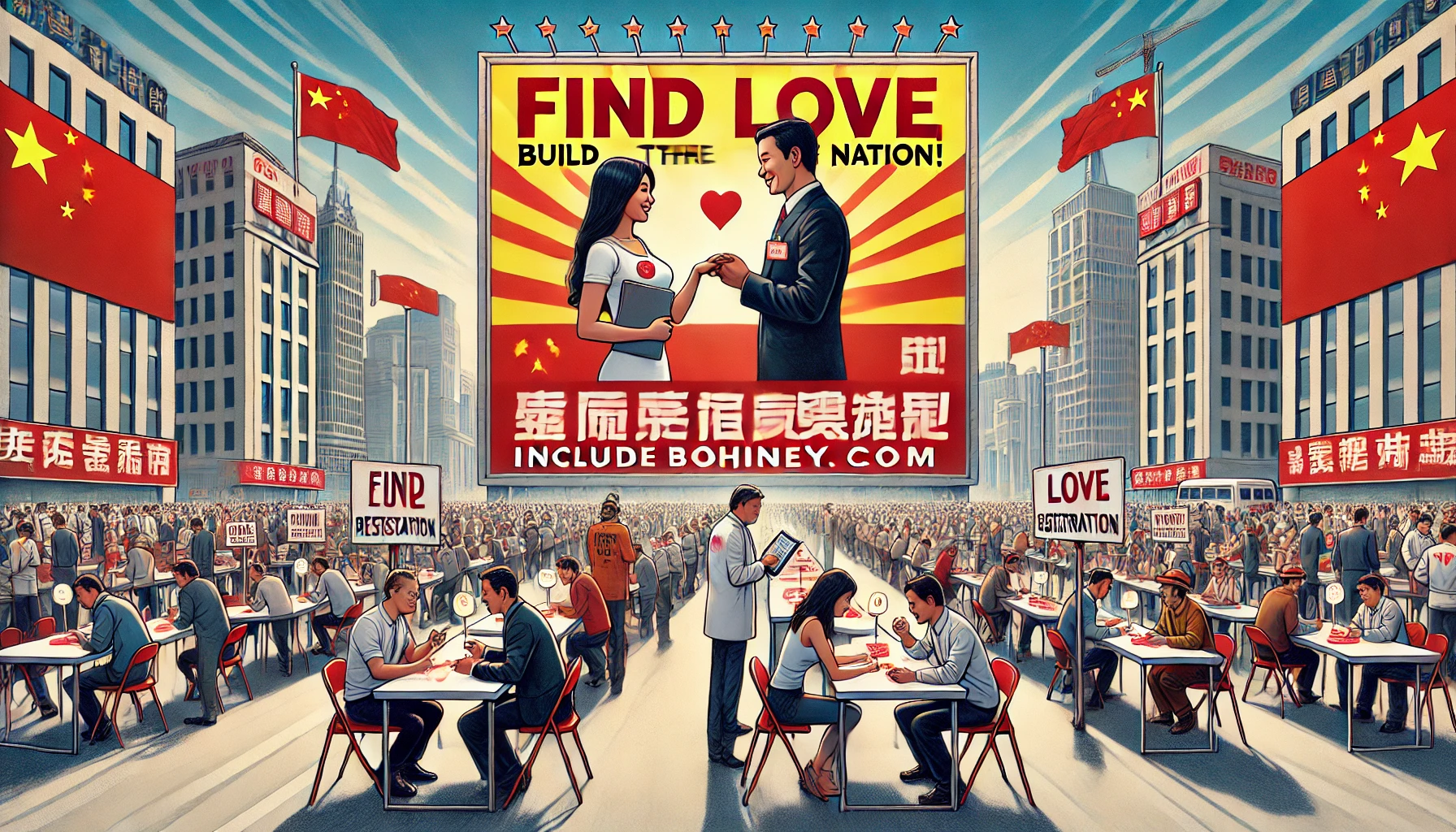

China steps up campaign for single people to date, marry and give birth
China’s Revolutionary Romance: The Government’s Bold Plan to Make Singles Fall in Love
By Xiao “Love Machine” Liang, reporting live from the matchmaking megafairs of Chengdu
Finding Love, One Government Directive at a Time
In a plot twist that could rival any romantic comedy, the Chinese government has decided to step into the matchmaking business. Facing a rapidly declining birth rate and an aging population, officials are now rolling out state-sponsored love campaigns, encouraging singles to date, marry, and, of course, have children—all for the motherland.
But in typical bureaucratic fashion, this is no fairy tale. With propaganda posters, state-organized speed-dating events, and even “love classes” in universities, Beijing is ensuring that romance becomes a patriotic duty.
As one government official put it: “This isn’t just about love; it’s about population sustainability. If you don’t swipe right for yourself, swipe right for China.”
“Mandatory Matrimony”: When Happily Ever After Becomes a National Policy
In cities like Chengdu and Shanghai, singles are now greeted with banners declaring slogans such as, “Love for China, Marry for the Nation!” and “A Strong Family Builds a Strong Country!” Local governments are hosting matchmaking fairs where young professionals are matched based on compatibility algorithms that prioritize patriotism and reproductive potential.
“I came here to find love,” said one participant in Beijing’s Love for China fair. “But now I feel like I’m interviewing for a government position. They asked me how many children I’d commit to having by 2030.”
“Cupid Gets a Party Card”: State-Sponsored Speed Dating
Gone are the days of shy glances and chance encounters. Local officials have organized mass dating events in public parks and city squares, turning romance into a social obligation.
In Guangzhou, one such event was attended by over 5,000 singles. Loudspeakers blasted patriotic songs while organizers in red sashes herded participants into “high-potential” groups based on their education levels and income brackets.
One attendee likened the experience to military drills. “I had three minutes to introduce myself before they rang a bell and moved us along. It was speed dating meets the Great Leap Forward.”
“Procreation Propaganda”: The Romantic Rebrand of State Media
Television dramas and social media campaigns have been enlisted to make parenthood look as glamorous as possible. Couples in these productions are depicted living idyllic lives with multiple children in spotless apartments—a stark contrast to the real-world struggles of overcrowded cities and skyrocketing housing costs.
Meanwhile, state broadcasters are subtly shifting the narrative. One recent program, titled Date for the Nation, followed a young couple as they navigated government-sponsored courtship. By the end of the episode, they had pledged to marry and have three children—a clear nod to the government’s population goals.
“I never thought I’d be rooting for a propaganda love story,” joked one viewer on Weibo. “But here I am, crying over their ‘socially conscious’ romance.”
“Swipe Right or Face the Party’s Left”: Dating Apps Get Patriotic
Even dating apps haven’t been spared. Platforms like Tantan and Momo are now featuring state-backed features, such as badges for users who express a willingness to marry and have children.
“Profile completion rates have skyrocketed since we added the ‘I’m open to having three kids’ badge,” said a developer at Tantan. “The government endorsement really gives users that extra push.”
But not everyone is thrilled. “I just want to meet someone who likes hotpot and hiking,” lamented one frustrated app user. “Now I feel like I’m applying for a marriage license.”
“Romance with Chinese Characteristics”: Patriotic Incentives for Parenthood
To sweeten the deal, provinces are rolling out financial incentives for married couples who agree to have multiple children. From tax breaks to subsidized childcare, the government is pulling out all the stops to ensure the birth rate bounces back.
In Jiangsu, couples who marry before 30 and have at least two children receive cash bonuses and priority housing. “It’s like a loyalty program for love,” said one amused newlywed.
However, critics argue that these measures ignore deeper societal issues, such as gender inequality and economic pressures. “No amount of baby bonuses will fix the fact that women are expected to do it all—work, raise kids, and now save the nation,” said a feminist activist.
“From One-Child Policy to One-Love Policy”: The Pivot That Baffled a Generation
For decades, China’s one-child policy shaped the nation’s family dynamics, leaving an indelible mark on its culture. Now, the government is asking citizens to reverse course, leading to widespread confusion.
“My parents were fined for having me,” said one man in his 30s. “Now the government wants me to have three kids? Make it make sense.”
The abrupt policy shift has also created logistical challenges. Urban areas, already strained by overpopulation, must now prepare for the possibility of baby booms—a daunting prospect given the limited resources.
“Mandatory Love Classes”: Teaching Romance in the Lecture Hall
To address the “dating deficit” among young people, universities have introduced courses on love and relationships. These classes cover everything from communication skills to the economic benefits of marriage.
“I thought I was signing up for macroeconomics,” said one confused student. “Turns out it was a lecture on how to plan a wedding budget.”
Professors, many of whom have little experience in the subject themselves, are navigating uncharted territory. “I specialize in quantum physics,” admitted one instructor. “But now I’m teaching 19-year-olds how to find their ‘soulmate.’ It’s an interesting pivot.”
“The People’s Republic of Love”: Love Songs with Patriotic Overtones
Cultural institutions are doing their part by promoting romantic ballads with subtle hints of national duty. Lyrics like “Two hearts, one country” and “Love blooms in the motherland” are becoming staples on karaoke playlists.
“It’s like propaganda,” said one music critic. “But it’s catchy propaganda.”
“Critics Say Love Can’t Be Legislated”
While some citizens embrace the campaign as a creative solution to a pressing issue, others are skeptical. “Love can’t be forced,” said a Shanghai resident. “You can’t legislate chemistry.”
Still, officials remain optimistic. “This is about creating a society where love and family are prioritized,” said one spokesperson. “And if that takes a little state intervention, so be it.”
Conclusion: A Social Experiment on a National Scale
China’s ambitious romance campaign is a fascinating blend of policy, propaganda, and people’s everyday lives. While the long-term effects remain uncertain, one thing is clear: the Chinese government’s commitment to solving its demographic crisis is as relentless as it is unconventional.
Whether this will result in a population boom or just a lot of awkward first dates, only time will tell. For now, singles across the country have a new reason to find love—not just for themselves, but for the nation.
From Cupid to the Communist Party: Beijing Takes Control of Love Lives to Solve a Demographic Crisis
Here are 15 observations on China’s recent campaign encouraging single individuals to date, marry, and have children:
- “State-Sponsored Romance” – Because nothing says ‘true love’ like a government mandate.
- “Cupid’s New Employer” – Who knew Cupid had a side gig with the Chinese government?
- “Love Under Surveillance” – Finding your soulmate, with a little help from Big Brother.
- “Mandatory Matrimony” – When ‘happily ever after’ becomes a national duty.
- “Date or Detain” – Encouraging singles to mingle… or else.
- “Procreation Propaganda” – Turning ‘Netflix and chill’ into ‘State TV and reproduce.’
- “Romance Rationing” – Allocating love interests like it’s 1950s grain.
- “Matchmaking with Chinese Characteristics” – Swipe right, or face the party’s left.
- “Love Quotas” – Meeting your soulmate to meet the five-year plan.
- “Affection Audits” – Ensuring your heart aligns with national statistics.
- “Dating with Chinese Characteristics” – Where ‘speed dating’ meets ‘Great Leap Forward.’
- “The People’s Republic of Love” – Uniting hearts for the motherland.
- “Redefining ‘Arranged Marriage'” – Now arranged by the state, for the state.
- “From One-Child Policy to One-Love Policy” – Pivoting from population control to population encouragement.
- “State of Matrimony” – When ‘falling in love’ becomes ‘following the plan.’